It is the third of our four days at the 2026 ST&HV Science and Technology Studies (STS) School. We file past laboratories populated by white-coated researchers and take our seats in a classroom in Seoul National University’s (SNU) College of Natural Sciences. “Look – real scientists!” someone jokes as we sit down. “Wow! Is that science in action?” an instructor exclaims, referencing Bruno Latour’s formative monograph.[1]
In any given field or subculture, cultural familiarity enables these puns and in-jokes to land: in clowning our shared context, they serve as invitations to cohabit a specific cultural space. Here, we are bonding over shared intellectual lineages, playing in the light and shadows cast by the luminaries of the field whose names recur in the essays we are presenting.[2] At the STS School, these moments of enculturation and connection are just as important as the abundant feedback and intellectual growth.
The School’s students are PhD candidates and early-career researchers, all of whom have submitted in advance a draft manuscript to be discussed in workshops. I sense a subtle atmosphere of almost bittersweet satisfaction as our minds turn to the final session before the final day. Having discovered the high standard of each other’s work, many of us present our own with some degree of self-effacement. But our contributions are understood to be works-in-progress, and this is a sympathetic audience. For the past few days, we have been ably guided by our instructors and mentors—the editors of ST&HV, and leading STS scholars in South Korea and beyond—who have modelled the “critical friendship” with which we have grappled with each other’s ideas.
Our disciplines are varied, spanning history, sociology, anthropology, geography, and beyond. Many of us are unified, though, by a productive discomfort with the perceived strictures of disciplinary identity (perhaps a hallmark of STS as a culture?); or recognise STS itself as a home discipline, “undisciplined” though it may be.[3] When we first introduced ourselves in the School’s opening session, we pondered how we found ourselves to be ‘doing’ STS. What path led us here, such that we could fall in ‘sideways’ from other professional or intellectual pursuits? What was the ‘gateway drug’ that left us hooked, after being introduced by friends in the know? It seems many of us happened upon STS quite unexpectedly, but also gratefully, hesitantly or far later than we now wish. Whatever the case, misfits or meanderers, here we are—in Seoul, doing STS—evolving a shared language to articulate that which is obscured, tacit, or might be otherwise.[4]
And although there is often a hint of deviance, mischief or even alienation that colours the way STS scholars describe and relate to their research contexts—as “tricksters”,[5] perhaps, who aim to unpick boundaries and expose the naïvité or vanity of technoscientific authority—there are few punchlines or ‘gotcha’ moments among these manuscripts. Instead, the conversations we have cultivated throughout the School are characterised by epistemic humility, reflexivity and care. At times, our interventions function more akin to a koan (a paradoxical phrase or story used as an object of Zen meditation), prompting contemplation and insight while leaving conclusions unsettled.
Shobita Parthasarathy’s keynote lecture on “the innovation paradigm”,was a skilled demonstration in this contemplative capacity afforded by STS perspectives: to broach big questions with analytical dexterity without reducing the world to diagrams of strategic action. Her analysis followed the institutionalisation and impacts of “inclusive innovation” on sanitation and menstruation in India. The political ambivalences of the project of inclusive innovation orient us to that which shapes sociotechnical change in ways that evade straightforward explanation: frictional logics, cross-scale recursions, and the cultural-historical specificity of the research setting. How else might we make sense, for example, of the emergent and unintended effects of otherwise well-intentioned initiatives, which recur continually despite “rarely achiev[ing] their intended purposes”?[6]
These themes somewhat foreshadowed the field trip we made on the second day. After lunch, we split into small groups and navigated our way to central Seoul. Led by our Korean colleagues and hosts, we walked a length of the Cheonggyecheon, Seoul’s now-iconic urban stream, dodging the hot sun and fantasising about joining those dipping their feet in the clear water. Transecting central Seoul, the Cheonggyecheon functions as an elongated oasis recessed one flight of steps below the streetscape. Along the public walkway, flowing water and riparian flora cool the air, young families spot fish near the rapids, and runners weave through commuters and tourists. But the restoration of the Cheonggyecheon in the mid-2000s from city sewer to “environmentally friendly civic jewel”[7] has been controversial, sparking debate about the politics and authenticity of ecological restoration. Critics argued the restoration project had produced nothing but a “concrete fish tank”.[8] Less visible in these debates is the way in which restoration has displaced the informal economies of the surrounding manufacturing district and catalysed urban gentrification.[9] With the advent of the Central Seoul Redevelopment Plan in 2022, shop owners, workers, and residents of the Cheonggyecheon-Euljiro district continue to make way for the rapid construction of luxury hotels and other high-rise developments.[10]
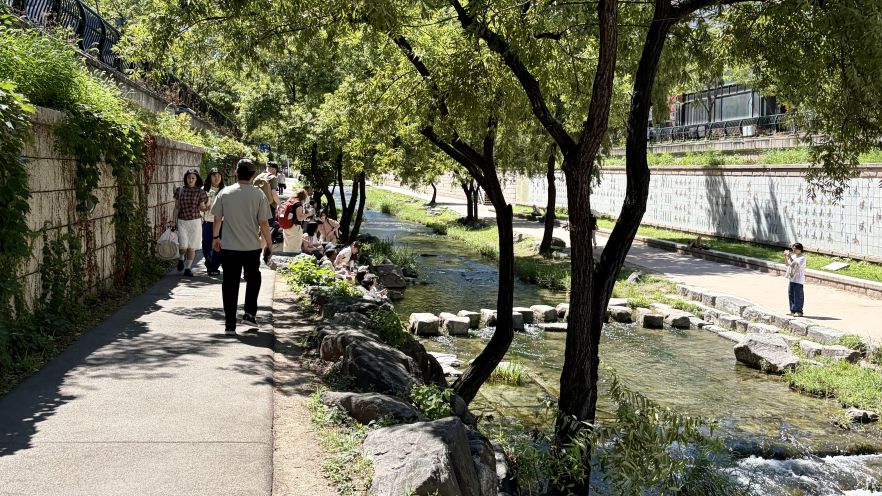
The restored Cheonggyecheon. In the background, the group prepares for a group photo. Image by author.
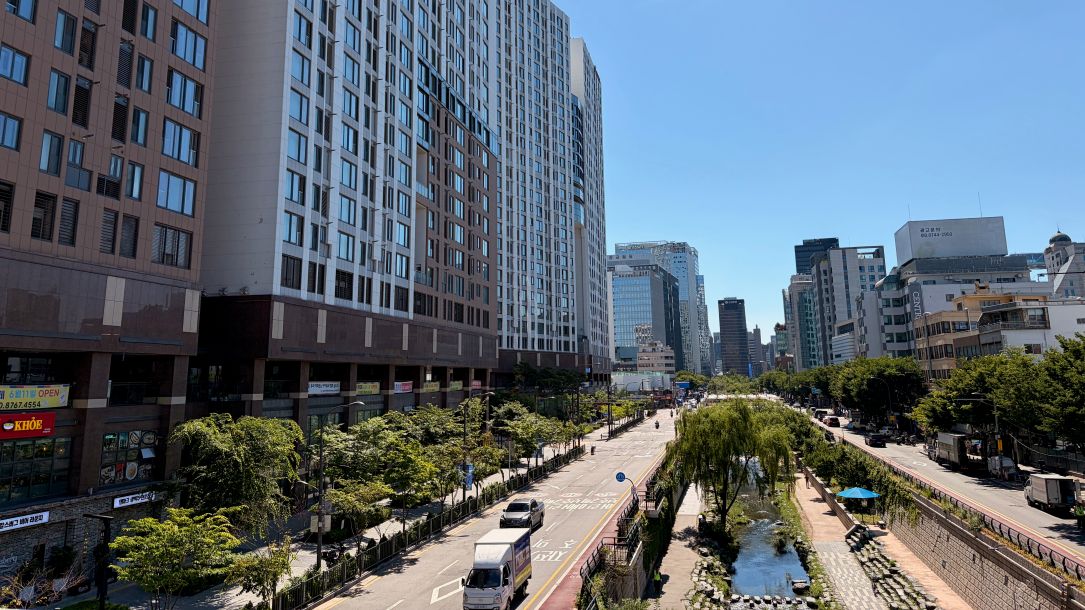
High-rises overlook the Cheonggyecheon. Image by author.
We were thus reminded of the material and affective impacts of the sociotechnical reproduction that surrounds us. Arriving in the machine tool district, we were met by our guide, Dr Park Eunseon, a critical geographer and campaigner working to protect the city’s heritage and the livelihoods of the machinists who have operated within this “tightly networked industrial ecosystem” for decades.[11] A force of nature, she decried the “bullshit” that developers and planners spouted to sidestep and obscure the human costs of urban redevelopment and its associated practices of aesthetic hygiene. Our tour of the machine shops, and Dr Park’s resolve to uphold the rights of the shop owners, highlighted the real-life stakes of the technopolitics we sometimes approach as alien analysts, and proved a timely counterbalance to our time spent cognising in classrooms.
After visiting the National Museum of Korean Contemporary History across the city, our field trip finished by recombining once again for dinner in an upstairs book café, which offered the chance to sink into an armchair and a conversation. In spite of our brushes with a few of the sobering spectres of modern Seoul and Korea’s history, I found it hard not to marvel at this enchanting city. Its immense energy, the warmth of its residents, and its scale all prompted reflections on the sheer volume of life in constant materialisation; the rampant becomings of here, there and elsewhere.
If STS has provided a fertile intellectual habitat for cultivating our various modes of inquiry, this was materialised in the STS School. The presentations exposed us to a remarkable array of different field sites, research practices, and charismatic objects. We were introduced to practices of care enacted in relation with companion robots; the “just-in-time” cultivation of the prized Miyazaki mango; the valuation of organic wine subject to nanotechnological futuring; and, of course, much more. Theoretically, sociotechnical imaginaries, economisation, and post-humanist “more-than” relations were favoured conceptual vehicles for several analyses, while biopolitics seemed to flow through many like groundwater—immanent, albeit often unmentioned. For all the novelty of these interventions, then, there was also strong continuity with scholarship that forms the sedimentary foundation of STS thinking.
A parallel purpose of the School related to the practical aspects of professional academic life. Our final morning comprised a pair of panel sessions: “Publishing in English-language journals”, and “Navigating early careers in STS”— topics best approached through discussion, where the subtleties of journal guidelines and the implicit meanings in job advertisements could be unpacked through experience. Within and between sessions, we quizzed our instructors for insights into their professional worlds, looking for guidance or footholds. In contrast to the professional insecurity that has come to mark academia, the School propagated collegial networks that might catch us in lieu of the institutional scaffolding that is increasingly eroded by the predatory “efficiencies” of neoliberal governance.
Our week closed with an occasion for participants to reflect on our experiences of the School itself, and on the broader conversations that punctuated it. The previous day a panel had explored “STS in Korea”, and whether there is such a thing as “Korean STS”. The aftermath of this conversation spilled into our reflections, as we discussed the geographic politics of academic knowledge production—is STS scholarship in Australasia really a decade “behind” that of Euro-America, or is this teleological claim an instance of American exceptionalism? What gets lost in translating subtle thinking from native languages into glossy English, and can non-native English speakers instead be proud to embrace a more organic “Korean English”, for example, that better carries the nuances of their original work? How does the tendency to default to the nation-state as a dominant scale of analysis limit our understanding of technoscientific developments and their politics, given the specificities of place and trans-national relations?
And, if one of the key strengths of STS is its capacity to unsettle, to open things up, and to keep things complex, how can we mobilise the democratising potential of our work? Given the decline in the overlap of shared realities around the world, what responsibility ought we take up for “closing some things down”? We might at least revisit Latour’s important question: “what’s the difference between deconstruction and constructivism?”[12] Naturally, the closing session posed new questions and settled none.
Later, over drinks, one colleague raised the point that regardless of the good intentions of perspectives that advocate for ‘democratisation’ (of science, technology, knowledge, etc.), ‘democracy’ is a term that carries substantial baggage due to its instrumental role in colonial and imperial histories—it is not the straightforward or universal aspiration some might presume. This is not to reject wholesale the ethical imperatives that drive such calls, but to remind us of the troubled genealogies of our normative frameworks and the challenges of their translocation.
These fleeting exchanges were some of the most valuable things I took home from the School. Sometimes they propel our thinking in an instant, or plant the seeds of later rumination. Most of all, they demonstrate how scholarship is a collective endeavour—one of communities, networks—that is ‘done’ and made anew through social practice; never still, always unfinished, and subject to its own recursive reformulations.
Acknowledgements
Much of the labour of producing this experience happened behind the scenes, before we arrived, and even after we had left. While I have felt uneasy reflecting, as a sole author, on a collection of individual experiences, I am sure that all participants would share my gratitude to our hosts from Seoul National University (SNU) and the Korea Advanced Institute of Science and Technology (KAIST), who coordinated the School with efficiency and grace; and to our instructors, for their generosity (of time, spirit, and thought) and careful programming. The organisation and ongoing consideration of how the School could reach its potential enabled it to do just that.
This post was curated by Contributing Editor Jackie Ashkin and reviewed by Contributing Editor Wanqing Iris Zhou.
Footnotes
[1] Bruno Latour, Science in Action: How to Follow Scientists and Engineers Through Society (Harvard University Press, 1987).
[2] Courtney Addison et al., “Latour and After, or What Comes After Latour?,” Science, Technology, & Human Values 48, no. 5 (2023): 971, https://doi.org/10.1177/01622439231190895.
[3] Kari Lancaster et al., “Centripetal and Centrifugal Forces in Science and Technology Studies (STS),” Science, Technology, & Human Values 49, no. 6 (2024): 1163, https://doi.org/10.1177/01622439241285624.
[4] Jane Calvert, A Place for Science and Technology Studies: Observation, Intervention, and Collaboration (The MIT Press, 2024), https://doi.org/10.7551/mitpress/14594.001.0001.
[5] David Turnbull, Masons, Tricksters and Cartographers: Comparative Studies in the Sociology of Scientific and Indigenous Knowledge (Taylor & Francis, 2003), https://doi.org/10.4324/9780203304587.
[6] Shobita Parthasarathy, “The Innovation Paradigm: Making Technology, Morality, and Citizenship in Aspirational India,” Keynote lecture, ST&HV STS School, Seoul National University, June 22, 2026.
[7] Brian Walsh, 2007, as cited in Chihyung Jeon and Yeonsil Kang, “Restoring and Re-Restoring the Cheonggyecheon: Nature, Technology, and History in Seoul, South Korea,” Environmental History 24, no. 4 (2019): 737.
[8] Jeon and Kang, “Restoring and Re-Restoring the Cheonggyecheon,” 752.
[9] Jeon and Kang, “Restoring and Re-Restoring the Cheonggyecheon.”
[10] Eunseon Park, “Cheonggyecheon-Euljiro as a Polycentric Manufacturing Ecosystem,” Presentation, 2026.
[11] Jeon and Kang, “Restoring and Re-Restoring the Cheonggyecheon,” 757.
[12] Bruno Latour, “Why Has Critique Run out of Steam? From Matters of Fact to Matters of Concern,” Critical Inquiry 30, no. 2 (2004): 232, https://doi.org/10.1086/421123.
