Whether through awe and wonder or death and grief, human-whale relations throw into relief important epistemic, ethical, spiritual, legal, and scientific tensions. Because whales migrate across oceans and have long been in relation with humans across the globe, they inhabit multiple and often conflicting worlds of meaning and obligation. What happens in the aftermath of a whale’s death, when a whale might simultaneously be an ancestor, a source of scientific knowledge, and a potential threat to the continuation of a local ecotourist economy?
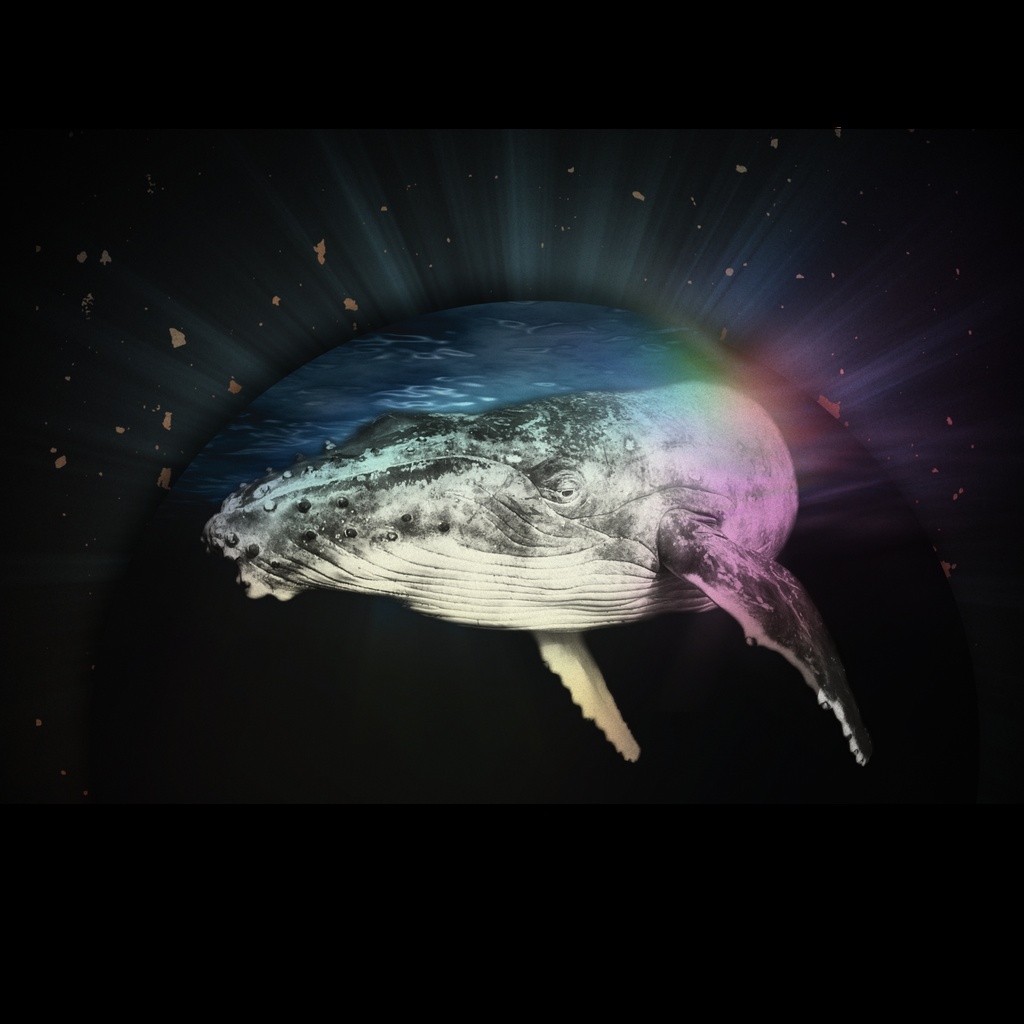
Collage by Marie Comuzzo, created using licensed assets in Adobe Express. Licensed under CC BY 4.0.
This question emerged from my fieldwork in Mo’orea, Tahiti, when the death of a humpback calf brought Indigenous Tahitians, scientists, French settlers, and tourists into deep conflict. While Tahitians were honoring the calf’s death and preparing the baby to be returned to the ocean, as is ritual custom on Mo’orea, scientists arrived at the site, conducted a necropsy, and then took the body to extract the bones and put them on display in the island’s museum. At the same time that Tahitians were incredibly upset for the disrespect shown to their ancestor, scientists acted under an established governmental and scientific protocol governing stranded cetaceans. For Native Tahitians, however, this protocol was a deep violation, as whales are their ancestor and protectors of the ocean. They felt strongly that the calf belonged to the ocean and should be returned.
When I discussed this instance with whale-watchers and French immigrants working in the whale-watching business, they voiced concerns that a dead whale in the bay would attract predatory sharks. Although they loved whales and empathized with locals, they felt that returning dead whales to the ocean would negatively affect the peace between humans, whales, and sharks on Mo’orea and, by extension, the thriving economy, citing shark attacks on other Polynesian islands as evidence of the risk they feared. This conflict made it clear that different modes of listening and meaning-making generated very different obligations toward whales and humans.
Recording of humpback whales (most likely a mother and calf) off the coast of Mo’orea in ‘Ōpūnohu Bay. [1]
This research is guided by related core questions: who do we listen with? Whose voices and which bodies do we recognize as meaningful producers of culture? With the support of an ACLS/Mellon Dissertation Innovation Fellowship I began to explore different formats for knowledge transmission, which ultimately led me to bring a wide community of thinkers, changemakers, and artists together, to participate in a production of knowledge that not only celebrates our differences but also centers whales as participants in cultural production.
Listening with Whales is a public-facing digital commons that brings scientific, artistic, musical, ancestral, poetic, trans, feminist, queer, decolonial, Black, Indigenous, and embodied forms of listening with whales into conversation (Bridge 2025, 2026; Cull O’ Maoilearca and Fitzgerald-Allsopp 2024; Janse 2024, 2026; O’Mahoney, 2024; South 2024, 2026; Susam-Saraeva 2025, 2026; Rothenberg 2022, 2023; Mentz 2023, 2024; Comuzzo and Ritchey 2026; Harrison 2024; Comuzzo 2026; Synder et al. 2024, 2026; Woodson-Gammon 2024, 2026; Zieman 2025; Zieman and Comuzzo 2026, Gumbs 2020; Neimanis 2017; Sakakibara 2020). Listening with Whales is primarily a place to build bridges between the many people who care deeply about and listen closely with whales, as we move toward respectful coexistence and peace among different knowledges, values, and forms of advocacy. It is an invitation to stay with the trouble together (Haraway 2016, 2008; Ohlson 2022) and to center those who are most oppressed (hooks 1984; Van Dooren 2019, Meijer 2019; Gumbs 2020; Marshall, Edwards, and Baechtold 2026; Quaies and Bender 2019; Lorde 1984) in our efforts to move toward collective liberation.
Together, we specifically ask how whales participate in the production of human cultures, and how their presence ripples and makes waves in our laws, music, environmental advocacy, art, poetry, and stories. These encounters—real, imagined, material, sonic, historical, ancestral, scientific, poetic, and artistic—reveal transformative paths toward ever-growing forms of kinship and places where different forms of knowledge converge in the obligations they require from us.
Listening with rather than to is at the center of the project: a way of listening that moves beyond the objectification of more-than-humans as primarily objects from which we extract knowledge (Janse 2024; Susam-Saraeva 2026; Neimanis 2017; Lasher 1998; Di Croce 2023; Meijer 2019; Tsing 2015; Van Dooren 2019; Viveiros de Castro 2014; Zieman and Comuzzo 2026; Fitzgerald and Janse 2026; Ramos 2025). For Māori, Aboriginal Mirning and Yuin people, whales are members of their extended families. As elder (iwi) Hori Parata pointed out, “Man’s greed in the ocean is hurting the whales,” and “Our ancestors tell us the strandings are a sign from the sea. So what is the sea telling us? We need to listen” (Roy 2019). In northern Māori pūrākau (traditional knowledge), kauri—the largest trees in Aotearoa, New Zealand—and parāoa (cachalots) are close kin that share oily, rich skin and size: “a physical manifestation of their mythological bond” (Halpern 2021). When one is sick, the other comes to support and heal the other. In recent years, disease has spread through and severely weakened the kauri forest, which concurs with mass strandings from whales. “As one falls the other gets sick: they ask: is it the loss of whales visits and singing that causes the trees to sicken and die?” (Adams 2020).
The contemporary Oranga Project takes seriously these relationships among kauri, whales, people, and places. Grounded in Te Rarawa iwi’s mātauranga, researchers and cultural knowledge holders have bought together taongo puōro (traditional Māori instruments), the sounds of a healthy kauri forest, karakia (traditional chants), and parāoa (cachalot) clicks in hope of strengthening the forest and the tree-whale bond, and restoring the ecological balance between land and ocean, as well as people and places (Sheehan et. al. 2026; Oranga 2022). These kinds of projects, rooted in whakapapa— a genealogical layering of relationships and relationality that connects beings and forms ontological meaning—not only map relationships as deeply interconnected but also generate obligations of reciprocity to, and care for, one another (He Whakaputanga Moana 2026; Chami 2024; Marshall, Edwards, and Baechtold 2026; Moananui Agreement 2026). A practice that can also begin with befriending a tree (Dedyukina 2026; Kimmerer 2013).
Studying humans who listen with whales has taught me, more than anything else, that knowledge about whales is something we actively co-create in relation with them. Listening with Whales asks to pay attention to how through their song, presence, touch, breaching, breath, cultures, forms of resistance, and deaths, whales move humans (Gumbs 2020; South 2026; Susam-Saraeva 2024; Comuzzo 2026; Rothenberg 2023; Bridge 2026; Janse 2024; Fitzgerald-Allsopp 2025; Harrison 2024; Comuzzo and Ritchey 2026; INCN 2025). This growing trans-disciplinary space holds many rivers of knowledge, in which often distinct modes of listening converge through cross-disciplinary currents. Grief, more than any other mode of listening and attuning, emerged as a through-line across all categories of listening, revealing how porous these categories are (Gare 2025; South et. al. 2025; Blakely 2024; Saultitis 2014; King 2013, 2019; Cull Ó Maoilearca 2024; Fitzgerald and Janse 2026; Comuzzo and Ritchey 2026).
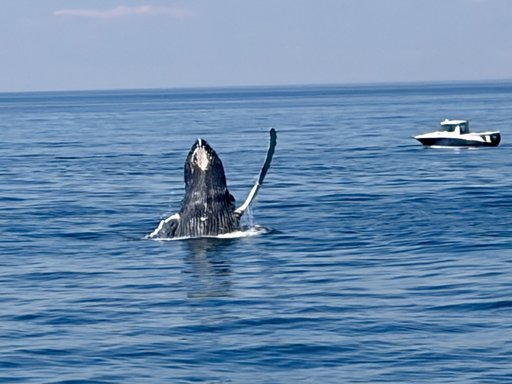
Photograph of a humpback off Provincetown, Cape Cod. Picture taken by Shannon Knudsen. CC BY 4.0.
I invite you to explore this website linearly, diffractively, and, most of all, chaotically. I initially framed the project and invited contributions through specific disciplinary categories. However, the research continually undid these boundaries. Instead, it showed how scientists listen musically and historically; how musicians listen scientifically, artistically, and ancestrally; and how ancestral listening intersects with genetic and historical knowledge while also often being musical, poetic, and ecological. These collaborations revealed even more clearly how the categories we construct to make sense of more-than-humans are continuously challenged and crossed, and how many of us, albeit approaching it very differently from each other, aim for a similar goal: to uplift, protect, care for, and learn from whales.
Listening with whales, then, is not simply to understand them rationally or be in awe of them, it is to remain open to the ways their presence reshapes our practices, our categories, our obligations, and the ways we relate with one another within the worlds we share.
Comuzzo I don’t think you understand Listening with orca Tahlequah [2]
Notes
[1] Text-based description of Audio: In the background, the ever-crackling presence of snapping shrimp sets a warm, rhythmic aliveness beneath the humpback whales’ singing. Long ascending tones alternate with almost ultrasonic, high-pitched interludes and quicker downward-sweeping gestures in fast-paced sequences, before the recording cuts off amid low, grumbling interludes.
[2] Read a text-based alternative for the video.
This post was curated by Multimodal Contributing Editor Chen Shen and reviewed by Contributing Editor Volney Friedrich.
References
Adams, Matthew. Anthropocene Psychology: Being Human in a More-than-Human World. Routledge, 2020. https://doi.org/10.4324/9780203703694.
Barad, Karen. “Diffracting Diffraction: Cutting Together-Apart.” Parallax 20 no. 3 (2014): 168–187.
Bridge, Max Chervin. “Voices of Humpback Whales: A New History of Whale Song Science, 1856–1986.” Historical Studies in the Natural Sciences 55, no. 3 (2025): 209-50.
Bridge, Max C. “Oceanic Listening: Sound, Cetaceans, and the History of Sensory Environments.” Ph.D. Diss, Brown University, 2025.
Bridge, Max C. “Still a Silent World: Fish Ears, Whale Politics, and the Science of Ocean Noise, 1941–1990.” Environmental History 30, no. 4. doi.org/10.1086/736607.
Blakely, Alexandra ahlay. WAILS: Songs for Grief. September 2024. Digital Album. https://ahlayblakely.bandcamp.com/album/wails-songs-for-grief
Chami R, Bender M, Bramley B, Cosimano T, Iles R, Nieburg D, Rosa E, Takoko Mere, and Fullenkamp C. “How Legal Personhood and Markets Can Partner to Help Save the Whale.” Ocean Sustain 2 no.1454751 (2024) doi:10.3389/focsu.2024.145475
Comuzzo, Marie and Marianna Ritchey. “Erosic Attuning and Grieving with Whales: Towards Ecosystemic Comradeship.” TRACE: Journal of Human and Animal Studies. (November 2026). Forthcoming.
Comuzzo, Marie. “Listening with Whales: From Silence to Song.” In Listening to the Swan Song: More-than-Human Beings and Sounds in Literature and Culture Through the Ages, edited by Piotr Kociumbas and Joanna Godlewicz-Adamiec. Vandenhoeck & Ruprecht Verlag, 2026.
Cull Ó Maoilearca, Laura, and Florence Fitzgerald-Allsopp. Interspecies Performance. Performance Research Books, UK, 2024.
Cull Ó Maoilearca, Laura. “Whale Grief: Episodes I + II.” Performance Philosophy 9, no. 2 (2024): 196–204. https://doi.org/10.21476/PP.2024.92516.
Dedyukina, Lena. “Learning to Befriend a Tree.” Terralingua (July 17, 2026), https://terralingua.org/stories/learning-to-befriend-a-tree/.
Di Croce, Nicola. “Forms of Future Coexistence: Towards a Multi-Species Sonic Ecology.” In Unheard Landscapes. Listening, Resonating, Inhabiting. Galaad Edizioni, 2023.
Gare, Sam. “Keening – Song of the Stranding.” North Harris Studio 2025. https://www.northharrisstudio.co.uk/keening.
Gumbs, Alexis. Undrowned: Black Feminist Lessons From Marine Mammals (2020) AK Press.
Halpern, Madeline. “Kauri Dieback Disease,” in A Living Giant. https://a-living-giant.earth/Kauri-Dieback-Disease-part-2-1.
Haraway, Donna Jeanne. When Species Meet. University of Minnesota Press, 2008.
Haraway, Donna Jeanne. Staying with the Trouble: Making Kin in the Chthulucene. Duke University Press, 2016.
Harrison, Michaela. “What it Take to Breach.” Dark Matter: Women Witnessing 17 (January 2024), https://darkmatterwomenwitnessing.com/jan2024/what-it-takes-to-breach/.
Held, Virginia. The Ethics of Care: Personal, Political, and Global. Oxford University Press, 2006.
“He Whakaputanga Moana: The Whale Protection and Legal Personhood Declaration,” The Whale Declaration (February 5, 2026) https://www.whaledeclaration.com/
hooks, bell. Feminist Theory: From Margin to Center. South End Press, 1984.
Hunt, Sarah. “Ontologies of Indigeneity: The Politics of Embodying a Concept” Cultural Geographies 21 no.1 (2014): 27-32.
IUCN Australian Committee. “Dr Jodi Edwards – VC Indigenous Senior Research Fellow, University of Wollongong.” YouTube Video, July 13, 2025. https://www.youtube.com/watch?v=jHMMLpGUQtQ.
Fitzgerald-Allsopp, Florence. “Entrapment and Empowerment: Towards an Interspecies Feminism in Contemporary Performance.” Ph.D. Diss, University of Surrey, 2025. https://doi.org/10.15126/thesis.901647.
Fitzgerlad-Allsopp, Florence, and Tessel Janse. “Listening with Whales Artistically,” Listening With Whales, 20 September 2026, https://listeningwithwhales.org/artistic.
Kimmerer, Robin. Braiding Sweetgrass. Indigenous Wisdom, Scientific Knowledge, and the Teachings of Plants. Milkweed Editions, 2013.
King, Barbara J. How Animals Grieve. The University of Chicago Press, 2013.
King, Barbara J. “The Orca’s Sorrow.” Scientific American 320, no. 3 (2019): 30–35.
Janse, Tessel. “Whales, AI, And the Right to Opacity: Decolonising Interspecies Communication in the Work of Ariel Guzik.” Kunstlicht vol. 45, no. 1/2 (2024): 62-70.
Janse, Tessel. Undoing Animal Colonialism: Interspecies Entanglements and Decolonial Ecologies in Contemporary Art. Ph.D. Diss, Goldsmiths University, 2026. https://doi.org/10.25602/GOLD.00040696.
Lasher, Margot. “A Relational Approach to the Human-Animal Bond.” Anthrozoös 11, no. 3 (1998): 130–33. https://doi.org/10.2752/089279398787000670.
Lorde, Audre. Sister Outsider: Essays and Speeches. The Crossing Press, 1984.
Lorde, Audre. Uses of the Erotic: The Erotic as Power. Kore Press, 2000.
Lorde, Audre. “The Uses of Anger,” Women’s Studies Quarterly, vol. 9, no. 3 (1981): 7–10.
Maoilearca, Laura Cull Ó. “Whale Grief: Episodes I + II.” Performance Philosophy 9, no. 2 (2024): 196–204. https://doi.org/10.21476/PP.2024.92516.
Marshall, Chels, Jodi Edwards, and Nate Baechtold, “Unbroken Whispers – The Ripples Connecting Sea-Kin. National Environmental Science Program, 2026. https://www.nespmarinecoastal.edu.au/publication/unbroken-whispers-the-ripples-connecting-sea-kin/.
Meijer, Eva. When Animal Speak: Toward an Interspecies Democracy. New York University Press, 2019.
Mentz, Steven. An Introduction to the Blue Humanities. Routledge, 2023.
Mentz, Steven. Sailing without Ahab: Ecopoetic Travels. Fordham University Press, 2024.
“Moananui Agreement: Consultation Document.” Moananui Sanctuary (2026). https://90cbf966-2b95-4425-bef4-67e2b4b129b9.filesusr.com/ugd/dc998a_bd6c03125ce44f23bd5e1870eae1143b.pdf
Mundy, Rachel. Animal Musicalities: Birds, Beasts, and Evolutionary Listening. Wesleyan University Press, 2018.
Neimanis, Astrida. Bodies of Water. Posthuman Feminist Phenomenology. Bloomsbury, 2017.
Oliveros, Pauline. Deep Listening: A Composer’s Sound Practice. iUniverse, 2005.
Ohlson, Kirsten. Sweet in Tooth and Claw: Stories of Generosity and Cooperation in the Natural World. Patagonia Works, 2022.
Olson, Alex. “To Save Washington’s Orcas From Extinction, The Snake River Dams Have to Go.” The Daily. June 2, 2025. https://www.dailyuw.com/article/to-save-washington-s-orcas-from-extinction-the-snake-river-dams-have-to-go-20250602
O’Mahony, Éadin N., Angela L. Sremba, Eric M. Keen, et al. 2024. “Collecting Baleen Whale Blow Samples by Drone: A Minimally Intrusive Tool for Conservation Genetics.” Molecular Ecology Resources 24, no. 8: e13957. https://doi.org/10.1111/1755-0998.13957.
“Oranga—Wellbeing,” New Zealand’s Biological Heritage, https://bioheritage.nz/research/oranga-wellbeing/.
Payne, Katharine. “The Progressively Changing Songs of Humpback Whales: A Window on the Creative Process in a Wild Animal.” In The Origins of Music. The MIT Press, 2000.
Payne, Roger S., and Scott McVay. “Songs of Humpback Whales: Humpbacks Emit Sounds in Long, Predictable Patterns Ranging over Frequencies Audible to Humans.” Science 173, no. 3997 (1971): 585–97. https://doi.org/10.1126/science.173.3997.585.
Quaies, Chelsea and Michelle Bender. “The Lummi Nation’s Fight for ‘Rights of the Orcas’.” Earth Law Center, October 22, 2019. https://www.earthlawcenter.org/blog-entries/2019/10/the-lummi-nations-fight-for-rights-of-the-orcas.
Ramos, Filipa. The Artist as Ecologist: Contemporary Art and the Environment. Lund Humphries Publishers, 2025.
Rendell, Luke. “Are we really about to talk to whales?”. The Conversation, May 16, 2024. https://theconversation.com/are-we-really-about-to-talk-to-whales-229778
Ritchey, Marianna. 2021. “Resisting Usefulness: Music and the Political Imagination.” Current Musicology 108 (November): 26–52. https://doi.org/10.52214/cm.v108i.7799
Rothenberg, David. Who Knows Why Whales Sing. Terra Nova Music, 2022. https://www.terranovamusic.net/#/who-knows-why-whales-sing/.
Rothenberg, David. Whale Music: Thousand Mile Songs in a Sea of Sound. MIT Press, 2023.
Roy, Eleonor Ainge. “What is the Sea Telling Us? Māori Tribes Fearful Over Whale Strandings.” The Guardian. January 3, 2019. Accessed September 24 2026. https://www.theguardian.com/environment/2019/jan/03/what-is-the-sea-telling-us-maori-tribes-fearful-over-whale-strandings.
Sakakibara, Chie. Whale Snow: Iñupiat, Climate Change, and Multispecies Resilience in Arctic Alaska. University of Arizona Press, 2020.
Saulitis, Eva. Into Great Silence: A Memoir of Discovery and Loss among Vanishing Orcas. Beacon Press, 2012.
Sheehan, M. A. H., Murray, J., & Smith, V. “Ihirangaranga: Interwoven Tapestry of Connection Through Vibration and Frequencies.” AlterNative: An International Journal of Indigenous Peoples 22, no. 1 (2026): 99-110. https://doi.org/10.1177/11771801251406142.
Snyder, Eric, et. al. “Where’s Whaledo: A Software Toolkit for Array Localization of Animal Vocalizations,” PLOS: Computational Biology (2024). doi.org/10.1101/2023.08.24.554565.
Snyder, Eric R., Holger Klinck, Léa Bouffaut. “Low-Frequency Whale Call Detection in Distributed Acoustic Sensing Data,” The Journal of the Acoustical Society of America 159, no. 4 (2026). doi.org/10.1121/10.0045132.
Šosterič, Teja. “Turning the Tide: A Queer Look at the Orca,” NiCHE (July 8, 2024), https://niche-canada.org/2024/07/08/a-queer-look-at-the-orca/
South, Alex, “Listening Towards A Multispecies Heterophony.” In Hingehört! Der Sound des Anthropozäns/Listen! The Sound of the Anthropocene. Edited by L. Herrmann-Fertig and M. Fenske. Würzburg: Königshausen & Neumann, 2024.
South, Alex. “Cetacean Strandings: Of Sound and Sociability.” Green Letters: Studies in Ecocriticism (2026): 1–19. doi:10.1080/14688417.2026.2720130.
South, Alex, Katherine Wren, Nerea Bello. Keening – Song of the Stranding. July 2025. Digital Album. https://alexsouth.bandcamp.com/album/keening-song-of-the-stranding.
Susam-Saraeva, Şebnem. “Dolphin and Whale Communication in Arts and Music – Towards a New Ethics of Translation and Representation.” In Translation in the Performing Arts: Embodiment, Materiality, and Inclusion, edited by Enza De Francisci and Cristina Marinetti. London and New York: Routledge, 2025.
Susam-Saraeva, Şebnem. “Translation Rights of the More-Than-Human – Thoughts on Whale
Bioacoustics,” Translation Studies (March 2026): 1–20. doi:10.1080/14781700.2026.2628086.
Tsing, Anna. Mushroom at the End of the World: On the Possibility of Life in Capitalist Ruins. Princeton University Press, 2015.
Van Dooren, Thom. The Wake of Crows: Living and Dying in Shared Worlds. New York: Columbia University Press, 2019.
Viveiros de Castro, Eduardo. “Cosmological Perspectivism in Amazonia and Elsewhere.” HAU Books, 2014. https://haubooks.org/cosmological-perspectivism-in-amazonia/.
Woodson-Gammon, Finley. “Between the Waves: Materiality, Mimesis, and Interspecies Musical Encounters.” Online Presentation at “Why More-Than-Human Musicking Now?” Symposium for Multispecies Sound and Movement Studies within the International Council for Traditions of Music and Dance (ICTMD). October 2024.
Woodson-Gammon, Finley. “Bones Relaxed and Readable: Toward and Embodied Ethics of Cetacean Listening.” In Ecofeminism Otherwise: Situated Knowledges in a Time of Planetary Crises. Routledge, 2027.
Zieman, Wer. “Planetary and Inter-Scalar Entanglements of Feminist New Materialisms, Exemplified by Astrida Neimanis’s Bodies of Water: Posthuman Feminist Phenomenology.” Symposium 2025: Feminist Philosophy—Language, Knowledge, and Politics. https://symposium.alws.at/#/article/f78f956d-4f0f-44aa-8787-2ab85009d496.
Zieman, Wer, and Marie Comuzzo. “Listening Diffractively with Whales,” Listening With Whales (17 September 2026), https://listeningwithwhales.org/diffractively.
