Mushrooms, and what they inspire through their networked connections through the land, I now realize, have been a part of my personal and pedagogical self for a very long time, in ways both explicit and hidden. Most recently, in our Becoming-With Mushrooms series, Dani Dilkes, Jenny Foley, and I have worked with and alongside our mushroom companions (Pearl, Lion, Blue, and Pink) to imagine Multispecies Collective Autoethnography (MSCoAE) as both metaphor and method for resisting the capitalist and colonial structures of higher education. As I stand in this season of my life – both midcareer and midlife – I have begun trying to articulate the threads that meaningfully weave together my experiences as a child growing up in Newfoundland, as a Biology student and then as an English one, as a graduate student then (and, again, coming up), and as an educator. Through our rich and generative collaboration over the past few months, my colleagues and mushroom companions have prompted me to reflect on the stories that shape me, why I teach in the ways that I teach, and for whom I do this work.
When I was growing up in Ktaqmkuk (the Mi’kmaq name for the island of Newfoundland), my dad, then a young university student who would go on to be a high school math and computer teacher, would take me on walks through Bowring Park, a multi-use urban space in the capital city of St. John’s that I still visit with my partner and children every time I am home. Walking around the duck pond (Image 1), hand-in-hand, he would take me “smurf hunting,” and we would spend hours searching for the little blue creatures from the cartoons among the mushrooms growing in the small forest. These walks of imagination, curiosity, trust, and exploration – as well as connection and learning – are still vivid in my memory now, decades later. My dad nourished the roots of what matters most to me as an educator by facilitating my love of reading and my commitment to ethical relationship building, and by modelling and embodying teaching as an act of connection. He remains one of the most powerful influences on who I am as an educational developer today.

Image 1. Photograph of the duck pond at Bowring Park in St. John’s, Newfoundland. (2012). Taken by Wikipedia Commons User Newfoundlander & Labradorian. Licensed under a Creative Commons CC BY-SA 3.0 License.
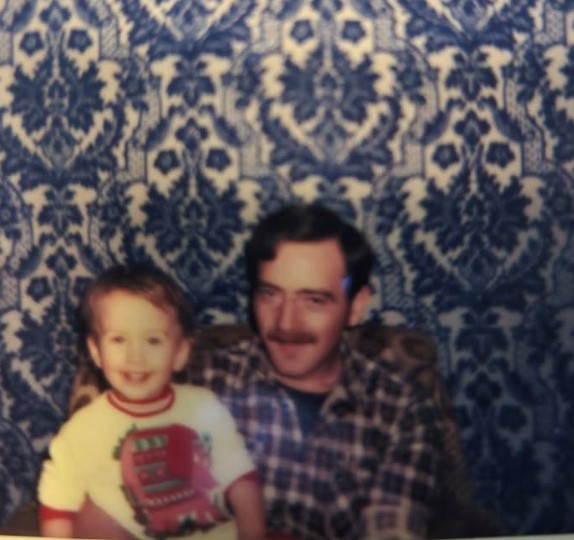
Image 2. Photograph of the author, Mandy Penney, with her father, Jim Penney (c. 1982).
Mycelial Properties: Binding, Liminality, & Decentralization
For our introductory post, Dani, Jenny, and I spent time reading and thinking about the roles that mushrooms and mycelial networks play in their ecosystems and how these might impact how we understand and talk about our work. As we engaged with these characteristics through the scholarly literature, including adaptiveness, detoxification, and symbiosis, three qualities in particular – binding, liminality, and decentralization – resonated for the ways that I have engaged in my teaching praxis, especially in the years since the beginning of the COVID19 pandemic in 2020.
The branching hyphae of mycelium can act as a natural binder by connecting with organic and inorganic substrates in its vicinity, functioning as a natural glue to preserve the environment (e.g., binding soil to prevent washouts) or produce sustainable materials (Alemu, Tafesse, & Mondal, 2022). Given this characteristic, mycelium’s binding capacities may illuminate how decolonial and critical teaching praxis relationally bind educators in equitable, care-focused ways as we nurture spaces to process, talk, share, and engage in mutual aid.
During the pandemic, I was separated from my extended family by provincially-closed borders. My dad and I – as well as the rest of my family back home – began using Zoom to connect. He watched my children play with the craft supplies he had sent. We had long talks about how we spent our time. We played Animal Crossing together on our Nintendos. Meanwhile, as I engaged with my colleagues and students online, synchronously and asynchronously, because of the in-person closure of institutions from March 2020, I began to consider how online times and spaces in higher educationcould be nurtured, planned, and facilitated to build relationships and centre care in a moment of global upheaval.
In addition to forming symbiotic connections to other organisms in the system, mycelium also facilitate communication and connection among and between these organisms, acting as mediators within an ecosystem. Similarly, educational developers function in a third space between traditional institutional roles (Whitchurch, 2013). Although sometimes uncomfortable, this position can lead to rich opportunities to engage with and connect parties that may not have had a direct path to each other due to the often-siloed nature of higher education institutions and the time and resource constraints placed on each party. However, these complex, diverse relational webs allow subversion of and even resistance to formal academic structures in nourishing and reciprocal ways.
Throughout my career as a faculty member, writing centre coordinator, and an educational developer, I have especially appreciated the opportunity to bring together teachers and learners from across positionalities, lived experiences, and disciplines to consider what kinds of teaching praxes we bring to our work and how the experiences, reflections, and advocacy of others might influence our own decisions in pedagogical spaces.
Finally, mycelial networks are non-hierarchical, serving to connect nodes and organisms within the network. Power and resources are thus distributed and interconnected (Simard, 2012). This opens up reflection – as in Jenny’s post on networks of knowledge sharing – on how a network built on connection, instead of gatekeeping, could foster relationships through collaborations, relationship building, care, and communication.
During my first Community of Practice and Care (CoPC) in the summer of 2022, I was struck by how many of the participants (in a CoPC on the theme of inclusive and accessible writing instruction) felt as though they had not been afforded space and time to process everything that had happened in higher education in the world between 2020 and 2022. They felt as though they were expected to continue on alone in their work in a status quo kind of way.
Mushrooming
Ultimately, as an educational developer, working in the spaces and connections between faculty, staff, and students in a staff educator role, I am particularly interested in how the pedagogical spaces we build can facilitate knowledge sharing and mobilization, but also in how they can build affective spaces of pedagogical solidarity – sharing what is going well, naming what isn’t, and considering how we can advocate for and action change at individual, institutional, and societal levels.
In many ways, the comic that circulated on social media during the early years of the pandemic, a 2017 artwork by Cat Lambert via Rebecca Solnit’s writing, visually distils the ways that educational developers engaged in decolonial and feminist praxis operate mycelially. Together, we operate in ways that sometimes yield visible fruit, but often after significant periods of time spent building relationships, sharing knowledge, and (un/re)learning:
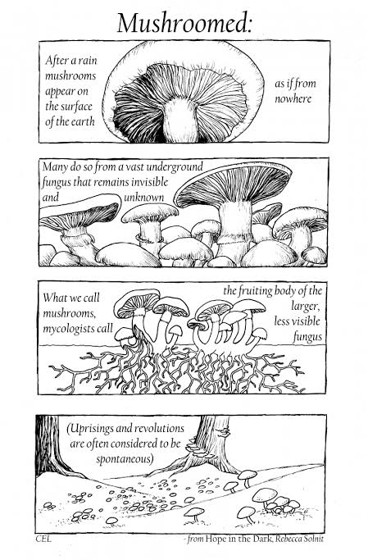
Image 3. “Mushroomed,” a comic about the underground work of underground fungal networks as a metaphor for the supposed spontaneity of uprisings and revolutions. Words by Rebecca Solnit in Hope in the Dark: The Untold History of People Power. Comic by Cat Lambert.
As a post-secondary educator, the comic above raised the following questions for me – questions that I take up while engaging with community members from across positionalities and disciplines in higher education:
- How do we support educators in navigating increasingly complex social, technological, and institutional landscapes at a time of polycrisis?
- What practices help people feel recognized, valued, and meaningful contributors to their teaching and learning communities?
- How might the systems, times, and spaces of higher education become places where care, equity, accessibility, and collective flourishing are understood as central to teaching and learning
The Community of Practice and Care framework and approach that I have been developing since 2021 has had, as one of its primary goals, to interrupt and critique the valorization of resilience and productivity in higher education and instead prioritize and make visible an ethics of pedagogical care that attends to the emotional, psychological, and physical well-being of educators and learners – and attends to these not just gesturally or performatively, but structurally.
Mycelial-Networks-in-Practice: Communities of Practice and Care (CoPCs)
During the early years of the COVID pandemic, as so many of us shifted to emergency online teaching, many of the barriers to engagement and accessibility in teaching and learning – long experienced by equity-denied educators and learners (e.g., across race, gender, sexuality, and disability) – were rendered acutely visible. It was during this moment of global health crisis, and inspired by Dr. Aimee Morrison’s blog post on Hook and Eye about teaching during “fragile times” and the weight of what we were all carrying, that I began to question what aspects of our pedagogy we should hold onto, and which we needed to loudly abandon. I was particularly influenced by Motta and Bennett’s 2018 article, “Pedagogies of care, care-full epistemological practice and ‘other’ caring subjectivities in enabling education.” In this piece, the authors identify the ongoing colonization of academic subjectivity: one that is marked through the growth of bureaucracy and professionalization. As an antidote to this “culture of hierarchy, competition, and individualism,” they propose a pedagogy of care through which educators can “foster the building of pedagogical intimacy which opens the possibilities for self and other recognition as knowers and creators of knowledge” (p. 643).
There were, ultimately, four key lenses shaping my development of CoPCs:
- The ongoing stress and trauma of multiple, intersecting health, climate, settler colonial, and genocidal crises
- The critical work of attending to Indigenization and decolonization at person, community, and systemic levels. In Canada, we are responsible for the Calls to Action from the Truth and Reconciliation Commission, a number of which pertain specifically to educational institutions
- The principles of Disability Justice, as developed by Sins Invalid, including intersectionality, the leadership of the most impacted, and committing to cross-disability solidarity, as well as recognizing wholeness and collective access
- The principles of slow academia (via Berg and Seeber), which advocate for resisting standard and ableist notions of productivity
CoPCs seek to demonstrate, model, and embody a teaching praxis that holds an ethics of care at the core – not just in the language, and not just as a side consideration, but rather as central to what it means to engage as a community accountable to each other for co-learning and shared well-being. In practice, a few (mycelial?) design components have emerged:
- sessions have been intentionally designed in a few specific ways: run online (to increase access for the greatest number of participants)
- multimodal options for engagement are provided both synchronously and asynchronously, alongside a recognition of presence as engagement
- no prep work is required between sessions
- a series of Community Engagement Guidelines (CEGs) are co-created amongst participants
- I seek to ensure that conversations are intersectional through critical reflection on positionality, sharing resources that consider the theme of the CoPC through a variety of critical lenses and attentiveness to settler commitments for Indigenizing and decolonizing teaching and learning.
Since beginning this work, I have facilitated six CoPCs across two universities – some faculty / staff or grad-student specific, with others as mixed cohorts. So much of this work has been, I think, about building spaces for community, solidarity, and support – values and practices that have also been modelled and embodied for me throughout my life by influential teachers, community advocates and activists, and scholars – including, notably, my father.
“And I Understood”: Imagination, Empathy, and Third Space Educators
My dad is now retired, dabbles in writing poetry, follows the news vigorously, and revels in being a grandfather. To my children, he is a constant presence, both online and in person, the helper for hard math questions, and the purveyor of delicious lasagna. To many of his former students, he remains a supportive voice and cheerleader on social media.
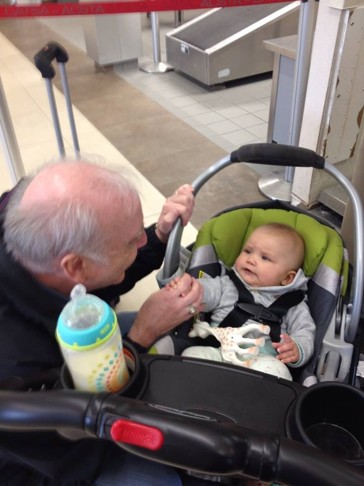
Image 4. Photograph of the author’s father meeting the author’s daughter for the first time in the Deer Lake Airport, Newfoundland. 2015.
In a paper written for his Master’s of Education degree about how his own lived experiences growing up in poverty in Newfoundland influenced his teaching practices, my dad wrote:
I had lived an experience so well known to many Newfoundlanders of the time, one of abject poverty, and the strength of character which that built in me thanks to my mother. It is a character trait which has grown with me as I entered into the lives of other Newfoundlanders in my classes, many of whom faced their own levels of poverty and need. One day I confronted a student who did not have my math homework done and asked him the usual question …
Why don’t you have your homework done?
I couldn’t do it.
Why not?
I don’t have the book yet.
Why not? It’s in the bookstore…
Silence.
Then I looked at him, his clothes, his hair, his eyes… and I understood.
Here’s my copy
Through my dad’s life and work, I have learned the value of binding your practice – in community, care, and love – to those who come before and after you in order to continue the work of justice- and care-oriented teaching practices. My dad’s imaginative empathy is mycelial in nature. As a teacher, he recognized and sought to mitigate the barriers experienced by the students he taught. In so many ways, his teaching values and approaches serve as a personal and relational model for the mycelial properties of binding, liminality, and decentralization – all of which I strive to model and embody in my own work as an educational developer. And, through his own values and approaches to teaching and learning, I learned who I was as an educator – what mattered to me, how I wanted to engage with learners, and how to show up for colleagues and students alike. Choosing care and respect over hierarchical and authoritarian modes of communication, my dad’s former students (many of whom maintain contact with him to this day) are afforded the space and time to be who they are, authentically, in community with each other. These are my primary goals as a third-space educator.
Author’s note, as I play with autoethnography and autotheory in this post: The role of the third space in higher education has largely been to provide nodal points of connection, supports, and communities. In the beginning of Autotheory as Feminist Practice in Art, Writing, and Criticism, Lauren Fournier (2021) identifies key features of what she calls the “autotheoretical impulse”: “close reading, feminist analysis, self-reflective anecdotes, and reparative forms of critique” (p. 1). The resonance of this flexible and creative genre, for me, has been the way that it resists the tidiness of more traditional, structured genres of writing within/out academic and personal life. In many ways, autotheory has offered me a writerly third-space that resists both the solitarily-focused and backwards-looking memoir and the abstractness of theory. This fusion offers endless and creative ways for feminist writers to explore the often nebulous, dynamic boundaries between the prescriptive and artificial borders between our academic, personal, and social lives. Similarly, mycelia facilitate communication and connection among and between organisms within a system, acting as mediators in a third space.
This post was curated by Multimodal Contributing Editor Dani Dilkes and reviewed by Contributing Editor Melina Campos.
Works Cited and Consulted
Alemu, D., Tafesse, M., & Mondal, A.K. (2022). Mycelium-based composite: The future sustainable biomaterial. International Journal of Biomaterials. DOI: https://doi.org/10.1155/2022/8401528.
Berg, S. & Seeber, B.K. (2013). The Slow Professor: Challenging the Culture of Speed in the Academy. University of Toronto Press.
Foley, J. (2026, August 13). Networks of knowledge sharing: Becoming-with mushrooms in academia. Platypus: The CASTAC Blog.
Foley, J., Dilkes, D., & Penney, M. (2026, June 19). Becoming-with mushrooms: Multispecies collective autoethnography for reworlding educational environments. Platypus: The CASTAC Blog.
Fournier, L. (2021). Autotheory as Feminist Practice in Art, Writing, and Criticism. Cambridge, Mass.: MIT Press.
Lambert, C. (2017, June 19). Mushroomed [Webcomic]. Quake & Quiver.
Morrison, A. (2020, December 9). Resilient pedagogy for fragile times. Hook & Eye.
Motta, S.C., & Bennett, A. (2018). Pedagogies of care, care-full epistemological practice and “other” caring subjectivities in enabling education. Teaching in Higher Education: Critical Perspectives 23. DOI: https://doi.org/10.1080/13562517.2018.1465911Penney, J. (2005). A Lived Experience: A Wealth of Knowledge [Unpublished manuscript]. Faculty of Education, St. Francis Xavier University.
Simard, S.W., Beiler, K.J., Bingham, M.A., Deslippe, J.R., Philip, L.J., & Teste, F.P. (2012). Mycorrhizal networks: Mechanisms, ecology, and modelling. Fungal Biology Reviews 26(1): 39 – 60. DOI: https://doi.org/10.1016/j.fbr.2012.01.001Sins Invalid. (2015). 10 Principles of Disability Justice.
Truth and Reconciliation Commission of Canada. (2015). Truth and Reconciliation Commission of Canada: Calls to Action. National Centre for Truth and Reconciliation.
Whitchurch, C. (2013). Reconstructing Identities in Higher Education: The Rise of Third Space Professionals. Routledge.
