This article is the fourth and final article in a series about gig and platform worker unions in India written by members of the Labor Tech Research Network. Read the introduction to the series here, the second post in the series here, and the third post here.
Unsettling the Promise of Flexibility
In January 2024, hundreds of women workers associated with the on-demand home services app Urban Company (henceforth UC) gathered in protest outside the platform’s regional office in Hyderabad, India. The workers, many of whom were working as beauticians on the app, were protesting a slew of platform policies that had steadily eroded their working conditions over time (Figure 1). Most notable of these was the introduction of a new feature called ‘auto-assign’, which requires workers to mark the time slots that they are available to work on the app, following which they are assigned gigs automatically by the platform. The new ‘auto-assign’ policy marked a significant shift away from a previously more flexible system, where women could choose their gigs and hours. The promise of flexibility has been a prime reason that attracted women workers to platforms like UC, as it enables them to access paid work while also attending to their housework and care work responsibilities. It is this very erosion of flexibility that women were holding UC to account for.
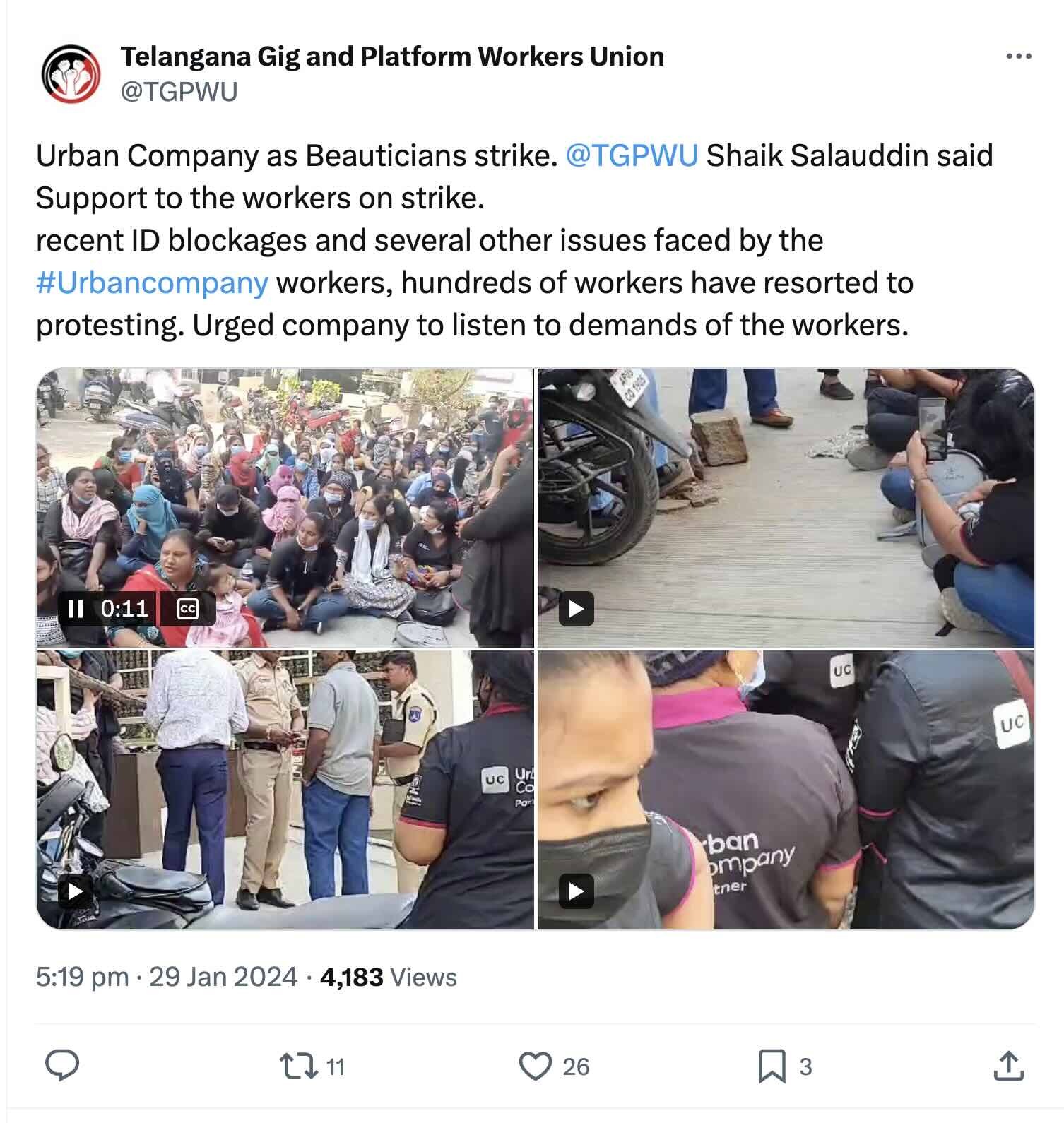
Figure 1: UC workers strike in Hyderabad, Jan 2024. Twitter/X post by Telangana Gig and Platform Workers Union on Jan 29, 2024, reproduced with permission from the author. Source: https://x.com/TGPWU/status/1751897741943607471
While platforms’ promises of flexibility come with the concomitant promise of autonomy over one’s work, women workers have time and again contested elements of algorithmic control in platform work that are gendered and lack understanding about the social and spatial realities of women’s lives. For instance, with growing restrictions on the number of cancellations workers are allowed to make per month, alongside the system of auto-assignment, women are often forced to accept gigs that conflict with their housework and caregiving responsibilities. Women also report being auto-assigned gigs that involve travelling to far-off locations, raising safety and mobility concerns. The combined effect of these policies is that platforms like UC ironically exclude the very demographic whom they are lauded for including within the platform economy. In response, women workers have found ways to raise their concerns both internally and through external mobilizing efforts.
Since 2021, recurring nationwide protests by women gig workers have firmly unsettled the romance of flexibility that platforms had sold for so long, exposing the cracks underneath. In June 2023–more than two years after the first public protest against platform policies– scores of women workers nationwide gathered spontaneously in protest against the large-scale worker terminations by the platform. Like their counterparts elsewhere in India and globally, these workers organized mainly online via WhatsApp, Telegram, and Signal groups. Workers whose labor had so far been confined to others’ private homes–and thus largely invisible in public discourse–made themselves visible publicly. These protests also made workers visible to each other, restricted as they were, by the geographies of their work sites and the organization of the home-service platform work model itself. The spontaneous protests later galvanized into a nationwide campaign against unfair and arbitrary terminations of platform workers, led by the All India Gig Workers’ Union (AIGWU) (see Figure 2).
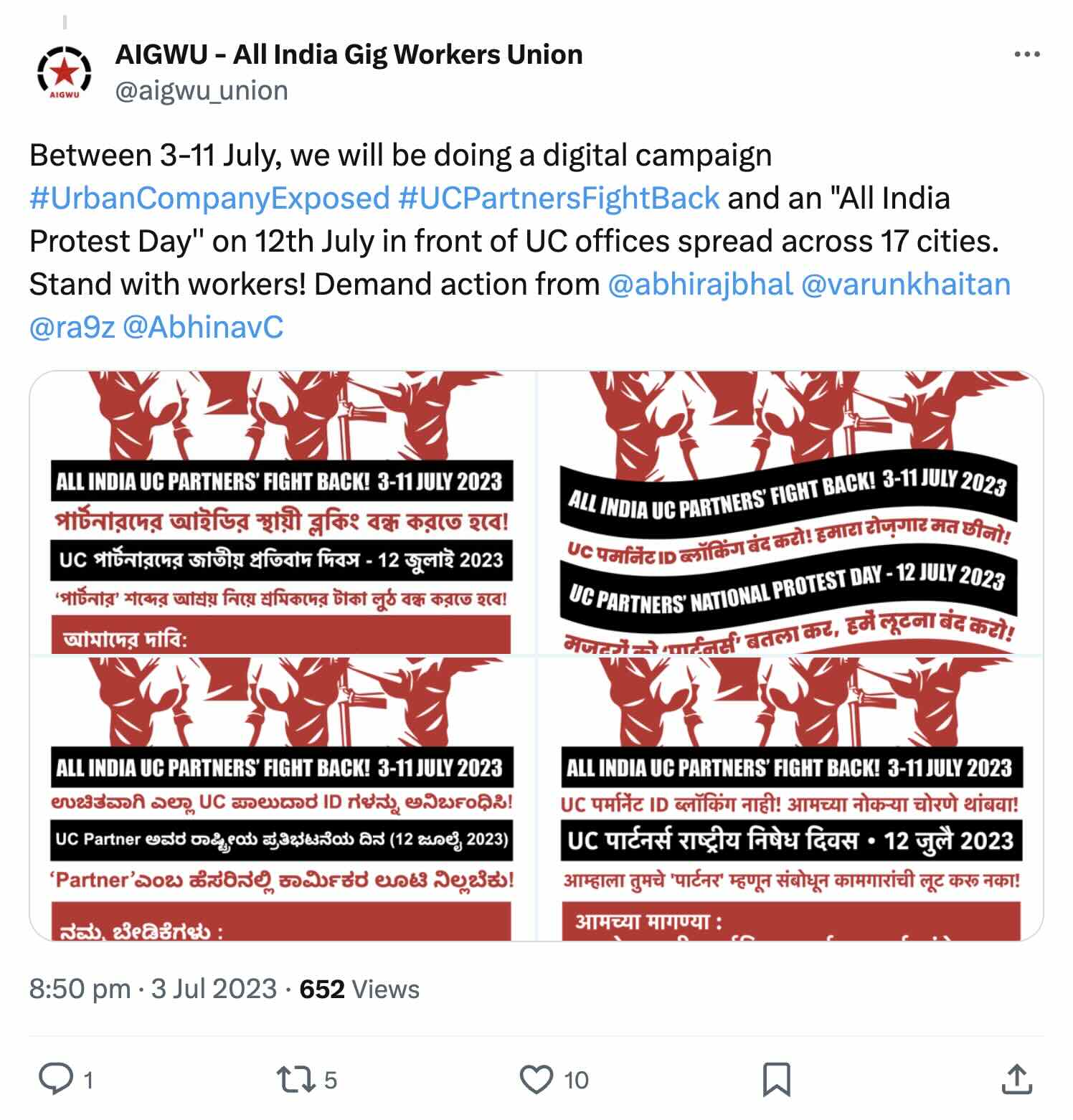
Figure 2: Campaign against arbitrary terminations by UC. Twitter/X post by All India Gig Workers union on Jul 3, 2023, reproduced with permission from the author. Source: https://x.com/aigwu_union/status/1675849525850968066
The Socially Reproductive Nature of Unionizing
The implications of employment on women’s economic, spatial, and social mobility has been a long-standing debate, with scholars pointing out that despite gaining entry into paid work, the burden of the ‘second shift’ at home has remained squarely on women’s shoulders (Elson & Pearson, 1981; Arizpe & Aranda, 1986; Kabeer, 2000; Hochschild & Machung, 2003). In the context of platform work, given its geographically fragmented character, we contend that these twin burdens of paid and unpaid work have not only implications for how women relate to work, but also whether and how they organize into unions and collectives.
At the outset, it is important to recognize that the labor of unionizing is socially reproductive work, demanding emotional and cognitive labor from the organizers who have to routinely intervene in situations where both platform companies and the state are absent (Medappa, 2023). In our research with platform workers’ unions, for instance, organizers were grappling with cases of road traffic accidents and accidental deaths for workers whose coverage under third-party insurance policies was buried under layers of legal and technical jargon. This called for patient follow-ups with both the platform and the third-party insurance company for the claims process–an arduous and lengthy one, never in favor of the worker. In such contexts, organizing work, which is emotionally and cognitively demanding, makes additional demands on workers and their time, disproportionately impacting women.
Because women are rarely accorded the luxury of free time after their paid work hours, they have to find time for organizing work amidst multiple and often conflicting demands on their time. When it comes to city-wide mobilizing campaigns, this understanding often comes slowly at the top, and through a learning curve that inevitably involves judgement errors. For instance, we have seen gig unions’ calls for women workers’ mobilization meetings repeatedly fail because they picked meeting times without consulting women, times that more often than not clashed with women’s evening work obligations at home. When women workers are not able to magically make it, they are then inaccurately written off as uncommitted, flighty, or uncaring.
Gendered Geographies of Work and Organizing
As labor scholars remind us, it is important to understand the local geographies of work (and their attendant material realities) as they crucially shape organizing strategies and processes. In this regard, neighborhoods have been key sites for workers’ organizing and collective action (Chandavarkar, 1994; Agarwala, 2013; Tewari, 2010). However, platforms design their apps to specifically prevent workers in the same locality or city from knowing, meeting, or gathering together. The apps treat gig workers as atomized units, alienate them from their fellow workers, and tend to place them in competition with each other, posing challenges for sustaining the convivial, everyday encounters and interactions that have historically laid the ground for workers to come together and collectivize.
In male-dominated sectors such as food or grocery delivery or ride-hailing, workers get to meet in various offline spaces, like dark stores, restaurant pick-up points, or parking lots, as they go about their workday. This allows crucial (though limited) opportunities to get to know each other, share local information, provide peer support and mutual aid, and flag and raise issues affecting workers in a particular locality. However, in the female-dominated home-services sector, the work is carried out in individual customers’ private homes, which limits opportunities to run into or interact with other workers during the day. This means that women workers rarely get to meet each other offline, other than through platform-mandated compulsory training programs in the office, and do not have the same opportunities to connect and support each other as their male counterparts. Considering the scattered geographies of their work, WhatsApp, Signal, and Telegram groups are an important medium through which platform workers share information and cultivate networks of support, sociality, and mutual aid (Nowak, 2023; Medappa, 2023; Qadri & Raval, 2021). In the absence of any common physical points of contact, these digital geographies of organizing are the primary modes through which home-service workers connect with each other.
Notwithstanding these alienating constraints, gig workers find and create unexpected opportunities to support each other, often crossing gendered expectations and stereotypes as they do so. In the delivery sector in Mumbai, for instance, which has very few women workers, a woman delivery worker commented about managing safety in the city:
The other delivery workers in my locality look out for me. In the early days, when I was learning how to use the maps and deliver items correctly, they would help me out if I got stuck. Whenever I have to make late-night deliveries in big buildings, if another delivery driver sees me there, he will tell me that he will take up my order for me, so that I don’t have to deal with any unwanted attention from male customers.
Such forms of peer support and the shouldering of additional burdens by male co-workers point to gendered courtesies and care that challenge classed stereotypes about gig work. We can recall many other instances where workers crossed ideological and gender lines to show up for each other, and where customers showed up for workers as well. In one instance in Hyderabad, male union drivers stood alongside a woman driver who was facing hostility from male drivers on the road, who accused her of stealing their gigs. In response, the union members rhetorically asked if Uber/ Ola actually gave a preference to passengers to choose a male/female driver, thereby debunking accusations being thrown at the woman driver. This is to say that even as the landscape of work and organizing poses gendered barriers, we also find workers crossing these barriers with sensitivity, camaraderie, and creativity.
We wish to highlight that such forms of care offer us openings for broader solidarities, in an era that has discovered the limits of identity politics (Nash 2019; Sa’ar 2005). In these examples and in our work with gig unions more broadly, we see opportunities to move past fractured and limited identity labels and intersectionality wars that seek to pit people and groups against each other, and to focus instead on shared commitments and visions toward more just futures. This implies that labor organizing can no longer be divorced from wider socio-political struggles, especially those concerning our cities today, and the shared futures we imagine. This is particularly important as the gendered nature of platform work is deeply embedded in the spatial infrastructures of the city–women workers are disproportionately disadvantaged, often through infrastructural lacks. For example, public toilets for women are far and few, are often shut early, or just unserviceable. Irregular public transit times also disadvantage women home-service workers who do not own a vehicle, as they are often late for gigs or forced to rely on male family members for rides. Any labor organizing, therefore, needs to also zoom in to the level of the city to address these gendered geographies of exclusion and access (or the lack of it). Thus, such organizing initiatives need to work in alliance with urban movements to advance claims toward the ‘right to the city’. Such organizing can neither function in a vacuum nor can it assume to be foolproof–it can only evolve in solidarity with other socio-political movements and through an honest grappling with its own moments of errors, tensions, and contradictions.
This post was curated by Contributing Editor Toh Sook-Lin and reviewed by Contributing Editor Pradip Sarkar.
References
Agarwala, R. (2013). Informal labor, formal politics and dignified discontent in India. Cambridge University Press.
Arizpe, L., & Aranda, J. (1986). Women workers in the strawberry agribusiness in Mexico. In E. Leacok & H. I. Safa (Eds.), Women’s work: Development and the division of labour by gender (pp. 174–193). Bergin & Garvey Publishers.
Chandavarkar, R. (1994). The origins of industrial capitalism in India: Business strategies and the working classes in Bombay, 1900–1940. Cambridge University Press.
Elson, D., & Pearson, R. (1981). ‘Nimble fingers make cheap workers’: An analysis of women’s employment in third world export manufacturing. Feminist Review, 7(1), 87–107.
Hochschild, A., & Machung, A. (2003). The second shift. Penguin Books.
Kabeer, N. (2000). The power to choose: Bangladeshi women and labour market decisions in Dhaka and London. Verso.
Medappa, K. (2023). Rethinking mutual aid through the lens of social reproduction: How platform drivers ride out work and life in Bengaluru, India. Journal of South Asian Development, 18(3), 383–408.
Nash, J. (2019). Black feminism reimagined: After intersectionality. Duke University Press.
Nowak, S. (2023). The social lives of network effects: Speculation and risk in Jakarta’s platform economy. Environment and Planning A: Economy and Space, 55(2), 471–489.
Qadri, R., & Raval, N. (2021). Mutual aid stations. Logic, (13). https://logicmag.io/distribution/mutual-aid-stations/
Sa’ar, A. (2005). Postcolonial feminism, the politics of identification, and the liberal bargain. Gender & Society, 19(5), 680–700.
Tewari, M. (2010). Footloose capital, intermediation and the search for the ‘high road’ in low-wage industries. In A. Posthuma & D. Nathan (Eds.), Labor in global production networks in India (pp. 146–165). Oxford University Press.
