Author’s editorial prelude:
In what follows, I open up insight into a micro-moment of everyday scholarly life which shows itself through the body; like that slightly deeper breath which follows while one is thinking through a problem that occupies the mind. Such fleeting moments pass unnoticed, yet they are part of the labour and effort of what counts as teaching and supervision ‘work’. I believe there is value in turning attention to and staying with such moments as they quietly shape how one thinks, reads, judges, writes, teaches, supervises and such. My request to the reader is to stay present with the moment, the internal self-talk, and recalls that I describe in this piece. A request that places a demand on the reader to perform the sometimes-tedious task of curbing the desire to go beyond the moment that is the subject of analytical attention.
The attention to one such pensive pause is what I share below. Pauses are never fully transparent, even to the person experiencing them, and the reasons behind silences we find ourselves in can never be completely known. Yet we have greater access to our own reasons and recalls than we do to those of others. Such dimensions of scholarly life are otherwise difficult to encounter, if not shared. That is why I wrote about the moment in what follows.
I am at the threshold, working out feedback to my supervisee (who has read the piece below and agreed to be named), when I encounter myself in the pensive pause of supervision.
The Pensive Pause
I leaned away from the laptop, perched upon my kitchen table; my eyes paused on a footnote in a google-doc on screen and my mind in a pensive pause. It was a footnote my supervisee, Waliyilah, had inserted in the chapter outlining the theoretical framework of his master’s dissertation on the entanglement of migrant youth in Nigeria with structural adultism (cf. Wall 2025). Adopting a decolonial stance toward human rights, he had inserted the footnote to make explicit that he was aware of the dismissal of Boaventura De Sousa Santos from his position as tribunal judge by The International Rights of Nature Tribunal, and to indicate the citation was not an endorsement of Santos’ alleged behaviour. The footnote performed the function of clarifying that Santos had gotten a place in the theoretical framework because his concept ‘Epistemologies of the South’ was “necessary”. The footnote was a response to my intervention a week ago when I saw Santos appearing in Waliyilah’s text, which I didn’t recall having encountered in the research proposal preceding this chapter. “Did I overlook this? I couldn’t have …,” I oscillated gently in self-doubt. With every oscillation, I landed a little bit firmer on the murmur in my mind that said, “I couldn’t have.”
Two years prior, I had discovered the collective autoethnographic inquiry into sexual (and intellectual) extractivism by Lieselotte Viane,Catarina Laranheiro and Miye Nadya Tom (2023), entitled “The walls spoke when no one else would”. This was a digression in my intended research engagement with my colleague Macarena García González’s (2024) childist analysis of what it means to decolonise reading lists in the age of artificial intelligence and large language models (like Chat GPT). My intended engagement was to keep up with the development of childist thinking (like feminist, but from an age-critical standpoint that learns from experiences of children and childhood as a structure; see Biswas et al 2024 and/or The Childism Institute n.d.). Half-way through the essay (pp. 9), Macarena addressed ‘Our Complicities’ through presenting her retrospective regret on opening one of her chapters on cultural diversity and social justice with a reference to Santos’ concept ‘epistemology of the South’ – the very same concept that Waliyilah had inserted that footnote in lieu of an ethical defence. The footnote my eyes were resting a pensive pause on.
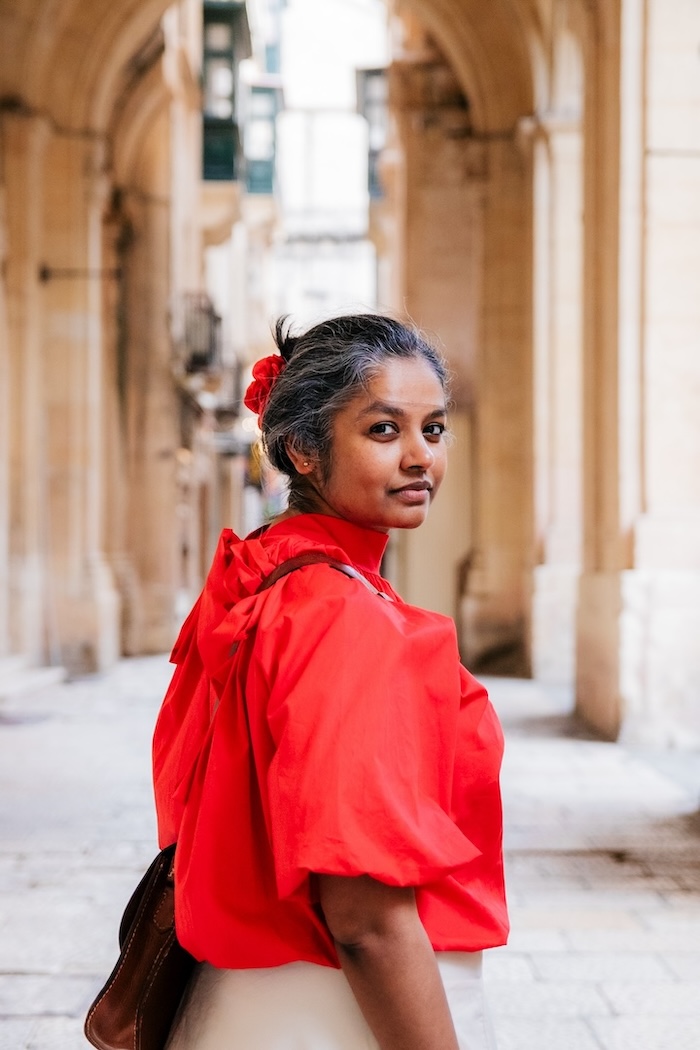
Image of the author at the National Library in Malta.
Macarena’s retrospective regret followed her reading of Viane et al (2023) whose publication led to public figures from the global South, such as the Brazilian state deputy Bella Gonçalves (Correia 2024; 2023) and Mapuche activist-writer Moira Millan (Matamala 2023) speaking out about the sexual abuse that Santos inflicted upon them. Viane et al’s work had a widespread social impact catalysing responses that went far beyond individual public figures like Bella Gonçalves and Moira Millan speaking out. Notably, the International Rights of Nature Tribunal revoked Santos’ title as tribunal judge issuing a statement distancing itself from extractivist behaviours; a statement I had routinely begun to advice students like Waliyilah to read when they cited Santos, considered an established name to drop while writing about decolonial work. The Center for Social Studies of the University of Coimbra (CES), Santos’s first employer, released a statement acknowledging the allegations and set up an investigation committee in response (CES, n.d.). CES later went on to publish an open letter apologising to Santos’ victims (CES 2024). Santos was very offended by the publication of the chapter (Viane et al 2023) and taken aback that Routledge published the work he claimed was “a criminal accusation under the guise of scientific work (Morgan 2023)”.
The publisher Routledge finally pulled out the chapter from the book after receiving a ‘cease and desist’ letter from an “individual who claimed to be identified in the book (ibid.)”. In turn, thousands of academics signed a statement problematising Routledge’s decision along with a petition for the chapter to be re-included (Patrick 2023; BUALA 2023). Eventually, Santos and his defenders began positioning Santos as the ‘victim’ by delegitimising the testimonies of women who spoke out and by evoking the problematic in light of a generational issue of ‘cancel cultures’ (Ramos 2025; Chaui 2025; Soares da Silva 2025). De-legitimisation of the victims was an indispensable ground for any defence of Santos and/or effort to protect his intellectual legacy could be built on, as the opponents like Isabelle Gonçalves Miranda and the Collective of CES Victims (2025) argued. The movement to empower the victims also materialised in a crowdfunding campaign to cover legal costs for defamation lawsuits that Santos filed against victims (cf www.academiasemassedio.com). Viane et al (2023) had published research of widespread impact, and it was present in the pensive pause behind my eyes resting on Waliyilah’s footnote.
My pensive pause was not a moral one – it was held by prudence of not wanting to be perceived as moralistic toward my student and by the desire to let him establish his own politics of citation, even if it meant a decision I could not identify with – on decolonial analytical grounds. Not moral ones. In Macarena’s retrospective regret, she had made a similar point. The moral shock Viane et al’s autoethnographic research (2023) evoked was only at surface level for rigorous decolonial scholarship. Macarena elaborated something that still remained with me as I was working through what I would offer as feedback to Waliyilah: who genuinely cared about decolonising the dark colonial weight on empirical research in and about Africa. She wrote,
“We have been told we can separate the author from the work, which I very much doubt we can. But also, I had already felt the crack in Sousa Santos’ concept of the epistemologies of the South. It was a useful concept to speak about those other ways of knowing, to give a hint of indigenous epistemologies and about less Westernised modes of thinking. But it promised a South for a North: it reinforced a simplistic binary between the ‘North’ and the ‘South,’ inadvertently creating a mirror image of the global hierarchy he aims to deconstruct. De Sousa Santos needed to essentialise the ‘South,’ representing it as a homogeneous space of resistance, free from its own internal colonialism, hierarchies, and power imbalances. This oversimplification not only overlooks the diversity and complexity of knowledge production but risks perpetuating some kind of ‘South romanticism’. Instead of dismantling the structures that enable coloniality, this concept may subtly reinforce them by framing knowledge production in terms of territorial and geopolitical oppositions. It fails to fully acknowledge that coloniality operates through more diffuse and interconnected networks of power that cannot be neatly mapped onto a North-South divide (García González 2024, p. 9).”
It seemed to me that Waliyilah was pursuing a citation politics based on the logic, “I cite the concept, not the person” as part of his disclaimer footnote defending an analytical decision to employ Santos – a logic that Macarena’s regretful retrospection had led her to reconsider by shedding light upon a moment of analytical discomfort she claimed to have brushed aside while citing Santos in a chapter she later regretted. She attributed this ‘crack’ to an analytical one, not a moral one. Viane et al (2023) had gone beyond making a moralistic point – they were pushing for ‘further research’ on a central tenet that decolonial scholarship can subsist on: the methodology of knowledge production is as relevant, if not more, as the knowledge produced. Overcoming the separation of ethics, metaphysics (including ontology), epistemology, and aesthetics that is possible in Western philosophical traditions, but not in non-Western traditions, lies at the heart of scientific work aimed at cultivating decolonial methodologies. Response to Waliyilah’s footnote carried with it the stakes of explaining decolonial theoretical grounds in a way that emphasised the analytical point. That was my function as the supervisor. It had to be done in a way that surface level perceptions triggering moral defensiveness, a defensiveness that even elder scholars such as Chaui (2025) continued to be imprisoned by, did not stand in the way of the analytical clarity.
I began perusing the Waliyilah’s text to understand the “necessity” he had expressed in his disclaimer footnote. What was precisely the job the Santos citation was doing in the text? What was the analytical “necessity” that only Santos could be employed for? The footnote named the very concept that Macarena had retrospectively noted to be cracked: ‘epistemologies of the South’. “But that is not even a concept Santos OR ANYBODY can own!” I exclaimed to myself; inching closer to questioning the authority beneath the influential name-dropping currency those concepts sought to purchase. That isn’t a coherent theoretical move, especially not a decolonial one. Every instance of Santos’ appearance in the text (and they weren’t many), it appeared alongside other citations. So, what was the specific purpose of citing Santos? “It’s nothing really, looks like a name alongside another with no analytical function,” I saw as far as my pensive eyes could see. Was there a citation politics behind his appeal to “necessity”, that perhaps Waliyilah was not yet aware of? Why was that scholar “necessary”? “Necessary” compared to which other scholars and concepts? Had Waliyilah deliberated his options before this ethical disclaimer? I couldn’t, in that moment, think of any concept that Santos had offered which couldn’t be replaced by another.
As much as I wanted to let Waliyilah make his own intellectual decisions, I found myself carrying questions which disabled me from standing up for that chapter in the dissertation I was supervising. I wasn’t morally disabled; I was analytically disabled. The only step then was to move closer to the screen and write to Waliyilah my questions; hoping my words wouldn’t trigger a defensive wall of morality; hoping that his analytical sense would be receptive to mine.
This post was reviewed by Contributing Editors Clarissa Reche and Samiksha Bhan.
References
Biswas, T., Wall, J., Warming, H., Zehavi, O., Kennedy, D., Murris, K., Kohan, W., Saal, B., & Rollo, T. (2024). Childism and philosophy: A conceptual co-exploration. Policy Futures in Education, 22(5), 741-759. https://doi.org/10.1177/14782103231185178
BUALA (25.09.2023). Public Statement. BUALA Blog
Carvalho Ramos, André (30.3.2025). Boaventura de Sousa Santos: “Qualquer mulher que diga que recebeu um piropo e nunca gostou é mentirosa ou hipócrita”, CNN PortugalBoaventura de Sousa Santos
Chaui, Marilena (24.8.2025). Contra a calúnia: Em defesa de Boaventura de Sousa Santos, por Marilena Chaui, Journal GGN
Gonçalves Miranda, Isabella (08.09.2025). Chaui, a verdade não se divide entre o ‘santo Boaventura’ e as denunciantes. Chaui, a verdade não se divide entre o ‘santo Boaventura’ e as denunciantes
Correia, Mariama (23.5.2024). Boaventura: pesquisadoras relatam denúncias de assédio. A Publica. Boaventura: pesquisadoras relatam denúncias de assédio
García González, Macarena (2024). Decolonising Reading Lists in the Age of AI: an Essay at the crossroads of Decoloniality, Childist Criticism and Chat GPT. La Palabra, núm. 48: e18310. https://doi.org/10.19053/uptc.01218530.n48.2024.18310
Jack, Patrick (6.10.2023). Hundreds sign letter against cutting book chapter on sexual misconduct. Times Higher Education
Manica, Daniela and Gama, Fabiene (17.12.2025). What Not To Do If You Are Accused Of Harassment: The Case Of Boaventura de Souza Santos | Platypus
Matamala, Lola (16.4.2023). Moira Millán: “No me iba a dejar violar aunque fuera Boaventura” El Salto. Moira Millán:
Morgan, John (12.09.2023). Misconduct chapter spiked as professor objects . Times Higher Education
Soares da Silva, Luciane (8.09.2025). Por que é preciso defender Boaventura de Sousa Santos? Le Monde Diplomatique
The CES Board and the Presidency of the Scientific Board (n.d.). STATEMENT from the CES Board of Directors and Presidency of the Scientific Board
The CES Board. (2024). Open Letter of the Board and the Chair of the CES Scientific Council, March 13, 2024. Available at: https://ces.uc.pt/en/agenda-noticias/destaques/2024/carta-aberta-da-direcao-do-ces.
The Childism Institute (n.d.). www.childism.org
The International Rights Of Nature Tribunal (27.3.2024). Public Statement: Dismissal Of Boaventura De Sousa Santos As Judge Of The International Rights Of Nature Tribunal Public Statement
Viaene, L., Laranjeiro, C. & Tom, M. N. (2023). The walls spoke when no one else would: Autoethnographic notes on sexual-power gatekeeping within avant-garde academia. Originally Included in D. E. Erin Pritchard (Editor), Sexual misconduct in academia : informing an ethics of care in the university (pp. 208–225). Routledge.
