“Mycelium is ecological connective tissue, the living seam by which much of the world is stitched together.” — Sheldrake, 2020
“Multispecies relationality tuned to the temporal and semiotic registers makes evident a lively world in which being is always becoming, becoming is always becoming-with.” — van Dooren, 2016
Higher education in Canada is currently in a state of fragmentation, isolation, and disconnection, due in large part to shifting institutional motivations and ideologies, emerging technologies, political upheaval, and ecological estrangement. Academic capitalism has resulted in an increased focus on efficiency, production and output, individualism, standardization, and competition driven by neoliberal logics (Centre for Leadership & Diversity, n.d.). As critical educational developers, working within the Canadian higher education system, our praxes each focus on attempting to re-establish relational approaches to educational practice, and re-imagine educational systems through a lens of interdependence, collectivity, and care. Finding the often hubristic anthropocentric nature of educational designs to be complicit in this increasing sense of disconnectedness, we turned to non-human wisdom and sensibilities to imagine new ways of knowing, being, and interacting in educational spaces.
We were drawn to mycelium/mushrooms as a conceptual companion species (Kapp, 2025) to guide this work because they offer unique characteristics for exploring relationality, community, interdependence, and care. Mycelia are the root-like, expansive, and interconnected structures of fungal vegetation which live and communicate both below and above ground. They serve as information and resource conduits, connecting with and between other organisms, resulting in ecosystem thriving. The unique characteristics of fungal networks have captured the imagination of artists (Ostendorf-Rodríguez, 2023), designers (Josi, 2021), academics (Haraway, 2016; Tsing, 2016), fantasy and science fiction writers (Lannin, 2023), and activists (brown, 2017), demonstrating how mycelium can act as a powerful, broad metaphor to understand our world and to open up imagining towards new possibilities and futures (Pinto, 2025). However, rather than ascribing mycelial metaphors, we endeavored to move beyond the metaphor to work with mycelia as companion-species (Haraway, 2003). As three postsecondary scholars and educational developers, our goal for this project was to cultivate a collaboration with mushrooms as a conceptual companion for reimagining educational designs, practices, and systems. We approached this as a Multispecies Collective Autoethnography (MCoAE), intentionally troubling traditional anthropocentric knowledge paradigms by acknowledging non-human epistemic authority and actively engaging in meaning making with mushrooms.
Our collaborative mycelial praxis weaves theories and methodological approaches that emphasize (auto)ethnography (van Dooren, 2016), plant-human collaborations and critical plant studies (Liukkonen, 2025; Kirksey & Helmreich, 2010; Tsing, 2012), epistemic and disability justice (Fricker, 2016; Todd, 2016; Piepzna-Samarasinha, 2019), and critical pedagogies (Freire, 1970/2000; hooks, 2003). These bodies of work offer opportunities to think about how ecological sensibilities and relationships can inform and enhance human ways of thinking, knowing, and being. They also allow us to explore how human practices (including education) are embedded within larger social-ecological systems.
Multispecies Collective Autoethnography
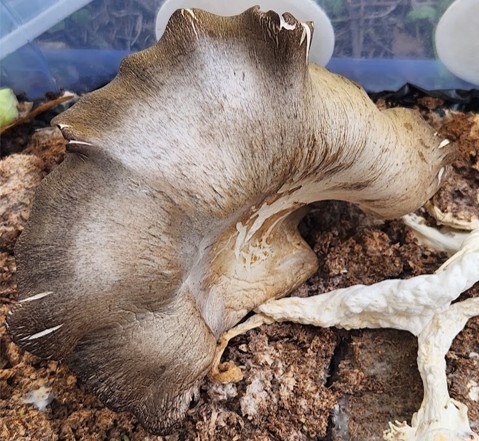
Figure 1. The fruiting body of Pearl, a Black Pearl Oyster Mushroom (Pleurotus ostreatus hybrid), and one of the 4 mycelial companions in this project.
Image © 2026 by Dani Dilkes is licensed under CC BY-NC-SA 4.0.
Collective Autoethnography (CoAE) is a powerful form of collective inquiry that allows researchers “to explore their shared experiences, positionality, and responses to common situations or phenomena” (Karalis Noel, 2023). However, CoAE remains an anthropocentric form of inquiry, limited by human ways of knowing and being. Multispecies Autoethnography offers a way of actively disentangling practice from anthropomorphic sensibilities (Gillespie, 2022). We engaged in Multispecies Collective Autoethnography (MCoAE) as not merely a world-describing practice, but as a form of multispecies worlding (Haraway, 2016), recognizing that human and non-human worlds are entangled with and shaped by each other. MCoAE itself can be understood as a mycelial practice because it allows decentralized, collaborative ways of working that encapsulate the diverse experiences of the human researchers and the more-than-human wisdom of our conceptual companions.
Although we attempted to decentre the human perspective, it is important to be aware of the tendency to ascribe human characteristics and sensibilities to our non-human companions. Daston, a historian of science, describes this as a “naturalistic fallacy-a kind of covert smuggling operation in which cultural values are transferred to nature, and nature’s authority is then called upon to buttress those very same values.” (Chiu & Gu, 2024). In our collaborative work, we seek to avoid this fallacy, even as we recognize that our lenses on the world – as humans, and through our unique positionalities – risk replicating these limiting paradigms.
Mycelial Ways of Being
Engaging with mushrooms as conceptual companions allowed us to explore the complex multiplicity of ways of knowing, living, being, and valuing that are entangled in world-building (van Dooren et. al., 2016). The mushroom, and more specifically, the entangled network of root structures below the visible fruiting body (known as the mycelial network), were “an embodied entry point” (Kapp, 2025) for reflection on how the structures, systems, and behaviours of mycelial networks could allow us to rethink and reshape knowledge sharing, perceptions of time, and constructions of self and knowledge in academia.
Mycelia establish a symbiotic relationship with plants. The nature of this relationship varies, with relationships potentially being helpful, neutral, or harmful (Leung & Poulin, 2008). Mycorrhizal networks are mutualistic networks in which mycelium conduct complex exchanges of nutrients and facilitate these exchanges between other organisms in the network (Kiers et. al., 2018). In addition to forming symbiotic connections to other organisms in the system, mycelium also facilitate communication and connection among and between these organisms, acting as mediators. The way that these intimate relationships and exchanges occur within mycelial networks allows critical consideration of the nature of relationships within educational environments and how to foster mutualism. Mycelial networks are non-hierarchical, serving to connect nodes and organisms within the network. Power and resources are distributed and interconnected (Simard, 2012). These qualities prompt a call for poignant reflection on how networks built on connection, instead of gatekeeping, could foster relationships through collaborations, interdependence, care, and communication.
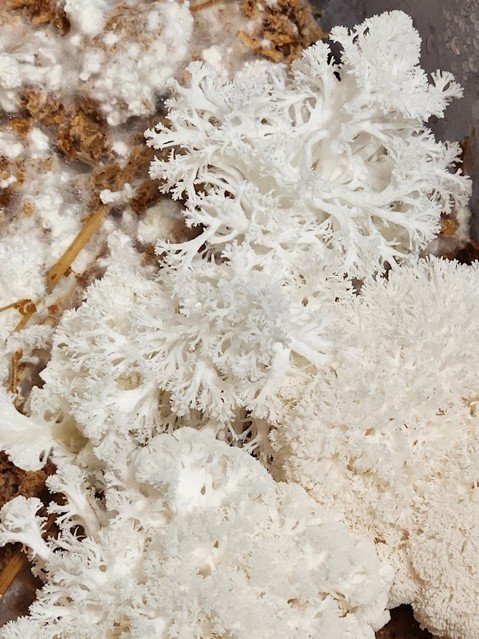
Figure 2. A close-up of the fruiting body of Lion, a Lion’s Mane mushroom (Hericium erinaceus). Image © 2026 by Dani Dilkes is licensed under CC BY-NC-SA 4.0.
Our Mushroom Companions
In early January 2026, we obtained 4 mushroom colonies from a local mycologist: Black Pearl Oyster (Pearl), Lion’s Mane (Lion), Blue Oyster (Blue), and Pink Oyster (Pink). We created four monotubs from heavy plastic buckets. Each bucket was filled with a different type of substrate (the base material that acts as nutrition and structure for mycelium to grow). Our substrates were a combination of natural, but store-bought or human-sourced, materials including straw, hardwood chips, sawdust, coco coir, and coffee grounds. The substrate materials were sterilized with boiling water and then the four colonies were each placed in their own monotub, housed by one of the three researchers (Dani Dilkes). Dani regularly documented mushroom growth, sharing photos with the rest of the team and stories about the mushrooms.
Working with mushrooms required a new, unfamiliar, form of communication. As none of the research team are mycologists or biologists, we were approaching this inquiry from a place of curious novice. The mushroom colonies arrived housed in sealed plastic bags; upon opening them, we discovered that Blue was covered in beads of an amber liquid. A quick web search informed us that this was fungal exudate, colloquially known as ‘mushroom pee’. This is a normal part of metabolic processes, but production of this exudate can be increased by stressful conditions.
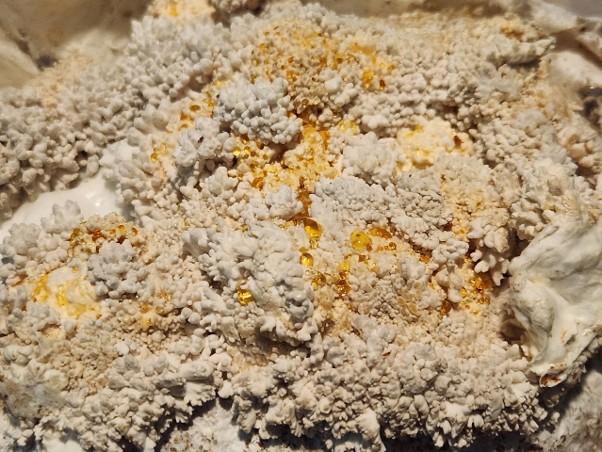
Figure 3 The fruiting body of Blue, a Blue Oyster mushroom (Pleurotus ostreatus), covered in droplets of a golden liquid called fungal exudate. Image © 2026 by Dani Dilkes is licensed under CC BY-NC-SA 4.0.
At the onset of this project, Dani was positioned in a primary care relationship with the fungi. Care consisted of frequent check-ins on the colonies, spritzing with water to maintain the humidity levels in the monotubs, and investigating and responding to the changing conditions of the tubs, including both white fuzz and blue-green mould. In establishing this care relationship, we encountered multiple points of tension with assumptions and enactments of human dominance which were challenging to overcome.
First, the conditions of growth, including the tub size, substrate materials, moisture levels, and access to light, were entirely human-dictated. By choosing to house the colonies in monotubs, we essentially created mycelial exhibitions: a space in which we could observe and control the life-cycle of the mushrooms. This reduced the agency of the mycelial colonies. Eventually, Lion, one of the four mycelial companions, escaped the monotube completely by pushing out the filters. These were some of our earliest moments of reflection on whether our approach of containing the colonies to plastic tubs was just and sound.
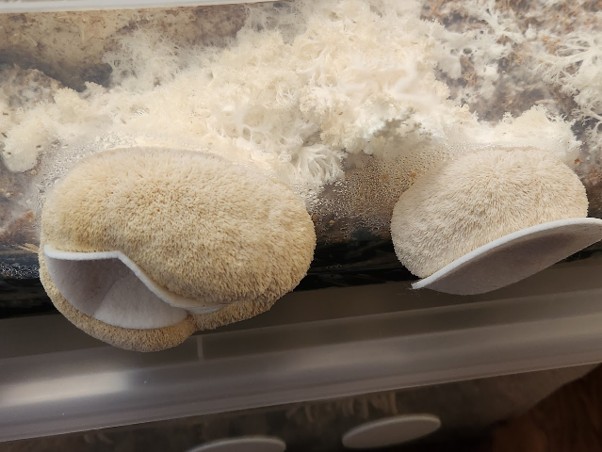
Figure 4 Lion’s fruit escaping the monotub by pushing out the filters (which have become attached to the mushroom). Image © 2026 by Dani Dilkes is licensed under CC BY-NC-SA 4.0.
Second, the fruits of the mushrooms naturally went through cycles of growth and decay. At times the colonies were also competing with other organisms within the tubs. It proved challenging to keep ideal humidity conditions within the tubs, and as a result two of the companions, Pearl and Blue, developed a greenish-blue mould called Trichoderma. Documenting these cycles highlighted for us our human discomfort with death and decay. It was tempting to omit the images that hinted at death, decay, or dis-ease. However, concealing this natural process would misrepresent the worlds we had co-constructed in this process.
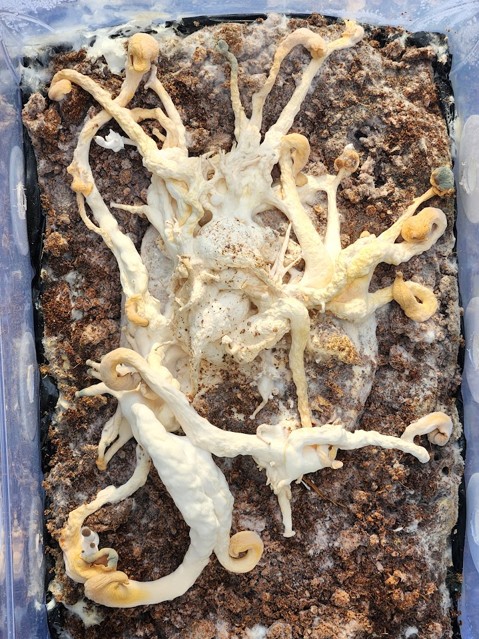
Figure 5 Pearl showing both decay and new growth while contending with a blue mould. Image © 2026 by Dani Dilkes is licensed under CC BY-NC-SA 4.0.
Third, we found it difficult to transcend our human conceptions of time and scale when tracking the growth patterns of mushrooms. Mycelial networks function below ground, invisible at the surface but performing a vital function connecting and nurturing organisms (Simard et. al., 2012). Most of our images showed primarily the fruit of the mycelium because that is what was visible to the human eye, largely obscuring the complex microscopic networks forming below the soil.
Becoming-With Mycelium
Beyond the frequent documenting and sharing of stories of the project’s companion species, each human collaborator took a different approach to their autoethnography, focusing on a unique area of inquiry; this series will offer insights into what was learned through each autoethnographic inquiry.
In the second post, Jennifer Foley (she/her), a third space academic working across librarianship, educational development, and material practice, reflects on a collaborative multispecies autoethnography project to explore how social and pedagogical relationships emerged through the process itself. Building from explorations of “becoming-with” mushrooms, the post will consider how through sharing in narratives surrounding the care of the mushrooms, collaborators related to one another and their wider communities; how expertise was shared and drawn upon; and how knowledge production emerged collectively through practices of care, observation, artistic experimentation, literature research, and informal conversation. As entangled networks of knowledge, these forms of understanding moved between participants resulting in less individualized and more reciprocal, relational, and collectively sustained learning. Drawing on more-than-human scholarship and critiques of extractive knowledge practices, the post will explore how collaborative engagement with more-than-human worlds might cultivate more caring, decentralized, and ecologically attentive approaches to academic knowledge sharing and community formation.
In the third post, Mandy Penney (she/her), a queer, cis, white, and disabled settler of primarily Irish descent, will engage in an autoethnographical exploration of the Community of Practice and Care (CoPC) model, which extends the traditional Community of Practice model to imagine and model the entwined approaches of disability justice, decolonizing pedagogies, and slow academia values and practices. In her post, she will draw on familial narratives (including Smurf hunting under mushrooms in Newfoundland with her dad) and professional ones (including this “mushy collaboration” with Jennifer, Dani, and the mushroom colonies) to map the nuances of the CoPC approach. During this narrative exploration of her pedagogical journeys across personal and professional time and space, she will explore the mycelial characteristics of binding, liminality, and decentralization, all of which are apt qualities for conceptualizing and embodying the work of resisting the hyper-productive, neoliberal, and colonial structures and strictures of higher education.
In the fourth post, Dani Dilkes (she/her) will explore sympoietic collaborations with mushrooms as the basis for reworlding educational designs. As an interdisciplinary scholar and educational developer whose academic work is focused on interrogating and changing unjust sociomaterial systems, Dani’s autoethnography focuses on exploring how mycelial wisdom can help navigate the complexities of collective access in educational spaces, particularly educational spaces shaped by neoliberal, ableist, and individualist ideals. In this framing, she has taken liberties with the ontological politics of mushrooms, understanding how mushrooms are sociobiological entities, and exploring mushrooms and mycelial networks as animated living things (both by tending to the companion species and engaging in local foraging), as cultural metaphors (by examining how mushrooms are positioned in literature, poetry, and art), and as nourishment (in culinary and medicinal settings). In this approach, mushrooms are still positioned as companion species but also recognized as multiplicity. Her hope was to engage in mycelial explorations of sympoiesis and other forms of relationality, challenging ideas of individualism and considering how systems can foster interdependence, collectivity, collaboration, and care.
Through this project and conversations with and about mushrooms, a new multi-species-social web emerged. Mushrooms, as both abstractions and embodied entities, were frequently encountered, and made increasingly visible through noticing and the sharing of stories, resources, information, and ideas with others in daily life. While our collective autoethnography has been situated in academia, as will be explored in forthcoming posts, we also recognize how this multi-species collaboration has rendered visible our entangled social connections in wider community contexts. As we move forward in our explorations through this blog series, we will extend our understanding of how humans and non-humans are inextricably stitched together (Sheldrake, 2020).
This post was curated by Multimodal Contributing Editor Dani Dilkes, , and reviewed by Contributing Editor Ritu Ghosh.
References
Alder-Rangel, A., & Rangel, D. E. N. (2025). Resilience in the Mycelial Network. Fungal Biology, 129(5), Article 101622. https://doi.org/10.1016/j.funbio.2025.101622Anderson, G.L., Desai, D., Heras, A.I., & Spreen, C.A. (2023). Creating Third Spaces of Learning for Post-Capitalism: Lessons from Educators, Artists, and Activists (1st ed.). Routledge. https://doi.org/10.4324/9781003345015brown, a.m. (2017). Emergent strategy : shaping change, changing worlds. AK Press.
Cabeen, L. (2017). Maps, Mapping and the Visual Arts. In: Brunn, S., Dodge, M. (eds) Mapping Across Academia. Springer, Dordrecht. https://doi.org/10.1007/978-94-024-1011-2_17Centre for Leadership & Diversity. (n.d.) Capitalism & Neoliberalism. Centre for Leadership & Diversity. Ontario Institute for Studies in Education. https://www.oise.utoronto.ca/cld/unleading/systems-oppression/capitalism-neoliberalismChiu, K. Y., & Gu, J. Y. (2024). Verbing with materials. In K. Y. Chiu & J. Y. Gu (Eds.), Material acts: Experimentation in architecture and design (pp. 11–14). Craft Contemporary.
Freire, P. (2000). Pedagogy of the oppressed (30th anniversary ed.). (M.B. Ramos, Trans.) Continuum. (Original work published 1970).
Gillespie, K. (2022). For multispecies autoethnography. Environment and Planning. E, Nature and Space (Print), 5(4), 2098–2111. https://doi.org/10.1177/25148486211052872Haraway, D. J. (2003). The companion species manifesto : dogs, people, and significant otherness. Prickly Paradigm Press.
Haraway, D. J. (2016). Staying with the trouble : making kin in the Chthulucene. Duke University Press. https://doi.org/10.1515/9780822373780hooks, b. (2003). Teaching community: a pedagogy of hope. Routledge.
Josi, M. (2021). Myco-collaboration for a new vernacular: a mycelium informed journey. Master of Science Nature Inspired Design. https://formation-continue.ensci.com/fileadmin/content_uploads/formation_continue/memoires_diplomes/NID/2021-NID1/miriam.josi/NID1_JOSI_memoire.pdfKapp, T. (2025). “Thinking With” the Mayfly. Ephemeral Epistemologies & Encounters: A Research Network. https://www.ephemeralnetwork.com/the-networkKaralis Noel, T., Minematsu, A., & Bosca, N. (2023). Collective Autoethnography as a Transformative Narrative Methodology. International Journal of Qualitative Methods, 22. https://doi.org/10.1177/16094069231203944 (Original work published 2023)
Kiers, E. T., Duhamel, M., Beesetty, Y., Mensah, J. A., Franken, O., Verbruggen, E., Fellbaum, C. R., Kowalchuk, G. A., Hart, M. M., Bago, A., Palmer, T. M., West, S. A., Vandenkoornhuyse, P., Jansa, J., & Bücking, H. (2011). Reciprocal Rewards Stabilize Cooperation in the Mycorrhizal Symbiosis. Science (American Association for the Advancement of Science), 333(6044), 880–882. https://doi.org/10.1126/science.1208473Kirksey, S.E. and Helmreich, S. (2010), The Emergence of Multispecies Ethnography. Cultural Anthropology, 25: 545-576. https://doi.org/10.1111/j.1548-1360.2010.01069.xLannin, R. (2023, November 27). Out of the damp and dark: The evolution of mushrooms in fiction. Strange Horizons. https://strangehorizons.com/wordpress/non-fiction/out-of-the-damp-and-dark-the-evolution-of-mushrooms-in-fiction/Liukkonen, P., Vartiainen, H., & Kokko, S. (2025). Becoming Materially Aware with Mushrooms: A Sociomaterial Analysis of Biomaking. The International Journal of Art & Design Education, 44(3), 545–560. https://doi.org/10.1111/jade.12550Ostendorf-Rodríguez, Y. (2023). Let’s become fungal! : mycelium teachings and the arts : based on conversations with Indigenous wisdom keepers, artists, curators, feminists, and mycologists (R. Gonz̀lez, Ill.). Valiz.
Piepzna-Samarasinha, L. L. (2019). Care work : dreaming disability justice. Arsenal Pulp Press.
Pinto, M. (2025, May 29). Mushroom as metaphor: The stories we tell about fungi say just as much about us. Orion Magazine. https://orionmagazine.org/article/mushroom-as-metaphor/Sheldrake, M. (2020). Entangled life : how fungi make our worlds, change our minds & shape our futures (First US edition.). Random House.
Simard, S. W., Beiler, K. J., Bingham, M. A., Deslippe, J. R., Philip, L. J., & Teste, F. P. (2012). Mycorrhizal networks: Mechanisms, ecology and modelling. Fungal Biology Reviews, 26(1), 39–60. https://doi.org/10.1016/j.fbr.2012.01.001Tsing, A. (2012). Unruly Edges: Mushrooms as Companion Species. Environmental Humanities, 1(1), 141–154. https://doi.org/10.1215/22011919-3610012 Thorpe, C., Partridge, H. The Third Space in Higher Education: A Scoping Review. High Educ Policy 39, 16–35 (2026). https://doi.org/10.1057/s41307-024-00374-zTodd, Z. (2016). An Indigenous Feminist’s Take On The Ontological Turn: “Ontology” Is Just Another Word For Colonialism. Journal of Historical Sociology, 29(1), 4–22. https://doi.org/10.1111/johs.12124van Dooren, T., Kirksey, E., & Münster, U. (2016). Multispecies Studies: Cultivating Arts of Attentiveness. Environmental Humanities, 8(1), 1–23. https://doi.org/10.1215/22011919-3527695Whitchurch, C. (2013). Reconstructing Identities in Higher education : The Rise of Third Space Professionals. Routledge.
