It was 38 degree Celsius, another day of scorching heat in Delhi in the month of June when I decided to go out and book my first order for a popular food delivery platform. It came after weeks of procrastinating to work as a delivery rider following a growing body of research on platform mediated labour where researchers worked as riders to learn about the latent work realities of the platforms (Timko & van Melik, 2021). Moments before the commencement of work, I was enjoying myself cruising on the roads of South Delhi on my rented e-bike, when my excursion was immediately interrupted by the urgency-inducing notification informing me about the imminent order. As I accepted the order, I was directed to the ‘Bikkgane Biriyani’, a cloud kitchen in South Delhi for collecting the parcel.
Mobility
I found myself embroiled in a race against time to reach on time and avoid a penalty. Cloud kitchens are the delivery-only food businesses which constitute the backbone of food delivery platforms in India. The 40km/hr speed of my vehicle was painfully inadequate in the dense traffic of Delhi roads for deftly moving across the space. I was relegated to the margins partly due to my incompetence as the first-time rider and partly due to the larger and faster vehicles which moved swiftly and aggressively annexing the available space on the roads. In this scheme my e-bike resembled a scavenger which fed on the residual space left vacant by the buses, mini trucks, cars and motorcycles. As I navigated my way through the interstices of the traffic a thin layer of dust and exhaust of gases accumulated on my face as I found myself amidst the cacophony of horns, abuses and shouts.
Once I completed the gig and got myself acquainted with the process, the corporeal aspect of the food delivery work unfolded for me. The algorithmic management is now a well-documented theme in the literature on the platform mediated gig work (Wood et al., 2019; Kadolkar, Kepes, & Subramony, 2025) but participant observation in the labour process is a potent tool for centring the experiences of the workers as they navigate the hostile urban spaces of roads, resting places and the gated societies. For me, working for the platform served as an epistemological device to arrive at the questions of how workers navigate through the spatiotemporal aspects of the labour process of the food delivery platforms. I took these questions to the workers whom I met during my stint with the platform for centring their subjective negotiation with the labour process.
Rest
There has been renewed attention to mobility in the literature characterising modernity in general (Sheller & Urry, 2006) and world of work in specific (Stevens & Shearmur, 2020). Such changes also produced methodological ramification as there is now a well-established case of using mobile methods for conducting ethnographic research (Marcus, 1995). However, the field realities of platform mediated gig work present an interesting case which is characterised by the combination of mobility interjected with the period of rests in between. PVR Anupam, a popular multiplex situated in South Delhi was one of the designated hotspots for workers to arrive and wait for the orders. Hotspots are the areas where there is greater order volumes owing to the concentrated number of restaurants and cloud kitchens. PVR Anupam emerged as one of my principal field sites because it allowed me to develop camaraderie with workers and sustain longer ethnographic engagements. Unlike many other hotspots where workers stopped only briefly before moving on to the next order, PVR Anupam offered adequate public space that encouraged longer breaks between deliveries. Workers would often spend extended periods there, resting, socialising, and discussing their experiences of platform work. These longer intervals made it possible for me to build relationships and engage in more meaningful conversations than would have been feasible at busier hotspots characterised by a faster pace of work. In this sense, the rhythms of mobility and immobility shaped the boundaries of the field itself, directing my ethnographic attention towards spaces where workers paused for relatively longer periods between their gigs. Thus, mobility (or the lack of it) dictated in marking the boundaries of the field for me.
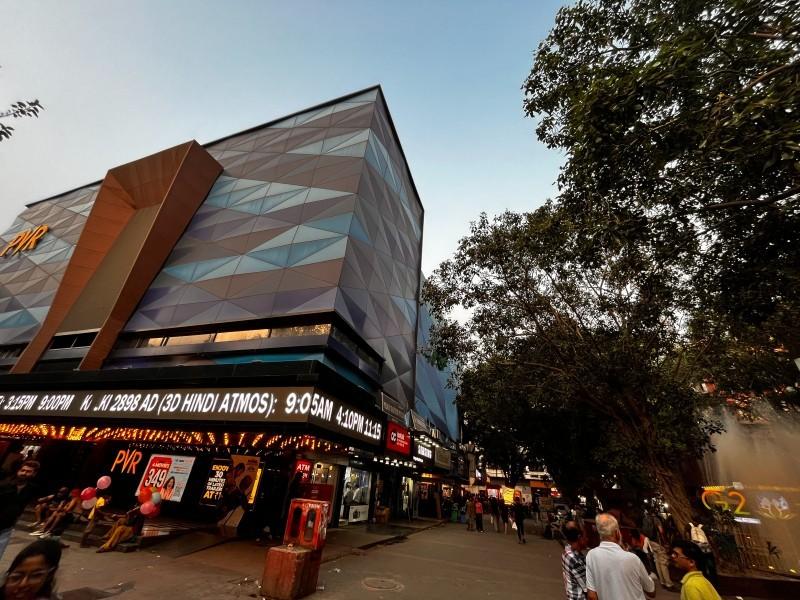
The PVR Anupam complex in Delhi, India. Photograph clicked by the author.
The relatively extended intervals of rest at PVR Anupam allowed for proper immersion in the everyday realities of the gig workers. My ethnographic engagements helped me learn the counter meanings and functions that workers often attached with the platform’s infrastructure. While platforms conceptualise hotspots only as a logistical node aimed at minimising the distance between the next available worker and the cloud kitchens or restaurants, workers end up refashioning the space as per their collective interests which emerge with the relationships they form with each other. They become the sites where workers caught their breaths between deliveries, forged friendships, and collectively navigated the ever-emerging contingencies of the labour process of the platforms. These contingencies came in the form of harassment by civic authorities, accidents and arbitrary penalties. In my ethnographic engagements, I learned that the police played a biased role in ensuring safety and security of the workers when they reported cases of thefts of their food parcels or assault by other commuters. I documented the same accusations against the municipal authorities which often seized vehicles of the workers without prior notice.
The literature on gig work has taken cognisance of the atomised nature of the labour platforms (Heiland, 2022), however what also needs to be acknowledged is that collective labour is a pertinent constituent of gig work although it remains outside the remuneration models of the platforms. Medappa (2023) calls it unseen labour of the workers who rely on each other to manage the everyday problems inherent in platform work. Ironically enough, this kind of sociality embedded in the hotspots ensure the ceaseless functioning of the labour process. Not always workers individually understood the nitty gritty of how smartphone application functioned, in such cases it their collective labour helped. While on the other hand it also engenders a possibility of nurturing embryonic solidarities amongst workers as my interlocutors informed me about the cases of organising strikes against the platforms even though such cases remain localised and rare. I documented a case when Ambience mall in Vasant Kunj area was not offering parking to the workers which increased their order fetching time without corresponding increasing in their earnings. The case resulted in the spontaneous protest by the workers and the mall authorities gave in. Thus, the period of rests between work allowed me to document the contradictory realities of platform’s infrastructural spaces which are characterised by their pertinent role of ensuring circulation of labour and at the same time aiding the workers in resisting the algorithm.
Ephemerality
The labour process of the food delivery platforms is also characterised with constantly changing templates of how work is organised. The workers not only find themselves chasing the targets set by the incentive conditions but they also lag behind in making sense of the ever renewing controls of platforms. I witnessed my interlocutors constantly finding themselves unable to navigate the ever-changing interface of the mobile application and how the novel incentive structures were going to affect their next day’s earnings. From the ethnographic perspective, it unfolded a methodological and political conundrum for me. Anthropologists have a long established tradition of revisiting their fields for documenting short term and long-term changes but gig work introduces a distinct dimension to the field, i.e the extraordinary pace of change in the work organisation. While I was in the process of documenting the work templates, they would transform with the next update. The field was ephemeral, perhaps more than others. However, the pace of change comes with its own politics. As Bear (2016) suggests, paying attention to the temporal organisations through anthropological engagements can be helpful in learning the hidden forms of inequalities. One of my interlocutors Yatendra had been working for food delivery platforms for over five years. He could recall when he started working for the platforms, he earned anywhere between Rs. 35,000 to Rs. 40, 000 on the monthly basis, even though it meant working for 15 hours a day. Over the years his daily working hours had not come down but now he lived on the meagre earning which hovered around Rs. 25,000 a month. Elated by the initial optimism with his earnings Yatendra had admitted his 4 years old son in an English medium school, which he told me with a tinge of pride followed with disappointment of not making it enough anymore. Not everyone shared the nostalgia of Yatendra, primarily the newer workers who had no memory of platforms paying Rs. 40,000 a month. They possessed no stable past to measure their present condition. With a labour process in perpetual transition, the template of work do not exist long enough for workers to compare and contest against the platforms and workers are left with little room for manoeuvres. I bypassed this institutional forgetting embedded in the labour process of the platforms by unearthing the pasts only thriving in the memories of the experienced workers like Yatendra. They found themselves going downhill even after years of chasing the incentive conditions which eventually lead to a vicious spiral of ever-increasing working hours and ever dwindling earnings.
Taken together, the aspects of mobility, rest, and ephemerality reveal platform-mediated food delivery work as a labour process organised through the management of movement, time, and uncertainty. The mobility is punctuated by moments of rest in hotspots that workers appropriate as spaces of sociability, mutual aid, and, occasionally, collective resistance. These counter-spaces expose the limits of the platform’s imperative to atomise labour as workers engage in collective labour to transcend the everyday contingencies of the labour process. In this context, my fieldwork experiences reinforce the findings of Pinheiro-Machedo (2025) to underscore the role of digital technologies in atomising the informal workers, but at the same time depart in showing that workers can often build the novel forms of collectivisation not anticipated by the platforms. Thus, platforms are by design embedded with institutional forgetting which undermines workers’ capacity to stabilise expectations about earnings and conditions of work. Constant change functions not merely as a technical feature but as a mode of labour control that fragments memory, individualises risk, and compels workers to continually chase an elusive promise of better earnings. Attending ethnographically to these contradictions illuminates the everyday politics through which platform workers endure, negotiate, and occasionally contest the conditions of algorithmic capitalism.
This post was curated by Contributing Editor Misria Shaik Ali and reviewed by Contributing Editor Victor Secco.
References
Bear, L. (2016). Afterword: For a new materialist analytics of time. The Cambridge Journal of Anthropology, 34(1), 125-129.
Kadolkar, I., Kepes, S., & Subramony, M. (2025). Algorithmic management in the gig economy: A systematic review and research integration. Journal of Organizational Behavior, 46(7), 1057-1080.
Marcus, G. E. (1995). Ethnography in/of the world system: The emergence of multi-sited ethnography. Annual Review of Anthropology, 24(1), 95-117.
Medappa, K. (2023). Rethinking mutual aid through the lens of social reproduction: How platform drivers ride out work and life in Bengaluru, India. Journal of South Asian Development, 18(3), 383-408.
Heiland, H. (2022). New forms of agency or atomization? Platform workers’ power resources and fragmentation. In Platform Labour and Global Logistics A Research Companion (1st ed., pp. 132–150). essay, Routledge.
Pinheiro-Machado, R. (2025). Rage, dreams, and insubordination: how the far right and digital media mobilize the new platform-based working class. Horizontes Antropológicos, (73).
Sheller, M., & Urry, J. (2006). The new mobilities paradigm. Environment and Planning A, 38(2), 207-226.
Stevens, L., & Shearmur, R. G. (2020). The end of location theory? Some implications of micro-work, work trajectories and gig-work for conceptualizing the urban space economy. Geoforum, 111, 155-164.
Timko, P., & van Melik, R. (2021). Being a Deliveroo rider: Practices of platform labor in Nijmegen and Berlin. Journal of Contemporary Ethnography, 50(4), 479–503.
Wood, A. J., Graham, M., Lehdonvirta, V., & Hjorth, I. (2019). Good gig, bad gig: autonomy and algorithmic control in the global gig economy. Work, Employment and Society, 33(1), 56-75.
