Elliðaey Island, in the Vestmannaeyjar archipelago off the coast of Iceland, hosts one of the world’s largest populations of Leach’s storm-petrels (Hydrobates leucorhous), a small seabird species. Nearly 90% of the individuals breeding in Iceland nest there, yet knowledge about this species, listed as globally vulnerable on The International Union for Conservation of Nature’s Red List since 2016, remains largely limited (Hurling, 2021).
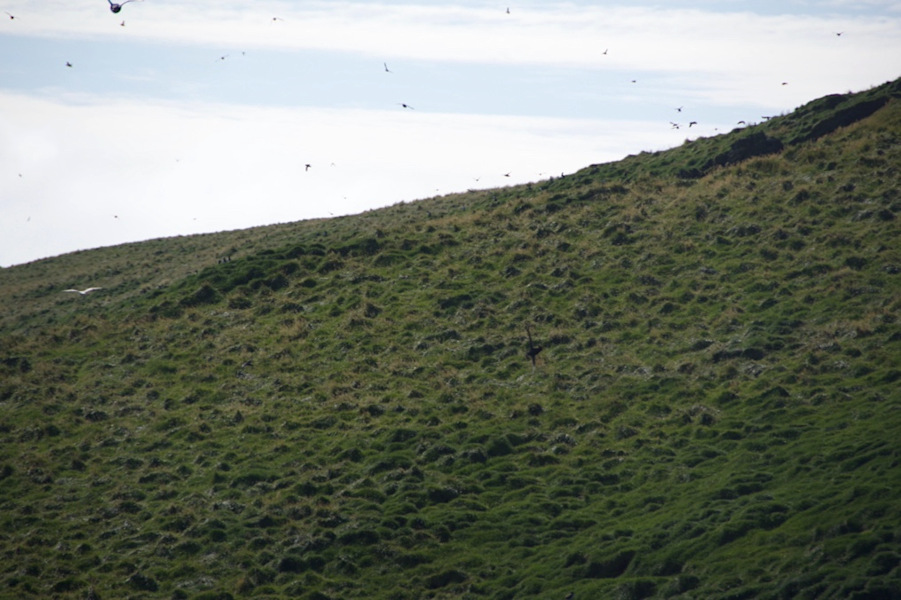
The Elliðaey colony. Photo by the author.
Since 2021, two doctoral projects have focused on the monitoring of this population. The first is led by Stephen Hurling, who aims to conduct the first scientific national census of the species using an innovative sound-based methodology to estimate population sizes. These petrels are difficult to study because they nest in burrows and rock crevices on a remote island bordered by steep cliffs, and are nocturnal, which limits their exposure to predators and other dangers – human and non-human alike. To count them, Hurling relies on recorded playback calls across the colony, eliciting responses from birds hidden underground. While imperfect, this method is relatively inexpensive and far less invasive than more traditional capture techniques used in ornithology (Oppel et al., 2014; Armistead and Sullivan, 2015). The second PhD project is mine. Or rather, it used to. As a geographer of science, I was interested in how marine ornithologists choose the colonies they study: why go there rather than elsewhere?
While following Stephen Hurling’s work on Elliðaey Island, that question gradually gave way to another, as I understood that what mattered to him was not accessing the colony once, but returning year after year to collect data. Bird colonies become scientific field sites because researchers return to them, year after year, sometimes for decades. The question was therefore not only how a field site is chosen and accessed, but also – and perhaps more importantly – how researchers can stay at that field site and return. Returning to the field is essential for sustaining long-term ecological monitoring, revealing deeper environmental trends, and building scientific careers. Yet the production of long-term data rests upon a fragile constellation of uncertain trajectories that must be intertwined, year after year, despite changing circumstances.
Long-Term Commitments in the Field
This question is not unfamiliar to anthropology or geography either. Disciplinary narratives have long celebrated figures of researchers who spend years in the field, learn local languages, build lasting relationships, and return repeatedly to observe both continuity and change within a community or place. Ornithologists operate according to a similar logic, returning to colonies over long periods to identify demographic trends and document the effects of climate change. Some of the most emblematic monitoring programmes in ornithology rely on precisely this kind of fidelity to field sites.
In an essay published in Nature, ornithologist Tim Birkhead (2014) reflects on his personal commitment throughout his decades-long career to return to the colony of Skomer in order to document the decline of another seabird, the common guillemot (Uria aalge), in the context of climate change. Yet after forty years of support from the Countryside Council for Wales, another institution, Natural Resource Wales, decided to terminate the funding for this monitoring in 2013. The population of Skomer’s guillemot had been monitored since the early 1970s in a context where the number of pairs had already decreased from about 100,000 in the 1930s to just 2,000. Birkhead and colleagues had shown the role of climate change in this decline and documented the role of extreme events, such as storms and oil spills. And yet, as he complains, “there is a feeling out there that conservation and monitoring is low-quality science and should be cheap; there is also a feeling that monitoring does not matter”. Indeed, ecology unfolds over the long term, accelerating under global warming and mass species extinction – which does not align with traditional funding schemes in science, renewing every three to five years. Yet, bird populations can only be understood through series of observations accumulated over years, sometimes decades. A single count reveals very little. It is through repeated comparison that decline becomes visible – ecological data are therefore products of persistence, of returning to collect observations again and again over time.
Bird colonies and other ecological sites are themselves embedded in multi-generational temporalities. Thom van Dooren (2014) beautifully captures the collective and resilient labour of generations of albatrosses on Midway Atoll, traveling back and forth between ocean and colony, year after year, and enduring countless dangers in the ongoing work of species survival. He writes, “We often do not appreciate – and perhaps we cannot truly grasp – the immensity of this intergenerational work: the skill, commitment, cooperation, and hard work, alongside serendipity, that are required in each generation to carry the species through” (van Dooren, 2014, 27).
Similarly, fieldwork never simply happens; the effort required to return to a site year after year should not be underestimated. Field sites are negotiated spaces, continually maintained through the work of researchers collecting data on places inhabited and negotiated by others (Raby, 2017; Shih, 2019)[1]. They are also places of collective commitment: seabirds returning to sustain their species, researchers returning to document those populations. And since 2021, there is also me, an ethnographer documenting how birds and researchers participate together in this collective endeavor.
Fragile Interweavings on Elliðaey
On Elliðaey, Hurling is the first researcher to commit to producing data on Leach’s storm-petrels, but his commitment is itself the outcome of collective work. He was introduced to the island by Erpur Snær Hansen, an ornithologist based in Vestmannaeyjar who has spent decades documenting the decline of Iceland’s seabirds. Before Hurling’s playback call survey, Hansen had experimented with a counting method based on a camera attached to the end of a pipe, allowing him to explore the depths of burrows without being seen by the birds. It was through Hansen that I met Hurling, who, in turn, opened the doors of his work on Elliðaey to me – and I myself had come to know Hansen through a succession of encounters over the course of my PhD. As a committed geographer, I needed a field site of my own: a space I could appropriate, return to, accumulate observations in, build relationships around, and develop expertise about. Like the ornithologists I studied, I depended on a chain of encounters, introductions, and collaborations that enabled me to access this place and turn Elliðaey into a “field site.” My access – and indeed Hurling’s own access – was therefore conditioned by arrangements that had already been negotiated by others over many years.
I first travelled to Vestmannaeyjar in June 2024, where I followed Hansen’s work monitoring Atlantic puffin (Fratercula arctica) populations across Iceland. I returned that August to observe Stephen Hurling and his field assistants on Elliðaey, but poor weather allowed us to access the colony for only a single day – not ideal for me, but a rather ordinary situation for ornithologists. At the time, I assumed this would be my final period of fieldwork. My thesis was due the following year, and I expected to spend most of that time confined to my office, writing. Instead, I had the opportunity to return in August 2025, for a third visit to the Vestmann Islands and less than a month before the end of my doctoral contract. I was no longer focused on gathering new material, and instead, I found myself paying attention to what I already knew, to what had remained unchanged. As in the previous year, the weather was poor, and we could only spend a day on Elliðaey. We spent that day walking across the colony and playing calls to identify occupied burrows and locate individuals that Hurling could equip with geolocators [2]. These tracking devices would allow him to reconstruct the migratory trajectories of storm-petrels – provided that he could recapture the birds the following year. Looking for a bird, therefore, meant projecting oneself into the future: if I find a bird, capture it, and attach a device to it, I will have to return next year to recover it; otherwise, no data will be produced. It is also a bet on the future: a bet that the bird will return, that the device will remain attached and functional, and that conditions will allow the researcher to return to the island at the same time the bird is back in its burrow.
That day, none of the birds equipped the previous year responded to our calls. At this point, Hurling’s fieldwork did not seem much more productive than my own. The burrows where a bird fitted with a tracking device might be found remained frustratingly silent, and by late afternoon, we were already contemplating leaving empty-handed, hoping that our next visit would be more successful. Instead, the weather deteriorated more rapidly than expected, forcing us to spend the night on the island. The next morning, more out of diligence than genuine expectation, Hurling suggested one final attempt: revisiting a burrow where a bird might have returned overnight. After a moment of suspense, a bird responded to the playback call broadcast above its nest. More unexpectedly, it was carrying a device. At the last moment, then, the field trip had not been in vain. It had not been in vain for Hurling because the bird had returned at the same time as he had. Nor had it been in vain for me, because the bird and Hurling happened to be there at the same time as I was.
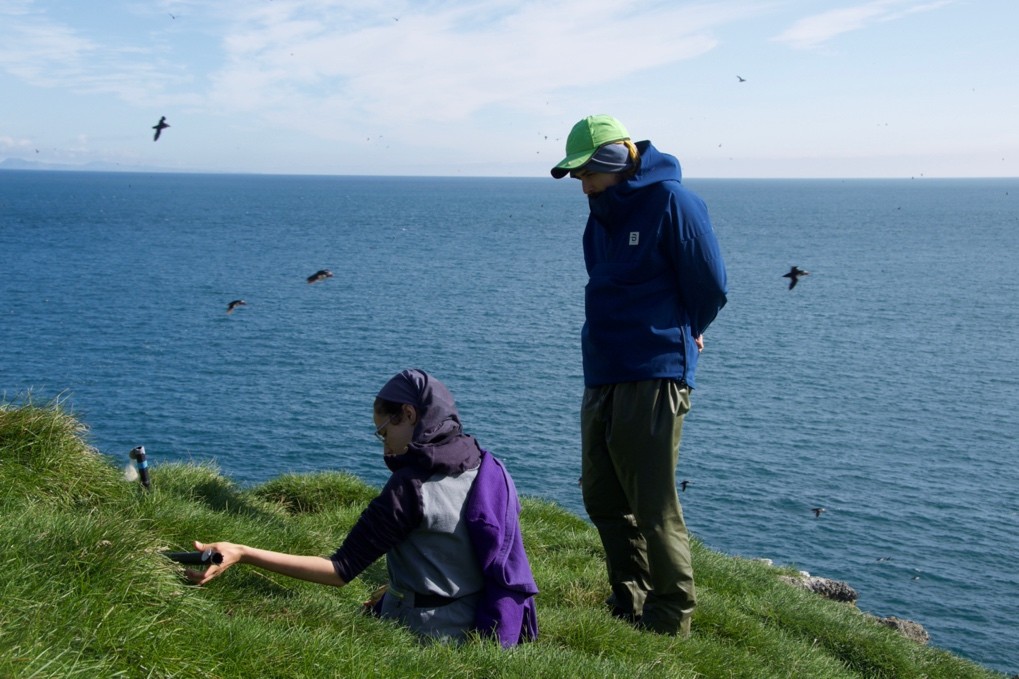
Field assistants preparing to inspect a storm-petrel burrow. Photo by the author.
Conclusion: Fragilities, Uncertainties, Continuities
This anecdote reveals the fragility of the encounter between Hurling, the bird, the tracking device, and me. From that encounter, two different forms of scientific data would emerge: the migratory trajectory of a Leach’s storm-petrel during the winter period up to its return to the nest, and an ethnographic account revealing the fragility of data that is nonetheless crucial for the conservation of the species. Many circumstances could have prevented this data from being collected by Hurling: the device might have detached during the winter, or the bird might have died, or it might simply have remained at sea during the ornithologist’s visit. Or the ornithologist himself might not have returned.
Throughout the summer, Hurling identifies new birds to equip and deploys additional tracking devices in the hope of recovering them the following year. Yet his doctoral funding is due to end at the close of the year, and he has no material guarantee that he will be able to return to Elliðaey. Alongside analyzing the data already collected, he therefore plans to spend the winter applying for new funding opportunities. My own PhD was also coming to an end, and with it my fieldwork. I knew that I would soon move to another country to begin a new research contract, one focused on a different topic and perhaps a different field site. Yet, as this essay itself demonstrates, I also knew that I wanted to come back.
There is, therefore, considerable uncertainty behind the production of ecological data. In the case of long-term data, which underpin much of our knowledge about climate change, the challenge is to produce reliable, continuous, and stable observations even as the funding, careers, and trajectories of both researchers and the beings they study remain fragile and precarious. Ecological monitoring often appears as a continuous series of data points. In reality, it rests upon a fragile succession of interweavings: coordinated encounters of movements between seabirds and researchers, which rely on birds returning to their colonies, researchers returning to their field sites, and short-term funding streams that make these interweavings possible. In the context of wide funding cuts for monitoring worldwide[3] and accelerating global warming that strongly impacts wildlife[4], long-term ecological studies have perhaps never been more fragile, uncertain – and necessary.
This post was curated by Contributing Editor Samiksha Bhan and reviewed by Multimedia Contributing Editor Christine Kim.
Notes
[1] In many cases, this has come at the cost of expropriations and other forms of land and territorial appropriations in the name of science. My case study did not highlight such dynamics, even though they are very much present and often overlooked in my contexts of field science. The work of Megan Raby and the article by Ashanti Shih are important resources in this regard.
[2] Geolocators, or Global Location Sensors (GLS), are tracking devices that can be attached to birds and other animals to know about their migrations across vast distances. Indeed, they weigh only a gram and use sunlight to determine locations, and so have an autonomy of up to a few years. Importantly, they need to be recovered to provide data, as they are not remotely downloadable. Due to their advantageous weight, size, and price, they are widely used in marine ornithology and movement ecology.
[3] In May 2026, the Global Ocean Observing System, monitoring oceanic health worldwide had, for instance, almost its funding cut despite its critical contribution in documenting the evolution of oceanic systems (Trenberth, 2026; Zhu et al., 2026).
[4] Marine heatwaves, and the heatwave that hit Western Europe in June 2026 have proven to be catastrophic for marine wildlife and bird populations, and should only intensify (Reporterre, 2026; Sojitra et al., 2026).
References
Armistead, G.L. and Sullivan, B.L. 2015. Better Birding: Tips, Tools, and Concepts for the Field, Better Birding. Princeton University Press.
Birkhead, Tim. 2014. “Stormy outlook for long-term ecology studies”. Nature 514(7523): 405–405.
van Dooren, Thom. 2014. Flight Ways: Life and Loss at the Edge of Extinction. New York: Columbia University Press, p. 208 Pages.
Hurling, Stephen. 2021. “Conducting a National Census of Iceland’s Nocturnal Seabirds”. Seabird Grant Report [Preprint].
Oppel, Steffen. et al. 2014. “Estimating population size of a nocturnal burrow-nesting seabird using acoustic monitoring and habitat mapping”Nature Conservation (7): 1–13.
Raby, Megan. 2017. American Tropics. The Caribbean Roots of Biodiversity Science. Chapel Hill, NC: The University of North Carolina Press.
Reporterre. 2026. « Je craque » : le désarroi des soignants face à l’afflux d’animaux sonnés par la chaleur, Reporterre, le média de l’écologie – Indépendant et en accès libre. https://reporterre.net/Je-craque-le-desarroi-des-soignants-face-a-l-afflux-d-animaux-sonnes-par-la-chaleur (Accessed: 29 June 2026).
Shih, Ashanti. 2019 “The most perfect natural laboratory in the world: Making and knowing Hawaii National Park” History of Science 57(4): 493–517.
Sojitra, Milan. et al. 2026. “Extreme weather effects on marine predator breeding outcomes in a global climate change hotspot” Science Advances 12(25) eaea3220.
Trenberth, Kevin. 2026. “The network watching the world’s oceans is under pressure – just when it’s needed most” The Conversation. https://doi.org/10.64628/AA.wquntpndm.Zhu, Yujing. et al. 2026. “Critical dependence of global ocean heat monitoring on the ocean observing system” Nature Climate Change 16(6): 657–660.
