This piece is one branch of Becoming-With, a multispecies collective autoethnographic project developed with Dani Dilkes, Mandy Penney, and our four mushroom companions (Lion, Pearl, Blue, Pink); from here forward known as the Mushy Collective. Together, we explore what it means to “become-with” mushrooms by thinking through mycelial structures while cultivating fungi and imagining more generative futures for academic spaces. Within this project, my post will explore my personal journey reconsidering resource sharing, writing, care work, and decentralized collaboration through fungal logics. I will turn attention toward the hidden infrastructures that sustain the academy while often remaining undervalued.
Knowledge in this project did not emerge linearly, but rather flowed between and through humans, fungi, digital spaces, material practice, memories, conversations, and revisitations; therefore, this post shares one path through my autoethnographic journey in a way that allows multiple contexts to engage and exist simultaneously. As such, this post may be considered as an output, as a visible fruit of my labour to share with you, but is by no means a finished product.
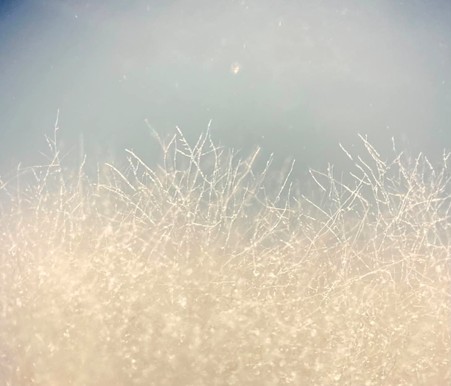
Microscope camera image of alternataria solani mycelial network. Image © 2026 by Zach Hoegy used with permission.
Reconceptualizing Networks
The experience of growing with mushrooms through autoethnographic research and collective mushroom care helped me recognize that slower periods of creation are not failures: that our human desires for success and production are imposed constructs that often ignore natural signals for rest, change of environment, or need for care and resources. Relational work matters too and is needed to produce output. Through intentional time and effort observing the growth of the mushrooms (Pearl, Lion, Blue, and Pink); by looking both above and beneath the surface of soil, the way I thought about “networking” changed. The term “networking” never sat comfortably with me, as it felt transactional to represent the process of gaining connections for future advantage. The reciprocal care relationships that sustain natural networks seem to disappear. I do not seek to romanticize every natural process of mushrooms and try to ascribe some kind of higher meaning to every way fungi act, but I am intrigued by the decentralized way signals and resources move in fungal networks. Mycelial networks do not function through top-down control. They instead spread horizontally, forming dense, interconnected webs that support entire ecosystems (Simard, 2012). When reading about mushroom growth behaviour and the physiological structures of fungi, I was drawn to the relational ways fungi move, share, bind, and branch. I found myself yearning for networks of my own that were grounded in curiosity and care. For spaces where ideas would be exchanged for learning rather than extraction of data or prestige. I explored these thoughts through informal writing, art, and then branched enthusiastically and organically into conversation with colleagues surrounding mushrooms in popular culture, teaching, and community. These exchanges eventually grew into our Mushy Collective research group where my understanding of my place in higher education and what contribution in a knowledge ecosystem can look like.
Fruiting Bodies and Hidden Networks
Why do we value the fruit of the mushroom and ignore the roots? Is this because the body offers us something to consume, something that nourishes and sustains us, something we can collect, and profit from? A tangible product. Is this too why current educational models are structured to value visible research outputs while overlooking the infrastructures that sustain them?
In one of the Mushy Collective team meetings, my co-researcher, Dani, shared images of the mushroom companions within their monotubs covered in a white fuzz. We wondered if this was part of the mushroom — the mycelial network we had been hoping to see — or another plant emerging. Mandy quickly identified that a cobweb mold had taken hold, and Dani read that hydrogen peroxide could be used to remove it from our mushroom companions. We shared in conversation about whether we should intervene. To deliberately remove the mold felt at once like we were protecting the mushroom companions from harm, but also like an imposition of control by methodically controlling the environment to exclude another organism we deemed unwelcome, representing an act of destruction and exclusion simply because another organism was competition for our preferred species. However, if we were entangled with the more-than-human in relationships that extended beyond consumption, why did we get to decide what type of organism lived or died?
This experience highlighted how deeply our sense of care was entangled with the mushroom companions. We were not growing them for consumption or profit, yet we still wanted visible signs of thriving, as if their success could confirm that we had cared for them well. Over the course of the research project, we also came to question the viability of housing the mushrooms in monotubs, as they were clearly not thriving in the controlled environment we had created. Once Spring emerged and Dani transplanted the mushrooms outdoors, I felt a sense of relief as they were returned to their natural environment. I longed to see the beautiful, webbed root structures of their mycelium through the clear plastic of the monotub, but felt a growing discomfort with the frequent interventions required to control their environment purely for our research goals. Conversations such as this — that were seemingly solely related to growing mushrooms — prompted us to discuss and question the neoliberal environmental pressure of uninterrupted, optimized workflow. Being in the role of cultivator prompted us to consider the tenuous balance between care and control, and ultimately to interrogate and reject the extractive data gathering of our observation method. When Lion pushed out its filters due to lack of space and ideal conditions, what was initially interpreted as a failure prompted a pause and reinterpretation to read this behavior as the organism setting a physiological boundary expressing a need for change whether it aligned with our research plans or not. The project changed out of respect for this boundary, directly challenging our desire to control the monotub environment for observation, writing, and publishing. By continuing to look to the mushroom companions as guides, I have reconsidered what nourishment, environmental changes, care, and resource sharing I might need to sustain myself and others in my work.
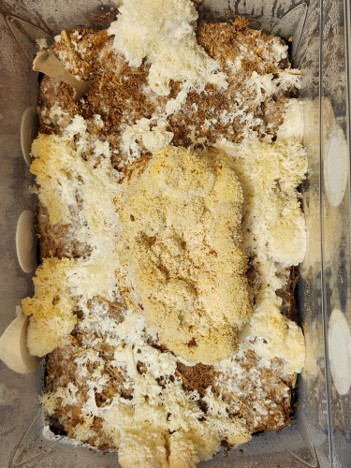
Figure 1. Lion, a Lion’s Mane mushroom (Hericium erinaceus) in the monotub environment. Image © 2026 by Dani Dilkes is licensed under CC BY-NC-SA 4.0.
Hyphae Crossing Borders
How does knowledge move between communities that institutional structures separate?
As a self-described third-space academic, I am acutely aware of institutional hierarchies in academia where certain disciplines, credentials, and roles are valued over others. Drawing on Whitchurch’s conceptualization, the third space for me refers to the spaces that exist between academic and professional domains, where the boundaries of traditional roles become permeable, and expertise converge through collaborative, cross-boundary work (2013). As an educational developer, I occupy this third space, working across institutional boundaries of staff and faculty to support teaching, learning, and the co-creation of knowledge. The fungal nature of my role usually allows me to exist as a resource connector and facilitator of growth and learning in academia.
Venturing into this research project exploring mushroom cultivation, I found myself more frequently describing the project to friends and colleagues by emphasizing what I was not doing rather than what I was doing. This became apparent to me as I hesitantly described the “Becoming with Mushrooms” project and writing to my friend, Z, a fungal scientist. I was sure to stress that although the project explored mushrooms and mycelial networks, my co-authors and I had no intention of positioning ourselves as mycologists or making claims of scientific authority. I emphasized that we sought to explore elements of the cultivation process for meaning making to imagine academia through relational networks of resource sharing, rather than rigid, hierarchical silos of knowledge production. Yet the conversation unfolded differently than expected. My friend met the project with curiosity and openness, sharing that his own research involved mapping fungal networks.
My encounter with Z reminded me of a fungal behaviour known as anastomosis: the process by which hyphae fuse, pooling resources, and exchanging information (Giovannetti, 2001). In academia, disciplinary silos and invisible hierarchies often block such exchanges, yet when those boundaries are crossed, knowledge circulates in more generative ways. In my role as an educational developer, I often act as a kind of hyphae — the long, branching, tubular filaments of the mycelium — within the academy by crossing disciplinary and positional boundaries in the university to facilitate connections and conversations that might not otherwise occur. Research, knowledge translation, teaching, and conversations both in and out of academic settings can all be places where complex and diverse relational webs can form. These relational encounters allow subversion of and resistance to some of the formal structures of information sharing and collaboration in ways that were mutually nourishing.
Fungal Writing
What does it mean to write “mycelially”?
As our project evolved, writing itself became part of the inquiry for the Mushy Collaborative. Our co-written blog post emerged through a process that mirrored fungal networks as it was decentralized, iterative, and relational. We worked across spaces and times by sometimes sitting together to write or meeting online, other times contributing asynchronously through shared document comments and Teams conversations. There was no single project lead; instead, we moved in and out of roles, contributing according to capacity and energy.
While learning to cultivate mushrooms and to write in academia, I have become more comfortable sitting with my own cycles of flourishing and rest. As exciting as periods of intense productivity can be (in my work, art, or writing), I now try not to expect them as a baseline. When our Mushy Collective chose not to pursue publication of an earlier chapter proposal, I mourned another “almost” publication. Another foiled chance to reach out a tendril of my own work and voice into the academic publishing world. But through conversations with Dani and Mandy, and consideration of the ways the mushroom companions thrived, I came to see the decision differently: we were choosing to grow in another direction aligned with our shared values of open knowledge sharing and collaboration. We mimicked the path of our mushroom companions when they were transplanted out of the monotubs to a better environmental fit at the base of a tree in Dani’s backyard. For us, this meant moving to a publication format and space that better fit how and what we wanted to share of our research journey.
This research and writing experience reframed the way I think about academic writing and publication. As ideas flowed through meetings, instant message conversations, annotations, and material exchanges of articles, books, art, blog posts, and photos, writing became less about producing a final product and more about sustaining an ongoing exchange with each other. Sharing in and learning from each other created pieces of writing that documented our experiences alongside the mushrooms. I found space to develop confidence in my voice and contribute in ways that felt supported. Rather than discarding an earlier draft we had written together, we broke it apart, reworked it, and recomposed it into something new. The original text was not lost; it was mulched and reconstituted. Just as the mushroom companions grew in a mulched soil mixture (or substrate) in the monotub, we too nurtured our collective writing project with the detritus of our past work. By writing in this way, we deliberately challenged pressures to “publish or perish” by taking additional time and care to redistribute power through an emphasis on collaboration, co-creation, and shared ownership of our research.
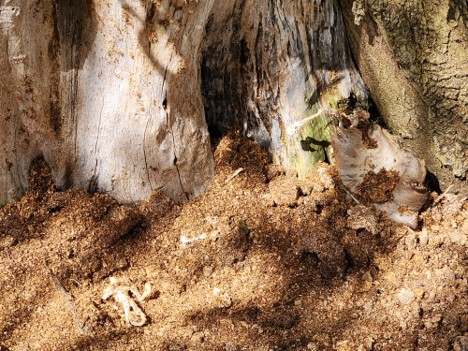
Figure 2. Transplanted mushroom Pearl, the Black Pearl Oyster mushroom (Pleurotus ostreatus hybrid) outside the base of a tree among scattered substrate. Image © 2026 by Dani Dilkes is licensed under CC BY-NC-SA 4.0.
Sending Out Signals: This Node, Among Others
The experience of becoming with mushrooms and being a part of the Mushy Collective changed how I understand and engage with knowledge production. Knowledge is not a finite product waiting to be harvested for display or consumption. It is a conversation, a process, and an exchange that moves relationally. It circulates through conversations, annotations, mentorship, shared documents, failed drafts, and moments of mutual curiosity. It requires care to meaningfully move between people and communities, and in that movement, it is continually translated, reshaped, and nourished by acts of context and care.
This post is one visible fruiting body of that process. Alongside it, in corners of the internet, shared documents, marked-up journal articles, exchanges with colleagues, and memories that will never appear in a citation list, my mycelial network of knowledge sharing exists. Rather than a finished product, this post is one branch in an ongoing process of becoming-with mushrooms in a much larger network of learning and transformation that continues to grow, share, and spread in infinite, entangled webs. This post is an invitation to notice the hidden networks that sustain both our work and your own: to value the relationships that nourish knowledge, and to imagine an academy where care, reciprocity, and collaboration are not merely invisible labour beneath the surface, but essential conditions for growth. This ongoing journey of connection, translation, decomposition, and re-composition that exists within a continually emerging collaborative multispecies autoethnography will be carried further by the voices of my co-researchers in forthcoming branches of this blog series.
This post was curated by Multimodal Contributing Editor Dani Dilkes and reviewed by Contributing Editor Melina Campos.
Works Cited
Giovannetti, M., Fortuna, P., Citernesi, A.S., Morini, S. and Nuti, M.P. (2001), The occurrence of anastomosis formation and nuclear exchange in intact arbuscular mycorrhizal networks. New Phytologist, 151: 717-724. https://doi.org/10.1046/j.0028-646x.2001.00216.x
Simard, S. W., Beiler, K. J., Bingham, M. A., Deslippe, J. R., Philip, L. J., & Teste, F. P. (2012). Mycorrhizal networks: Mechanisms, ecology and modelling. Fungal Biology Reviews, 26(1), 39–60. https://doi.org/10.1016/j.fbr.2012.01.001
Thorpe, C., Partridge, H. The Third Space in Higher Education: A Scoping Review. High Educ Policy 39, 16–35 (2026). https://doi.org/10.1057/s41307-024-00374-z
