Imagine that every time you poop, your hygiene routine involves depositing your used toilet paper into a toilet-side receptacle. As you wash your hands, the device mixes, processes, and extracts microbial DNA from your stool. It sequences the microbial DNA for a real-time readout of your microbiome (the microbial genomes from within your gut, or at least the ones that made it to your stool), automatically sending the information to a large-scale microbiome database that integrates it into its data, algorithms, and analytic programs. The program connects to an app on your phone, telling you that based on your personal version of a healthy microbiome, today your microbiome is looking a little low in the bacterial species Akkermansia municiphila and high in some risky metabolites (the molecular outputs of some of your gut microbes). It recommends that you eat extra polyphenol- and fiber-rich foods today, and asks if you want a recipe for a berry- and seed-laden oatmeal for breakfast.
The vision I describe here is a technoscientific imaginary: a shared vision of a future, mediated by science and technology (Marcus 1995). Technoscientific imaginaries are always embedded in historic and cultural contexts and narratives, which shape what future visions we find possible, desirable, and relevant. In this post, I examine how this technoscientific imaginary draws on narratives about promise and precision medicine inherited from genomics, as well as newer ones based in new understandings of the human microbiome and its powerful associations with many aspects of human health.
While I have taken some speculative license with the app function (a method inspired by Benjamin 2016), the above vignette is not too far outside a future envisioned by some microbiome scientists and companies, especially in biotech spaces where they pitch novel products, methods, and technologies.[1] Specifically, this describes a possible future vision behind a product called GutLab™ by a biotechnology startup called BiomeSense—though other “smart bathroom” technologies and stool-tracking apps are in the works (Raffaetà and Ferrari 2025).
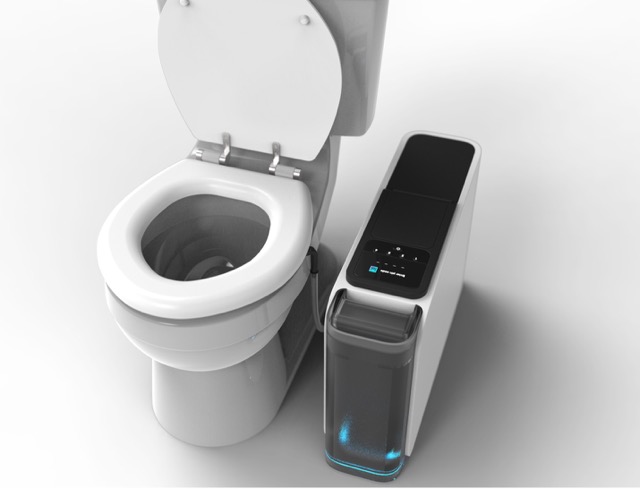
A rendering of GutLab™, one of several emerging technologies aiming to enable continuous, at-home microbiome monitoring. Photo reproduced with permissions from BiomeSense, Inc.
At the 10th Annual Translational Microbiome Conference held in Boston in 2025, Kevin Honaker, BiomeSense’s CEO and co-founder, gave a talk pitching the “gap” that GutLab™ was poised to fill. He explained that it reduced the cost of sample collection and was user-friendly, solving a major non-compliance problem with potential stool donors who are just too grossed out to follow through with collection (60% of the time, by some measures). But the majority of the talk focused on a different problem: that getting enough gut microbiome data—derived from stool samples—for high-quality analysis was a major hurdle for microbiome science. In this sense, the vision that Honaker described was less about GutLab™ as a standalone product than as one part of a larger vision of an “end-to-end platform.” In that vision, GutLab™ generates Big (Microbiome) Data that can then be analyzed at scale by MetaBiome, their AI-powered microbiome platform, “resulting in stronger research, better discovery, and ultimately new microbiome-based health innovation,” according to Honaker.
Genomics and the Rise of the Microbiome
The human microbiome rose to scientific prominence in the mid-2000s and early 2010s. By the turn of the millennium, large-scale genome sequencing projects like the Human Genome Project had created entire scientific infrastructures: dedicated gene sequencing centers, databases and data-sharing norms, protocols, and new fields and professions such as bioinformatics, which arose to analyze the unprecedented volume of biological data that sequencing projects produced (Kevles 1997; García-Sancho 2011). In many a fundraising and hype-mongering moment, the Human Genome Project and others like it promised to decode the book of life and find cures for countless diseases (Kay 1999; Fortun 2001, 2008). Instead, the primary takeaway was ultimately a new understanding of the immense complexity of genetics (Fox Keller 2000).
Consequently, as the “postgenomic era” emerged in the early 2000s, it was with a focus on genes and environment. It was in this moment that the idea of the microbiome emerged, promising postgenomic insights into the environmental factors that shape genetic expression. At the same time, the microbiome was itself a genomic endeavor. Also called the “second human genome” or the “human metagenome,” the microbiome characterized the combined microbial genomes within the human body; indeed, the “ome” in microbiome is in part a reference to “genome” and other related “omics” (Lederberg and McCloskey 2001).
These roots matter because alongside the promise the microbiome carries for rethinking the individual, the organism, and the environment, the ways we know the microbiome are often deeply entangled in genetic ways of knowing and worldmaking—frameworks anchored in human categorization (Benezra 2023); genetic reductionism (Fox Keller 2000); big data (Tempini and Leonelli 2018); and speculative promise increasingly entangled with investment capitalism (Fortun 2001; Sunder Rajan 2006).
On one hand, the microbiome is promising. For many people suffering from illnesses that conventional biomedicine has struggled to treat, microbiome treatments such as fecal microbiota transplantation, microbiome-based nutrition, and helminth therapy promise new sources of hope (Wolf-Meyer 2024; Vega 2023; Lorimer 2018). For scientists and scholars disturbed by the iron grip that genetics and genetic determinism held on the human body throughout the 20th century, the microbiome promises a new lens into understanding the role of socioenvironmental worlds on highly situated and ever-changing biologies, and moreover an opportunity for interdisciplinarity between the social and biological sciences (Lock 2018; Benezra 2023). For others, the microbiome promises an opportunity to rethink the liberal individual in favor of the “holobiont:” a multispecies, ecologically entrenched being entangled with inner and outer worlds (Fuentes 2019; Tsing et al. 2017; Rees et al. 2018). As the microbiome rose to prominence, promise replaced peril in associations with microbes, and not only for scientists (Paxson and Helmreich 2014).
At the same time, microbiome science is a molecular biological science with deep roots in genomics. The Human Microbiome Project, launched in 2007, was one of the first concentrated efforts to sequence the human microbiome and understand its effects on health and disease (Turnbaugh et al. 2007; Sangodeyi 2014). Modeled heavily upon the Human Genome Project (HGP) in far more than just its name, one of the Human Microbiome Project’s major aims was to build out microbiome science as a field. From the HGP, the Human Microbiome Project also took over three of its five main sequencing centers; many scientists and technicians; an imperative to quickly translate basic scientific findings into actionable treatments; and numerous tools, logics, and rhetorics from the human genome sequencing era. These included a discursive environment heavily suffused with promise to cure myriad human illnesses, as well as the HGP-era enthusiasm for precision (also called personalized) medicine and its companion, big data.
Precision Medicine
While forms of personalized medicine based in data science and statistics increasingly informed biomedicine throughout the twentieth century, precision medicine in its current sense emerged in the late 1980s and 1990s. In a society captivated by the Human Genome Project and increasingly reliant on a rapidly expanding tech economy, precision medicine represented new methods and scales for collecting, storing, and using data.
Using individuals’ unique molecular blueprints, precision medicine aims to understand how a given treatment will affect any particular person. For example, pharmacogenomics uses genetic markers to predict whether certain drugs will affect someone beneficially, neutrally, or negatively—sometimes with dramatic, life-or-death outcomes. Other arms of precision medicine might look for biomarkers or microbial metabolites. But in any arena, precision medicine’s promise is to personalize treatments at a molecular level.
Even without their shared roots in genomics, the microbiome seems tailor-made for precision medicine. Some of the most promising reconfigurations of the microbiome era link the molecular to surrounding conditions. One such insight is that microbiomes are in constant flux, changing continually and throughout the life course, likely affecting every other body system from digestion to immune response. Similarly, microbiomes are extremely specific to individuals, such that “what is healthy for me may not be healthy for you”— a constant refrain from several of my scientific interlocuters.
To many, this feels promising. Instead of characterizing our molecular blueprints only by the rather static and essentializing genome, imaginaries for microbial precision medicine often include elements such as diet or antibiotic use—factors that account for biologies that are situated in local, mutable material and cultural conditions (Lock 2018).
However, unlike other forms of personalized medicine such as functional medicine, Ayurveda, or Traditional Chinese Medicine that emphasize holistic approaches, it is key to remember that precision medicine is fundamentally rooted in molecular ways of knowing, on one hand, and data science and statistics on the other. In practice, this means trying to trace molecular connections between variables like genetics, demographics, diet, microbial species, what those species’ genes do, and human health outcomes. And under the vision of precision medicine, the only way to do this is by amassing and analyzing more microbiome data.
Conclusion
This brings us back to GutLab™ and other biotechnologies for continuous microbiome monitoring. If precision medicine relies on ever-larger microbiome datasets, then consumer-facing microbiome technologies are not merely diagnostic tools, but mechanisms for producing research data. The line between direct-to-consumer products and academic research blurs because both derive value from the same object: microbiome data (Raffaetà and Ferrari 2025).
As anthropology continues to appreciate the promise, wonder, and ideas opened by new knowledge of the microbiome, it is important to also keep in view the epistemic and material contexts and histories within which this scientific object is produced. Advances in the human microbiome field come from the increased collection, categorization, and analysis of data, which itself comes from the laborious process of collecting countless biological samples from people selected for their health, illness, race, BMI, riskiness, sex, diet, lifestyle, or any number of other categories understood to matter (Valdez 2022). As microbial bodytech like the GutLab™ reduce the scientific labor and cost of collecting samples, they pave the way for more and better data. In doing so, they both make space for daily life and socioenvironmental conditions in biological understandings of the body and continue to smooth the way for the intertwined forms of biological, racial, and surveillance capitalism in which biomedical data is increasingly embroiled (Valdez 2022).
Like DNA ancestry testing, amniocentesis, or any technology, microbiome monitoring is inherently neither good nor bad—it all depends on how we use it (Nelson 2016; Rapp 1999). The microbiome has enormous potential to unsettle biological determinism and reductionism, anthropocentrism, and conceptions of the body as individual and tightly bounded. At the same time, as a scientific object, it is embedded in historically and culturally specific frameworks that can also intensify some of these same processes and other slippery slopes, such as biosurveillance. As we know from other circumstances, simply aggregating more data will not automatically reduce inequities or create healthier futures (Benjamin 2016, 2019; Eubanks 2018). Rather, whether microbiome monitoring contributes to healthier futures will depend on the technoscientific infrastructures and forms of governance that shape how biodata is collected, interpreted, and circulated. This requires accountability to tools that foreground privacy, ongoing consent, and meaningful participation by the communities whose data and health futures are at stake.
Footnotes
[1] In “Racial Fictions, Biological Facts: Expanding the Sociological Imagination through Speculative Methods,” Ruha Benjamin (2016) makes a powerful argument for the use of speculative methods to expand our thinking about what kinds of futures are possible, and to consider the possibilities they engender beyond overly simplistic lenses such as inevitability, utopia/dystopia, and critique.
This post was curated by contributing editor Eva Rose Steinberg, with help from Tayeba Batool.
References
Benezra, Amber. 2023. Gut Anthro: An Experiment in Thinking with Microbes. University of Minnesota Press.
Benjamin, Ruha. 2016. “Racial Fictions, Biological Facts: Expanding the Sociological Imagination through Speculative Methods.” Catalyst: Feminism, Theory, Technoscience 2 (2: Nothing/More: Black Studies & Feminist Technoscience): 1–28.
Benjamin, Ruha. 2019. Race After Technology: Abolitionist Tools for the New Jim Code. 1st ed. Polity Press.
Eubanks, Virginia. 2018. Automating Inequality: How High-Tech Tools Profile, Police, and Punish the Poor. St. Martin’s Press.
Fortun, Michael. 2001. “Mediated Speculations in the Genomics Futures Markets.” New Genetics & Society 20 (2): 139–56.
Fortun, Michael. 2008. Promising Genomics: Iceland and deCODE Genetics in a World of Speculation. University of California Press.
Fox Keller, Evelyn. 2000. Century of the Gene. Harvard University Press.
Fuentes, Agustín. 2019. “Holobionts, Multispecies Ecologies, and the Biopolitics of Care: Emerging Landscapes of Praxis in a Medical Anthropology of the Anthropocene.” Medical Anthropology Quarterly 33 (1): 156–62.
García-Sancho, Miguel. 2011. “From Metaphor to Practices: The Introduction of ‘Information Engineers’ into the First DNA Sequence Database.” History and Philosophy of the Life Sciences 33 (1): 71–104.
Kay, Lily. 1999. “In the Beginning Was the Word?: The Genetic Code and the Book of Life.” In The Science Studies Reader, edited by Mario Biagioli. Routledge.
Kevles, Daniel. 1997. “Big Science and Big Politics in the United States: Reflections on the Death of the SSC and the Life of the Human Genome Project.” Historical Studies in the Physical and Biological Sciences 27 (2): 269–97.
Lederberg, Joshua, and Alexa McCloskey. 2001. “’Ome Sweet ’Omics– A Genealogical Treasury of Words.” The Scientist Magazine. https://www.the-scientist.com/commentary/ome-sweet-omics—a-genealogical-treasury-of-words-54889.
Lock, Margaret. 2018. “Mutable Environments and Permeable Human Bodies.” Journal of the Royal Anthropological Institute 24 (3): 449–74.
Lorimer, Jamie. 2018. “Hookworms Make Us Human: The Microbiome, Eco-Immunology, and a Probiotic Turn in Western Health Care.” Medical Anthropology Quarterly 33 (1): 60–79.
Marcus, George E., ed. 1995. Technoscientific Imaginaries: Conversations, Profiles, and Memoirs. Late Editions: Cultural Studies for the End of the Century. University of Chicago Press.
Nelson, Alondra. 2016. The Social Life of DNA: Race, Reparations, and Reconciliation After the Genome. Beacon Press.
Paxson, Heather, and Stefan Helmreich. 2014. “The Perils and Promises of Microbial Abundance: Novel Natures and Model Ecosystems, from Artisanal Cheese to Alien Seas.” Social Studies of Science 44 (2): 165–93.
Raffaetà, Roberta, and Luciano Ferrari. 2025. “From Gut Feelings to Data Assets: Ethnographic Explorations of the Gut’s Metabolic Political Economies.” Humanities and Social Sciences Communications 12 (1): 429. https://doi.org/10.1057/s41599-025-04609-1.
Rapp, Rayna. 1999. Testing Women, Testing the Fetus: The Social Impact of Amniocentesis in America. Anthropology of Everyday Life. Routledge.
Rees, Tobias, Thomas Bosch, and Angela E. Douglas. 2018. “How the Microbiome Challenges Our Concept of Self.” PLoS Biology 16 (2).
Sangodeyi, Funke Iyabo. 2014. “The Making of the Microbial Body, 1900s-2012.” Ph.D., Harvard University.
Sunder Rajan, Kaushik. 2006. Biocapital: The Constitution of Postgenomic Life. 1st edition. Duke University Press.
Tempini, Niccolò, and Sabina Leonelli. 2018. “Genomics and Big Data in Biomedicine.” In Handbook of Genomics, Health and Society, edited by Sahra Gibbon, Barbara Prainsack, Stephen Hilgartner, and Janelle Lamoreaux. Routledge.
Tsing, Anna Lowenhaupt, Elaine Gan, and Nils Bubandt. 2017. Arts of Living on a Damaged Planet. University of Minnesota Press.
Turnbaugh, Peter J., Ruth E. Ley, Micah Hamady, Claire Fraser-Liggett, Rob Knight, and Jeffrey I. Gordon. 2007. “The Human Microbiome Project: Exploring the Microbial Part of Ourselves in a Changing World.” Nature 449 (7164): 804–10.
Valdez, Natali. 2022. Weighing the Future: Race, Science, and Pregnancy Trials in the Postgenomic Era. University of California Press.
Vega, Rosalynn A. 2023. Nested Ecologies: A Multilayered Ethnography of Functional Medicine. University of Texas Press.
Wolf-Meyer, Matthew. 2024. American Disgust: Racism, Microbial Medicine, and the Colony Within. University of Minnesota Press.
