The Zettelkasten technique involves writing down your ideas on index cards and assigning them a code that allows you to organize and branch out those ideas to connect them to one another. When you return to your notes weeks, months, or even years later, what you find there often surprises you. Because estrangement and surprise are valuable in research, I want to explain how I believe this phenomenon occurs. In doing so, I argue against the representation of slipboxes as “Second Brains for productivity,” a framing that has become popular in recent years. Instead, drawing on my own experience, I argue for approaching them within a framework of slow, crip temporality—as a way to challenge traditional conceptions of the value of preserving and “managing” knowledge. I propose an experimental perspective, open to fragile modes of existence and knowledge, situated halfway between light and shadow (Souriau, 2016, p. 220).
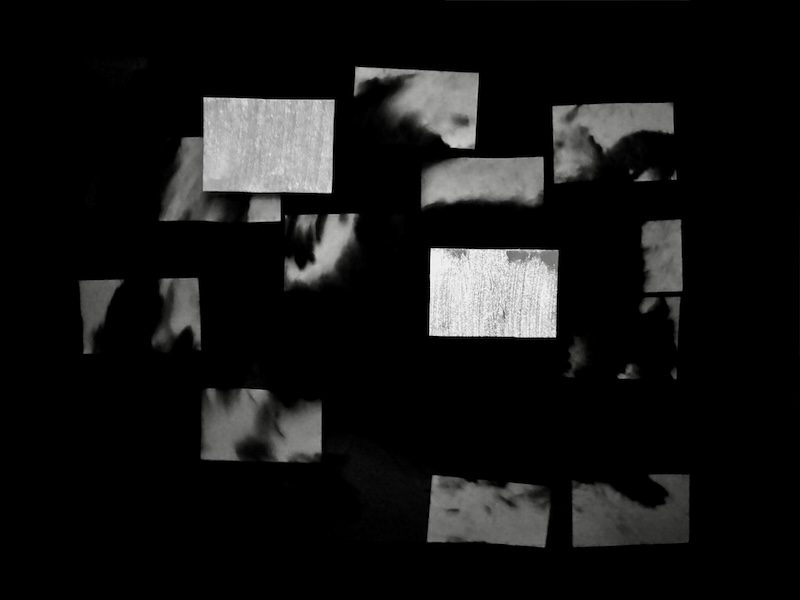
“Serendipitous connections” (Acrylic fluorescent paint, plastic film and paper). Image by the author.
When I started using the Zettelkasten technique as a note-taking strategy, I was intrigued by the way people in some online forums described their interaction with their index cards: as encountering a ghost inside the box. Niklas Luhmann—the most well-known developer of this technique—used this expression in his own Zettelkasten to describe the disconcertment, even disappointment, felt by curious visitors who glanced at his notes and saw nothing spectacular (ZK II Zettel 9/8,3). The German sociologist also referred to a kind of spectral quality when he playfully suggested the existence of “joker” files that would swap places, hide, and disappear as soon as someone opened the archive (ZK II Zettel 9/8j). However, what some Zettelkasten users describe when they talk about the ghost in the box effect—and what I myself have observed on numerous occasions over the past five years of working with my own physical and digital slipboxes— are strange, even spooky, [1] experiences in which it becomes clear that the Zettelkasten is much more than the sum of its parts (Luhmann, 1992, ZK II Zettel 9/8e).
Certain formal aspects of the Zettelkasten make it an excellent source of surprises. The most important, in my view, is that the notes are not organized hierarchically or thematically (Luhmann, 1992). In other words, you do not organize your index cards the way you would when drafting a document. A card’s value comes from the connections it can make with other cards. You add cards by seeing which existing cards the new cards can link to, and you insert them in a branching order. [2] This makes the Zettelkasten a nonlinear, highly valuable tool for research and writing: 1. because the possibilities for combining index cards are immense; and 2. because simply interacting with the box leads to “happy accidents” that can be incredibly generative.
Some of the most common surprises arise from:
- Mistakes: Sometimes you come across a misplaced note. Mistakes and accidents can spark questions and ideas you would not have considered otherwise.
- Chance: A very productive way to make unexpected connections is to pick notes at random. (Chance can bring an inactive note back into play.)
- Forgetting: Some notes and sections of the archive are forgotten; we simply no longer return to them. It is a process of deselection that we have not consciously undertaken.
- Disagreement: Organizing a new note forces you to review the ones that were already there. Without even meaning to, when you revisit old notes, you read them with fresh eyes. Nuances, counterexamples, counterarguments, and new questions emerge.
- Lost notes: Searching for a note inside the box is a way to rediscover notes that, despite having no preexisting connection, can end up engaging in a wonderful dialogue with one another.
These unexpected, unintentional situations are where we see the ghost in the box at work. Not only do they spark new ideas and perspectives on the written word, but also help us to question certain assumptions about the value of archiving and “managing” knowledge. To counter the portrayal of the Zettelkasten that has recently become widespread in productivity culture around personal knowledge management (PKM), I want to emphasize Luhmann’s metaphor of the card index as a “complex digestive system of a ruminant” (ZK II Zettel 9/8i). I think this image best illustrates my everyday experience working with my archive of notes, in both analog and digital forms. For me, a note box—while exciting and intellectually rewarding—takes time and can be quite chaotic (since it does not follow a single line of thought, but rather many lines that do not need to be consistent with one another). It is not always the most efficient process, nor does it provide the fastest results, as the popular idea of a Second Brain claims (Forte, 2022).
The idea of “technologically enhanced” creativity and memory is extremely seductive in the age of fast academia and paperism. One need only look at the admiration online communities express for Niklas Luhmann, who wrote more than 50 books and 400 articles using this technique. “You can be that productive,” “if you manage your knowledge, you can achieve all your goals”—that is the message of many videos and blog posts on personal knowledge management. However, what if, instead of imagining ourselves as powerful knowledge managers, we imagine ourselves as allies of half-finished buildings, [3] full of ghosts that invite us to take part in not-knowing in the presence of… (De la Cadena, 2021), to unlearn, to go on tentative explorations, to journey? (Souriau, 2016)
So perhaps the issue is not compensating for the “fragility of our biological brains” (Forte, 2022, p. 4). In fact, an archive—even in digital form—is far more fragile and unstable than it appears. Continuing with the ghost metaphor, it is a real source of fear when notes disappear because of a technical problem; for example, when a note’s content is suddenly deleted, ghost duplicates are created, [4] or a file becomes corrupted. It is rare, but when it happens, we realize we do not have complete control over archives—they, too, are vulnerable in their own way. This is why it is worth approaching the relationships we establish with them from a crip perspective. I have found that slip-boxes are especially useful for neurodivergent and mad folks. They give us a structure the world sometimes does not offer. They help us organize our thoughts and, yes, carry out our projects when it feels like the world is moving at a different pace. We should emphasize not autonomy and empowerment—derived from “outsourcing the job of remembering to intelligent machines” (Forte, 2022, p. 18)—but alliances among existences with tenuous, hesitant, and fallible ways of being.
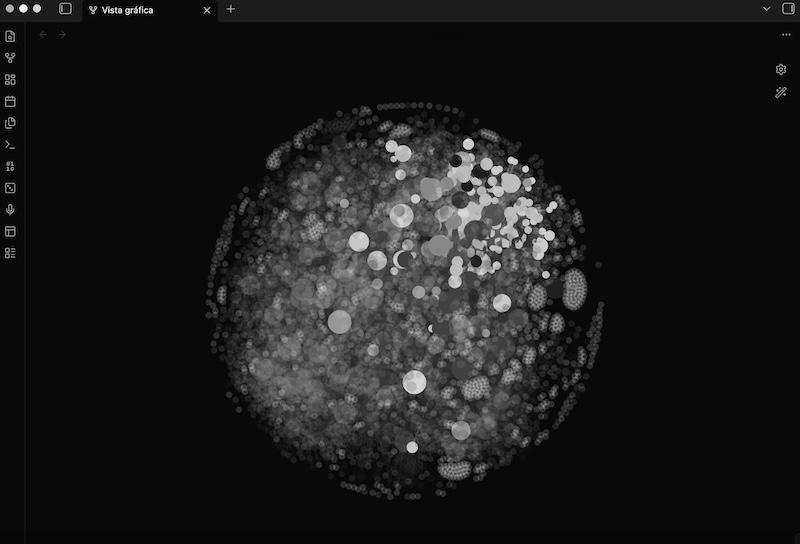
Screenshot of my digital notes in graph view. Image by the author.
Zettelkasten-human assemblages can constitute heterogeneous agencies capable of collaborating under highly complex informational and material conditions. To understand the ontological specificity of this coupling—which, I insist, feels more like inhabiting a haunted house than a smart building with reinforced high-tech security features—it is worth returning to Tiago Forte’s promise of becoming capable of remembering everything. It is true that those of us who take notes and organize them so we can refer back to them later have a sort of “expanded” memory. But, in my view, not in the sense of a super memory, but rather a process of constant explosion, of a sticky overflow. Some things we see, read, and discuss stick with us, while others do not; knowing this allows us to understand the selection processes we often make unconsciously. When we take notes, we assess the importance of certain issues while dismissing others. That is why I believe the Zettelkasten is a note-taking technique whose value lies not in storing information to manage it efficiently, but in acting as an accompanying tool that allows us to un-archive ideas that emerged at specific moments, examine the assumptions underlying them, ruminate on them, view them from multiple angles, doubt them, and experiment by exploring other possible ramifications. We can do all of this “conscientiously”. However, it becomes even more surprising and enjoyable when our partner tells us—in its own other way—what to unarchive and when. I mean those moments when, by chance, you sense the ghost’s presence inside the box.
Notes
[1] See the interesting conversation in: Scott P. Scheper. (2023, January 18). Zettelkasten and consciousness (“The ghost in the box”). To clarify, in my interpretation of the ghost in the box effect, I follow an STS theoretical framework that focuses on the Zettelkasten’s agency and infrastructural aspects, while distancing myself from interpretations that treat it as an independent consciousness or mind. Even when thinking of it as a “communication partner” (Luhmann, 1992), it seems appropriate to me to conceptualize it as an informational system, not a psychological one.
[2] A more detailed explanation of how this note-taking technique works can be found at: https://zettelkasten.de/introduction/
[3] Permanente obra negra [one possible translation: “permanent working site”] is a book by Mexican writer and editor Vivian Abenshushan. Inspired by David Markson and Walter Benjamin, the author explores the index card format as an experimental medium for writing, playing with the possibilities offered by its fragmentary nature and incompleteness.
[4] Do not mistake this technical issue for what is known in the Obsidian user community as “ghost notes”—that is, a link to a note that has not yet been created but exists (albeit virtually) and can be referenced within the system.
References
Abenshushan, V. (2019). Permanente obra negra. Sexto Piso.
De la Cadena, M. (2021). Not knowing: In the presence of …. En: A. Ballestero & B.R. Winthereik (Eds.), Experimenting with ethnography: A companion to analysis (pp. 246–256), Duke University Press.
Forte, T. (2022). Building a Second Brain: A proven method to organize your digital life and unlock your creative potential. Atria Books.
Luhmann, N. (1992). Kommunikation mit Zettelkästen: Ein Erfahrungsbericht. In Universität als Milieu: Kleine Schriften. Verlag Cordula Haux. [English translation: https://luhmann.surge.sh/communicating-with-slip-boxes]
Souriau, É. (2016). The different modes of existence. University of Minnesota Press.
Scheper, S. (2023, January 18). Zettelkasten and consciousness (“The ghost in the box”) [Video recording]. https://www.youtube.com/watch?v=nZHvp_evKYU
