Author Archives: Mpho Primus

I am computer science and AI governance scholar whose academic work focuses on African language technologies, particularly tone, pragmatics, and the linguistic complexity of low-resource languages. Her research advances decolonial and feminist approaches to AI, examining how language, data, and power shape the design and governance of intelligent systems.
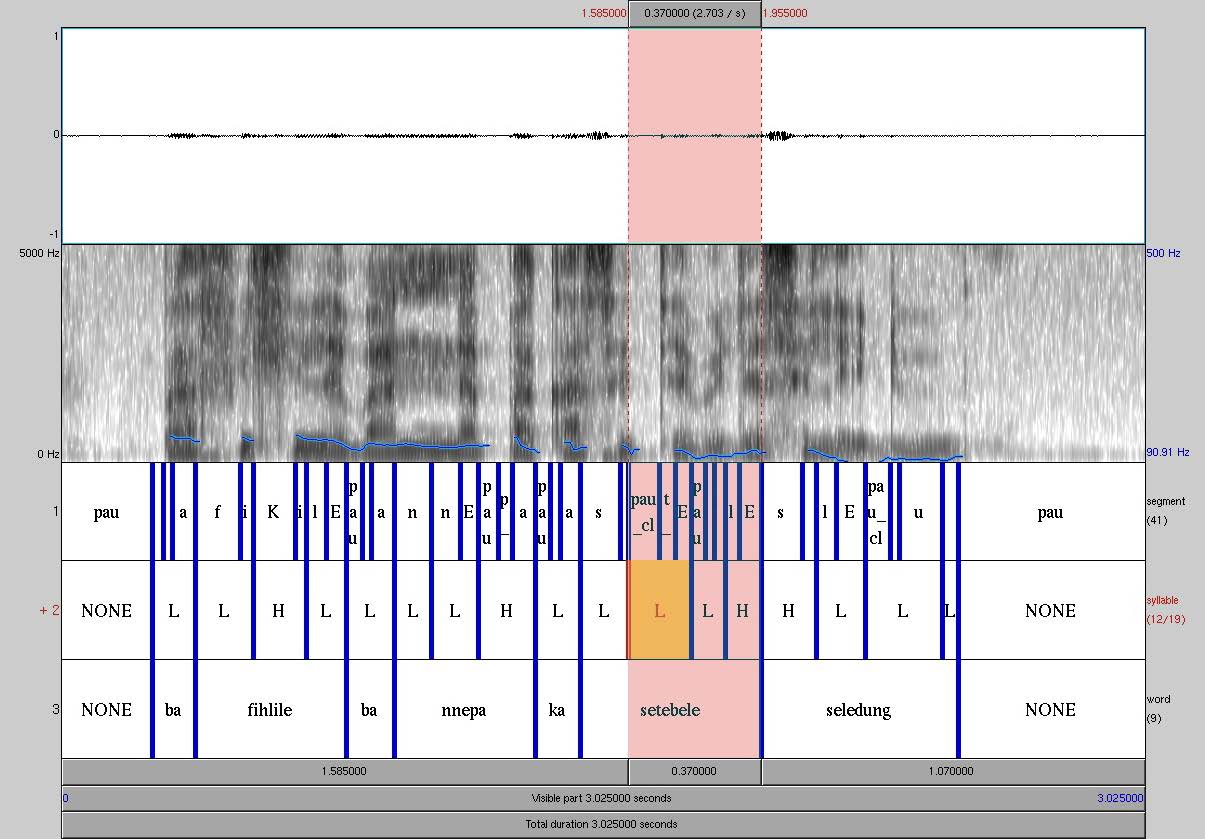
The image is a screenshot from the speech analysis software Praat, showing a multi-layered acoustic and linguistic analysis of a short spoken Sesotho utterance lasting approximately 3.03 seconds. The display is divided into several horizontal panels. At the top is the waveform, which shows the loudness of the speech over time, with silence at the beginning and end and speech concentrated in the middle. Below the waveform is a grayscale spectrogram, where darker vertical bands represent speech energy across frequencies from 0 to 5000 Hz. A blue pitch contour runs near the bottom of the spectrogram, tracing the speaker's fundamental frequency (F0) throughout the utterance. A section near the middle of the recording is highlighted with a pink shaded rectangle, indicating the currently selected time interval (approximately 0.37 seconds). Within this highlighted region, one syllable is additionally marked with an orange box, indicating the syllable currently under analysis. Beneath the spectrogram are several annotation tiers separated by horizontal lines. The first annotation tier segments the speech into individual phones or phonetic units using narrow blue boundaries. The second tier labels each syllable with its lexical tone, using L (Low), H (High), or NONE for pauses. The highlighted syllable is labelled L, followed by another L and then an H within the selected word. The third tier contains word-level annotations, showing the sentence segmented into the words "ba", "fihlile", "ba", "nnepa", "ka", "setebele" (highlighted), and "seledung", with pauses before and after the utterance. The image illustrates how Praat aligns the speech signal with acoustic information (waveform, spectrogram, and pitch) and multiple layers of linguistic annotation, allowing researchers to examine the relationship between the audio signal, phonetic segmentation, lexical tone, and word boundaries.

Automating Language, Losing Relationality: Feminist Reflections on African Language AI

A grandmother pauses before answering a child. The meaning of her words lies not only in the words themselves, but in tone, shared history, the relationship between speaker and listener, the setting, and even the silence that precedes the response. None of these become part of the training data for today’s large language models (LLMs). (read more...)