Welcome to our annual wrap-up, where we share some highlights for CASTAC’s 2025 activities! We are grateful to for your generous engagement with our content this year, and we look forward to sharing more pieces on the anthropology of science and technology in 2026.
Platypus: The CASTAC Blog
Kim Fernandes, previously a longtime Contributing Editor, began as the Managing Editor. Katie Ulrich, who served as the Managing Editor in 2023 and 2024, stayed on as the special series editor.
In 2025 the Platypus team included twenty Contributing Editors and eleven Multimodal Contributing Editors, our largest team yet. This group reflects growing geographic, linguistic, and gender diversity, a trend we plan to continue. Stay tuned for our 2026 Welcome Post in January, where we will introduce next year’s team.
This year, we published 65 posts. A quarter of these posts were also available in languages other than English (Portuguese, Spanish, Russian, Mandarin, and Hindi). These join posts from previous years also in German, Burmese, Urdu, Kiswahili, Khmer, and Swedish. The team of multimedia contributing editors produced posts this past year in new and creative formats, including an interview on STS academic publishing as a work of hope.
In 2025, Platypus’s readers came from 175 different countries, with 45% of our total readership coming from outside the United States. The nine largest groups of readers from outside of the US come from Germany, Taiwan, India, South Korea, Canada, China, Australia, Brazil and the United Kingdom.
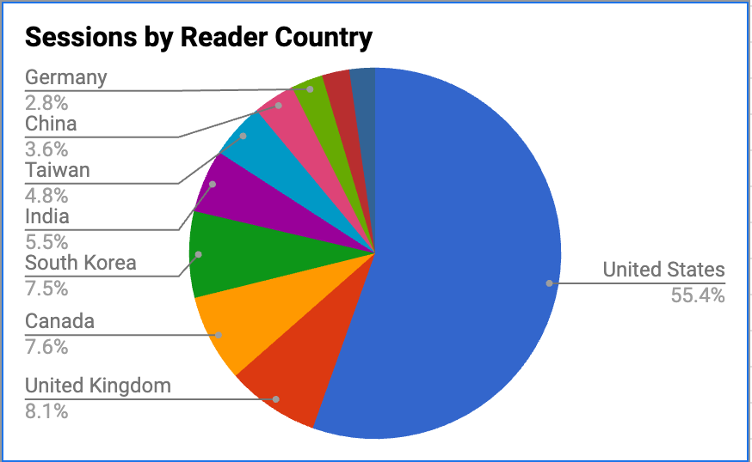
For the period between September 2024 and October 2025
Our readers have consistently come to Platypus from different sources. Among our blog referral list were seventy-three unique university learning management systems (e.g., Blackboard, Canvas, and Moodle) suggesting that our blog is being assigned and/or recommended to students for learning at approximately seventy-three universities.
Reflecting Platypus’s commitment to accessibility, in 2025 we continued to offer all posts as audio recordings available for listening on Platypod. This feature started in 2022 with the help of our Webmaster Angela VandenBroek, who continues to provide technical support and guidance.
Platypus’s sustained growth has taken place thanks to its dedicated and diverse team, who are committed to deliver quality and nuanced posts from different parts of the globe. The work of our dedicated Public Relations manager Natalia Orrego amplified Platypus’s presence online, facilitating a ~22% growth in the blog’s readership.
Finally, the top ten most popular posts published in 2025 (for the period between September 2024 and October 2025) were the following:
- Underneath it All: Unveiling the Toxic Reality of Fast Fashion Underwear and the Social Dimension of Health
- Do Academics Need Agents?: Part 1 of Publishing in Academia
- How to Create Figurations and Inhabit Feminist STS Research: A DIY Manual
- Trade versus Academic Press: Part 2 of Publishing in Academia
- The Evolution of the Digital Divide: New Dimensions of Digital Inequality
- Disruptions in Grace: Embracing Mutation and Disability in Nature through Art
- Common(s) in Science and Technology? Dispatches from the SEEKCommons Network
- Major Internet Outages are Getting Bigger and Occurring More Often: A Reflection on the CrowdStrike IT Outage
- The Cyborg is Dead: The Node Rises
- Laughter and Dreaming of Wins in Recovery
Platypod
In 2022, we launched Platypod, the official CASTAC Podcast. Angela VandenBroek laid out the entire technical infrastructure for the podcast and provided instructions on how to upload and circulate podcast materials. Platypod features original episodes and recordings of readings from the blog. Most listen to the podcast from our website and Archive.org and from August 2021 to today, we’ve had 82,523 listens across all episodes and bonus episodes. By October 6, 2025, Platypod produced 11 full length episodes on varied topics. All episodes have full transcripts available and are posted on Platypus.
As of August 2024, Rebecca Carlson became Platypod’s producer, with Ana Carolina de Assis Nunes (who acted as a producer before August 2024) continuing as Contributing Editor. Rebecca released a podcast in fall of 2025 on “Worrying over Speaking and the Pretentiousness of Podcasts.”
Prizes
Diana Forsythe Prize
2025 marks the 27th year in which CASTAC has presented the Diana Forsythe Prize in partnership with the Society for the Anthropology of Work (SAW). The prize was created in 1998 to celebrate the best book or series of published articles in the spirit of Diana Forsythe’s feminist anthropological research on work, science, and/or technology, including biomedicine. It is awarded annually at the meeting of the American Anthropological Association by a committee consisting of one representative from SAW and two from CASTAC. This year’s selection committee consisted of Noah Tamarkin (chair), Caterina Scaramelli, and Alex Blanchette.
We received a total of 43 nominations for the prize. This year’s winner was Dr. Emily Yates-Doerr for her book Mal-Nutrition: Maternal Health Science and the Reproduction of Harm (2025, University of California Press). Additionally, Dr. Amy Zhang received an honorable mention for their book Circular Ecologies: Environmentalism and Waste Politics in Urban China (2024, Stanford University Press).
David Hakken Graduate Student Paper Prize
Since 2015, CASTAC has awarded a graduate student paper prize in recognition of excellent work by rising scholars. In 2016 the prize was renamed in honor of the memory of David Hakken, for his pioneering work at the intersection of ethnography and cyberspace. The prize is awarded to a paper that exemplifies innovative research at the intersection of anthropology and science and technology studies, demonstrating theoretical sophistication and an appreciation of the methodological challenges facing scholarship in the anthropology of science and technology.
We received 10 eligible submissions. This year’s winner is Paige Edmiston (University of Colorado, Boulder) for her paper “So Consistently Incompetent It Feels Purposeful: The Strategic Inefficiency of Paperwork in the American Health System.” The honorable mention is awarded to Julien Porquet (University of Cambridge) for his paper, Training to See in Latent Space: Style Transfer Algorithms and the Political Economy of Perspectives. This year’s David Hakken Prize Committee consisted of Timothy Loh, Matthew R Webb, and Spencer Kaplan. We are grateful for their hard work in selecting this year’s winners.
CASPR (CASTAC in the Spring)
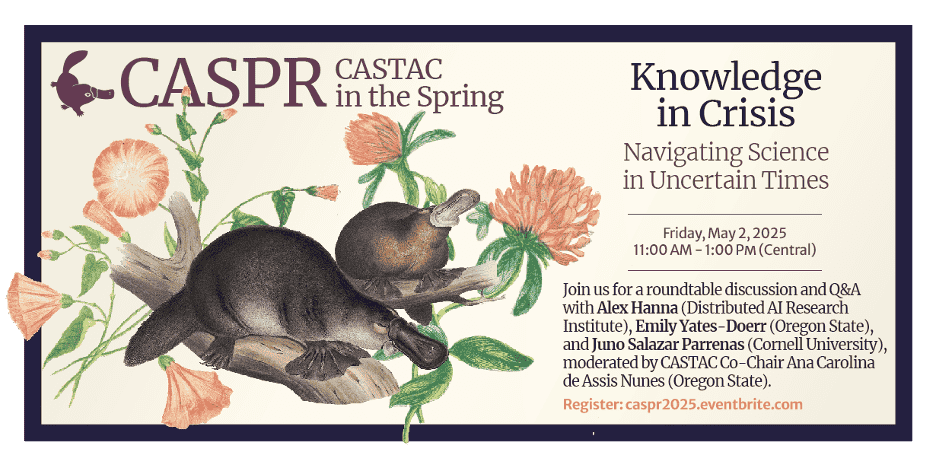
This year, we hosted the fourth annual CASPR virtual event. This year’s theme was “Knowledge in Crisis: Navigating Science in Uncertain Times.” We were very fortunate to have Alex Hanna (Distributed AI Research Institute), Emily Yates-Doerr (Oregon State), and Juno Salazar Parrenas (Cornell University) participate in a roundtable that was moderated by senior co-chair Ana Carolina de Assis Nunes. The forum then invited questions and answers, as well as individual breakout rooms on subjects such as the strategies necessary to implement interdisciplinary collaboration and advocacy, to ensure scientific knowledge translates into equitable societal benefits, building resilience and solidarity across different groups (academics and non-academics) in the face of the current challenges, and the importance of rebuilding public trust in scientific institutions and scientific knowledge. The forum had 180 registrants, and the roundtable portion of this forum will soon be released as an episode on Platypod.
CASTAC at the AAAs
For this year’s invited lecture, Dr. Syed Shoaib Ali presented a virtual talk titled “The Fragility of Promised Futures: A Case for Centering Maintenance in Nature Restoration.” Dr. Ali’s research examines environmental restoration in the Western Himalaya, bringing ethnographic and STS perspectives to bear on global initiatives such as the UN Decade of Ecosystem Restoration and the Bonn Challenge. His work highlights the fragility of the optimistic futures these projects promise, and instead makes the case for centering maintenance and repair as vital to ensuring the long-term durability of restoration sites. By drawing on insights from maintenance and repair studies, Dr. Ali shows how concepts like usefulness, breakdown, and technical diplomacy can shed light on the often-overlooked, repetitive work of sustaining ecological projects. In reframing restoration as maintenance, he points to new forms of partnership and nature diplomacy that can reshape restoration futures in the Global South. Dr. Ali’s lecture was hosted online after the AAA meeting, and Co-Chair Rebecca Carlson will facilitated a discussion after the talk.
Additionally, in person at the AAAs, Co-Chair Ana Carolina de Assis Nunes hosted a roundtable discussion with this year’s Forsythe prize honorees. As the first CASTAC event of its kind, this event was designed to provide members with the opportunity to interact with the honorees.
Thank You!
We thank you for reading, listening to, and engaging with our content and hope to connect with you again in 2026! We also thank outgoing CASTAC Co-Chair Nicole Taylor for her years of committed service. For the 2026 term Ana Carolina de Assis Nunes will take over as senior Co-Chair, with Rebecca Carlson as rising Co-Chair.
CASTAC is an entirely volunteer-run organization with an unpaid staff of more than twenty people. As we do not directly collect dues from our members, our operating budget of $300 per year (for costs associated with the blog website, etc.) comes from a portion of the dues paid to the General Anthropology Division of the American Anthropological Association.
Our community and our ambition to support it are growing faster than our budget! If you enjoy the work CASTAC does, consider donating and volunteering (watch for calls for applicants on the listserv). All donations will go directly to CASTAC to support our existing programs and develop new ones! Consider supporting CASTAC by making a donation using this link and following us on social media on @CASTAC_AAA.
