Creativity is often imagined as a deeply human capacity: a moment of inspiration, a flash of originality, or an individual act of expression. Yet in contemporary digital environments, creativity rarely unfolds in isolation from technological systems. Across creative industries, from fashion and design to visual media, branding, and online content production, creative work increasingly takes shape within infrastructures of platforms, software tools, and algorithmic systems. These technologies do not simply enable creativity; they actively shape how creative ideas are imagined, produced, circulated, and evaluated.
Platform Infrastructures and the Conditions of Creativity in China
China provides a particularly important context for examining these transformations. Over the past decade, China has developed one of the world’s most extensive platform ecosystems, where social media, e-commerce, and digital content production are deeply integrated. Applications such as WeChat, Douyin, and Xiaohongshu function simultaneously as communication tools, marketing platforms, content distribution channels, and commercial marketplaces.
This high degree of integration distinguishes China’s digital ecosystem from many Euro-American contexts, where social media, e-commerce, and payment systems often remain more segmented. In China, creative production is immediately embedded within circuits of monetization and visibility. Content can move seamlessly from aesthetic expression to commercial transaction, collapsing distinctions between artist, influencer, and entrepreneur.
Drawing on nine months of ethnographic encounters in 2025 with ten designers and creative entrepreneurs working in Shanghai’s urban creative industries, this essay explores how creativity emerges within technologically mediated environments. The interviewees operate across fields such as fashion design, branding, photography, digital illustration, and social media content creation. Their work depends not only on aesthetic sensibilities and artistic training but also on navigating complex digital ecosystems that shape how creative work becomes visible and economically viable.

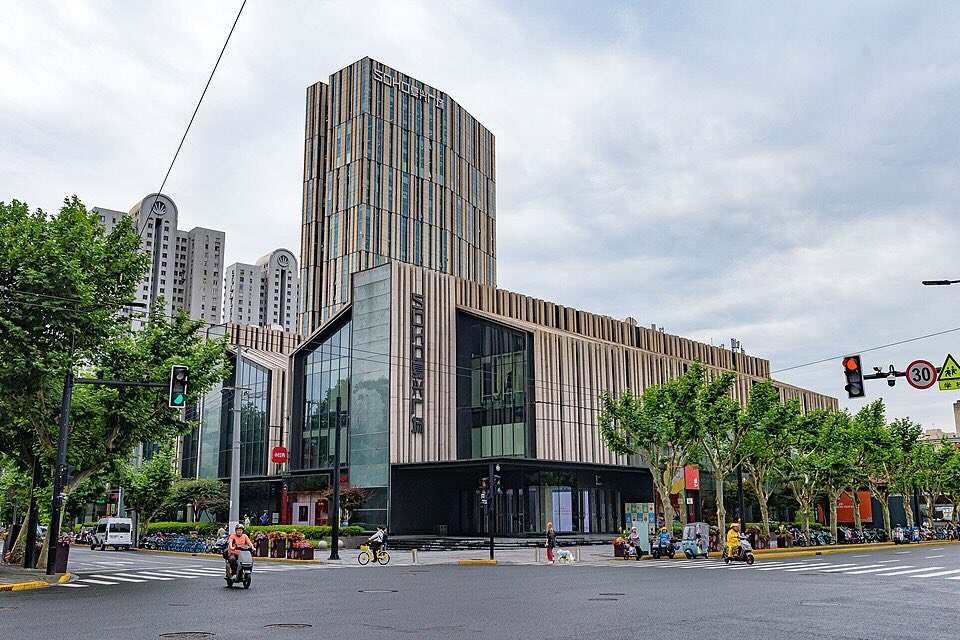
M50 Art District is a key node in Shanghai’s creative economy. Fabio Achilli 2013 via Flickr Creative Commons 2.0
Designing for Visibility: Algorithmic Aesthetics
This essay approaches platforms, software, and algorithmic systems as active participants in the creative process rather than as a neutral set of tools. Scholars of digital media have increasingly emphasized how technological infrastructures shape cultural production and online visibility (Gillespie 2018; Bucher 2018; Poell, Nieborg, and Duffy 2021). In China, these dynamics are especially pronounced because platforms often integrate multiple functions that elsewhere remain separate. Platforms like Xiaohongshu or Douyin embed content creation, influencer marketing, and e-commerce within a single interface. Social media content can instantly connect to online retail, influencer marketing, and brand promotion. As a result, creative production is tightly entangled with digital infrastructures that govern attention, circulation, and commercial exchange.
Creators make this dynamic visible when they design specifically for China’s platform-based ecosystems, where visibility depends on (Seaver 2017; Striphas 2015), audience engagement metrics, and constantly evolving platform trends. Designers and content creators develop strategies to make their work more “discoverable,” experimenting with posting schedules, image formats, visual styles, and narrative techniques that align with platform expectations. In this sense, their practices resemble those of search engine optimization (SEO), where online visibility is structured by algorithmic logics that privilege certain forms of content over others (Noble 2018). Here, however, these dynamics extend beyond search rankings to encompass the broader organization of attention within platform ecosystems, shaping not only what is seen, but how creative work is produced in the first place.
During fieldwork, several creators described how they actively study platform dynamics as part of their creative practice. Jing, a 35-year-old graphic designer from Shanghai who produces visual campaigns for fashion brands, explained that designing for social media requires thinking beyond the image itself. “You have to imagine how it appears in the feed,” she told me. “Is it scroll-stopping? Does it look good as a thumbnail? Will people share it?” For her, aesthetic decisions such as color contrasts, composition, typography, and pacing are often shaped by how images circulate within algorithmically curated streams.
Bo, a 36-year-old stylist based in Shanghai who produces fashion reels on Xiaohongshu, similarly described how analyzing platform performance has become a routine part of his creative workflow. After posting a video, he closely tracks engagement metrics, views, shares, and comments, comparing which edits gain traction and which are quickly buried in the feed. He often revisits the same footage, re-cutting it into different versions to test how variations in pacing, framing, or sequencing affect visibility. Over time, he has learned that certain visual rhythms such as quick transitions, close-up shots, and behind-the-scenes moments tend to resonate more strongly with both audiences and platform recommendation systems. “You start to see patterns,” he explained, noting how trends circulate and stabilize across the platform. As he put it, “Creativity now also means understanding the algorithm.”
Human-Technical Collaboration in Creative Practice
Contemporary creative work unfolds through collaboration not only among people but also with digital tools and automated systems. Software platforms, from image editing programs and 3D modeling tools to generative design software, play an active role in shaping creative outcomes. Anthropologists have long noted that tools and materials do not simply execute human commands; they suggest possibilities, constrain certain actions, and expand others (Ingold 2013; Suchman 2007).
Accordingly, designers frequently described creative workflows as interactive processes with their tools. Yan, a 26-year-old entrepreneur and digital illustrator, explained that much of her experimentation occurs within the software environment itself. She manipulates layers, applies filters, and tests visual effects suggested by the program’s interface. Sometimes the software produces unexpected results that inspire new directions. “The tool surprises you,” she said. “You start with one idea, but the software shows you something else.” Here, creativity is distributed across human and technological actors. The final design is not solely the product of individual imagination but emerges through ongoing interaction with software environments.
Artificial intelligence and automated design complicate this dynamic by blurring the boundary between tool and collaborator. Increasingly, creators experiment with AI-assisted systems that generate visual variations, suggest layouts, or assist with editing tasks. For some designers, these systems function as creative partners that accelerate experimentation and expand aesthetic possibilities. For others, however, this shift raises concerns: automation may standardize visual forms, or diminish the perceived value of human authorship. Creators must navigate this tension in their practice, treating AI simultaneously as These dynamics are particularly visible in China’s rapidly evolving digital industries, where technological innovation and intense market competition continually reshape the conditions of creative labor.
Platform Labor as Creativity
In platform-driven environments, creators must constantly produce content, maintain online visibility, and engage with audiences. Creative labor extends far beyond producing a single artwork or campaign. It includes editing, formatting, caption writing, responding to followers, and analyzing performance metrics.
Many creative entrepreneurs describe the pressure to remain active online. Posting regularly helps maintain algorithmic visibility, while audience engagement metrics like comments, shares, and likes, signals relevance to platform systems. Here, creativity involves designing campaigns and tweaking them according to platform feedback.
For example, Hao, a 30-year-old independent product and fashion designer based in Shanghai, described how platform dynamics shape how he designs his work from the outset. Developing small-batch accessories and garments, he regularly shares prototypes and works-in-progress on platforms such as Xiaohongshu to gauge audience reactions before moving into production. He pays close attention to comments and engagement patterns, using them to decide which designs to refine, discard, or bring to market. “Sometimes a piece I like doesn’t get any response,” he noted, “and something I wasn’t sure about suddenly gets a lot of attention.” In these moments, he adjusts materials, colors, or styling to better align with audience preferences and platform trends. For Hao, design is not a linear process that moves from idea to finished product, but an iterative cycle shaped by ongoing feedback, where aesthetic decisions are closely tied to visibility and potential sales.
China’s digital ecosystem intensifies these dynamics because platforms function as essential digital infrastructure for both cultural production and commerce. While creators elsewhere also navigate multiple platforms, Western ecosystems often distribute these functions across more specialized services, for example, separating social media, e-commerce, and payment systems across apps such as Instagram, TikTok, or external marketplaces. By contrast, Chinese platforms such as Xiaohongshu and Douyin more tightly integrate these functions, enabling content, transaction, and monetization to occur within the same ecosystem. Designers and entrepreneurs therefore move not only across platforms, but within interconnected infrastructures that streamline the conversion of attention into economic exchange.
Xiaohongshu, known in English as RedNote and headquartered in Shanghai, has over 350 million active users. Wikimedia Commons 2025 Creative Commons 4.0
In this environment, creators experiment with platform environments, learning how algorithms work, testing visual strategies, and adjusting creative approaches over time. One fashion photographer described this process as “working with the system rather than against it.” For many this means aligning with platform logics to maximize visibility and engagement. However, this is not the only possible approach. Working “against” the system may involve resisting dominant aesthetic trends, rejecting optimization strategies, or producing content that does not conform to algorithmic expectations, even at the cost of reduced visibility. Rather than a single mode of adaptation, creators navigate a spectrum of engagement, balancing visibility, experimentation, and independence.
Rethinking Creativity in Platform Societies
The case of China highlights these transformations particularly clearly because of the scale, speed and integration of its platform-centered digital economy. Even more so than other highly online societies, a number of dominant platforms in China structure large parts of everyday life. Algorithms shape visibility, interfaces shape aesthetic possibilities, and engagement metrics shape perceptions of success. Creative expression does not disappear within these systems, but it becomes entangled with them in complex ways.
Understanding creativity today therefore requires attention not only to artists and designers but also to the technological environments within which they work. Platforms, software, and automated systems participate in shaping what counts as creative, what becomes visible, and what ultimately circulates as culture.
The ethnographic scenes described here suggest that creativity in contemporary China is neither purely human nor purely technological. Instead, it emerges through collaborations between creators and the digital infrastructures that increasingly organize cultural production. By examining these interactions in the Chinese context, where platform integration and market competition are particularly intense, anthropology can better understand how culture itself is being reconfigured in an era of platforms, algorithms, and technologically mediated expression.
This post was curated by Contributing Editor Aaron Neiman and reviewed by Contributing Editor Ivan Flores.
References
Bucher, Taina. 2018. If…Then: Algorithmic Power and Politics. Oxford University Press.
Gillespie, Tarleton. 2018. Custodians of the Internet: Platforms, Content Moderation, and the Hidden Decisions That Shape Social Media. Yale University Press.
Ingold, Tim. 2013. Making: Anthropology, Archaeology, Art and Architecture. Routledge.
Latour, Bruno. 2005. Reassembling the Social: An Introduction to Actor-Network Theory. Oxford University Press.
Nieborg, David B., and Thomas Poell. 2018. “The Platformization of Cultural Production: Theorizing the Contingent Cultural Commodity.” New Media & Society 20(11): 4275–4292.
Noble, Safiya Umoja. 2018. Algorithms of Oppression: How Search Engines Reinforce Racism. New York: NYU Press.
Poell, Thomas, David B. Nieborg, and Brooke Erin Duffy. 2021. Platforms and Cultural Production. Polity.
Seaver, Nick. 2017. “Algorithms as Culture: Some Tactics for the Ethnography of Algorithmic Systems.” Big Data & Society 4, (2) (2017): 1-12.
Striphas, Ted. 2015. “Algorithmic culture.” European Journal of Cultural Studies 18, (4-5): 395-412.
Suchman, Lucy. 2007. Human–Machine Reconfigurations: Plans and Situated Actions. Cambridge University Press.

.jpg)