In November 2025, in Rio de Janeiro, the seminar (in)SAM — “Food (in)Security Under the Microscope: Rethinking the Relationship Between Food Systems, Microorganisms, and Sanitary Norms” — brought together researchers from different countries and professionals from various fields of knowledge for two days, with the aim of contributing to the development of inclusive sanitary norms for non-industrial food production. The panel discussions, which featured social science researchers and leaders from traditional peoples and communities, addressed topics such as: challenges for multispecies planetary health and for promoting food and nutritional sovereignty and security; food, microorganisms, and sanitary regulations; biopolitics in global food systems, agribusiness, and the production of large-scale (in)securities; and methodological and interdisciplinary challenges for research and regulations involving microorganisms.
The seminar was initiated and made possible by a call for proposals issued by the Centre for Social Studies on Microbes (CSSM) at the University of Helsinki, Finland, to fund an international seminar focused on the relationships between humans, non-humans, microorganisms, and their environments. The call resonated with the concerns of a group of Brazilian researchers attentive to the demands raised within the National Council for Food and Nutritional Security (CONSEA) and by social movements in Brazil, which seek to overcome the exclusionary character of sanitary norms for foods produced by family farmers, peasants, indigenous peoples, and traditional peoples and communities. These populations have been suffering the growing impact of the imposition of industrial hygiene and quality standards developed within the framework of international trade, which do not recognize traditional knowledge and production practices and render a wide variety of animal and plant-based foods illegal — many of which are integral to regional food cultures, such as cheeses, meat sausages, fish, cassava flour, vegetable oils, nuts, sweets, and fruit pulps, among others.
Under the justification of preventing microbiological contamination, sanitary regulations require industrial production standards and prohibit traditional buildings, equipment, utensils, and ways of knowing and doing; for example, they do not allow the use of wood, basketry, or ceramics, requiring instead stainless steel, plastics, disposable materials, and chemical inputs, among other things (Cintrão, 2017). Similarly, increasing biosafety measures geared toward large-scale industrial animal production hinder the sale of poultry, eggs, and meat produced on a small scale in diversified agricultural systems. This inadequacy of sanitary norms has created obstacles to the legal sale of these foods at local fairs and markets. It has also undermined programs considered strategic under Brazil’s National Food and Nutritional Security Policy (PNSAN), such as direct public procurement of food from family farms and traditional peoples and communities for school feeding programs (Brazil, 2010).
One of the obstacles to developing differentiated and inclusive regulations for food production by these populations has been the scientific and technological training of professionals working in public health regulation — such as veterinarians, nutritionists, food scientists, agronomists, public health specialists, and epidemiologists — whose understanding of food safety is shaped by hygiene standards and quality parameters oriented toward large-scale industrial production. As Latour demonstrated in his study of French microbiology, the Pasteurian revolution was not merely scientific but a profound reorganization of practices, institutions, and ways of governing life (Latour, 1988). What we have inherited from this process is a scientific and professional formation in which microorganisms appear primarily as threats to be controlled, eliminated, and standardized.
This perception has become more pronounced since the 1990s, when the outbreak of successive epidemics and pandemics linked to industrial food production and large-scale industrial animal husbandry placed microorganisms at the center of global debates, heightening concerns about their control. Since then, food safety and microbiological quality standards agreed upon in international forums — such as the Codex Alimentarius and pandemic agreements — have reinforced biosafety requirements that are often difficult for countries in the Global South to meet and even more inaccessible to peasant populations and traditional peoples and communities.
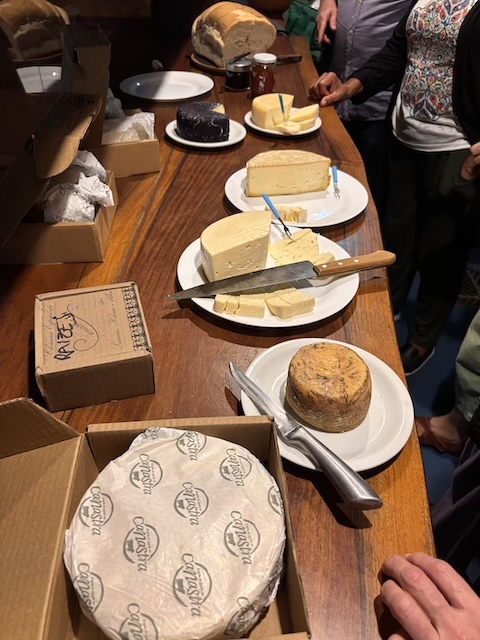
Artisanal cheese from different parts of Brazil, served during the (in)SAM Seminar. (Image by Authors)
One example is Brazilian artisanal cheeses made from raw milk. Since the 1990s, their production has been subject to microbiopolitical mechanisms — periodic requirements for laboratory analyses to verify “microbiological quality indicators” — that have threatened the continuity of their production, leading to aggressive enforcement actions aimed at preventing their informal sale and creating a discursive space that casts suspicion on these foods as contaminated and potentially dangerous to human health (Cintrão and Dupin, 2020).
Although designed for exports and the global food commodities trade, these norms have increasingly been imposed on small-scale production and local markets (Cintrão, 2017). Moreover, these requirements are also rooted in moral disputes over notions of dirt, pollution, and risk, in which industrial production systems seek to present themselves as safer and attribute risks to non-industrial production practices, even creating “epidemic villains” (Perrota, 2020).
Biosafety requirements, which focus on automation and industrial systems for controlling microorganisms considered pathogenic and/or indicators of hygiene, equate “food safety” with increased sterilization and the absence of (micro)biological contaminants. They oversimplify the complex relationships between humans, non-humans, microbes, and their environments, disregarding socioeconomic, cultural, and political factors that play a crucial role in environmental balance and global health. And they are generally at odds with the traditional knowledge and practices that guide the decentralized production of a range of foods embedded in the food cultures of different regions of Brazil. Since the late 1990s, Brazilian family farming social movements have sought to negotiate with national sanitary regulatory agencies to establish differentiated norms for foods produced by family-based agriculture and by traditional peoples and communities (Cintrão, 2017). However, one of the major obstacles to developing sanitary norms that are less exclusionary and more appropriate to the conditions and practices of these populations is the fact that sanitary regulations — and much of the scientific research underpinning them — ignore the existence of different grammars of care among peripheral populations, both rural and urban, rooted in different cosmologies regarding their relationships with land, nature, microorganisms, health, and bem viver (Perrota, 2020; Cintrão, 2017; Cintrão and Dupin, 2020).
With the aim of supporting negotiations for inclusive sanitary norms and the recognition of traditional knowledge and practices in food production and processing, the (in)SAM seminar sought to bring into the debate new interdisciplinary fields of research and scientific evidence on the importance of microbiological diversity as constitutive of human and environmental health, contributing to a challenge of Pasteurian views that consider only its pathogenic role (Paxson, 2008; Paxson & Helmreich, 2017; Lorimer, 2020; Raffaetà, 2022; Benezra, 2023). Added to this is an increasingly robust body of scientific evidence pointing to health problems caused by the excessive artificiality of ultra-processed foods, increasingly associated with rising health issues such as allergies and chronic non-communicable diseases (Louzada et al., 2022).
All of these approaches have given anthropology new tools for analyzing how different social groups — scientists, sanitary inspectors, environmental managers, doctors, farmers, consumers of fermented foods, religious leaders, and others — perceive and interact with these microscopic actors, and how these actors interact with one another, at the center not only of health and environmental questions but also political, economic, and cultural ones.
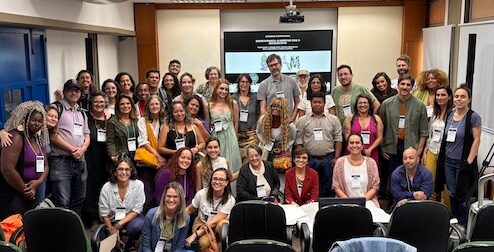
Participants of the (in)SAM seminar in November 2025. (Image by Authors)
The (in)SAM seminar underscored the importance of interdisciplinary research and reflection that brings together contributions from researchers in the humanities, leaders of rural social movements, and health professionals, in order to deepen and enrich the debates and political advocacy surrounding the development of more inclusive sanitary norms, and to contribute to a critique of the reductionist, colonialist, and exclusionary perspectives dominant in the Codex Alimentarius, pandemic agreements, and One Health approaches.
The debates highlighted, on one hand, how globalized food systems have exacerbated social inequalities and environmental imbalances, generating disease throughout their entire chain — from land concentration, deforestation, and river pollution, to soil degradation caused by excessive agrochemicals in large-scale monocultures, intensive animal farming in industrial systems that generate increasingly dangerous zoonoses, and large meatpacking plants that become hotspots for disease transmission. On the other hand, the discussions drew attention to how peasant populations, fisherfolk, indigenous peoples, and quilombola communities hold more expansive conceptions of health, tied to bem viver, that do not separate humans, nature, and microorganisms and that go beyond the reduction of microorganisms to threats to be combated. Approaches from geography, sociology, and anthropology help challenge these narrow conceptions of food safety and health, offering a broader perspective on the indivisibility of nature and culture, and of humans and microorganisms.
This post was curated by Contributing Editor Victor Secco and reviewed by Contributing Editor Clarissa Reche.
References
Benezra, Amber. 2023. Gut Anthro: An Experiment in Thinking with Microbes. Minneapolis: University of Minnesota Press.
Brasil. Decreto nº 7.272, de 25 de agosto de 2010. Regulamenta a Lei nº 11.346, de 15 de setembro de 2006, que cria o Sistema Nacional de Segurança Alimentar e Nutricional – SISAN. Brasília, DF: Presidência da República.
Cintrão, Rosângela P. 2017. Food security, risks, scales of production – challenges to sanitary regulation. Vigilância Sanitária em Debate, vol. 5, núm. 3, 2017, Julho-Setembro, pp. 3-13. https://doi.org/10.22239/2317-269X.00971.
Cintrão, Rosângela.; Dupin, Leonardo V. 2020. Microbiopolítica e regulação sanitária: desacordos entre ciência e saberes locais na produção dos queijos minas artesanais. Horizontes Antropológicos, v. 26, p. 239-274, 2020.
Latour, Bruno. 1984. Les microbes. Guerre et Paix, suivi de Irréductions. Paris, A.-M. Métaillé.
Lorimer, Jamie. 2020. The Probiotic Planet: Using Life to Manage Life. Minneapolis, MN: University of Minnesota Press
Louzada, Maria Laura C. et al. 2021. Impacto do consumo de alimentos ultraprocessados na saúde de crianças, adolescentes e adultos: revisão de escopo. Cad. Saúde Pública 37 (suppl 1). https://doi.org/10.1590/0102-311X00323020
Paxson, Heather. 2008. Post-pasteurian cultures: the microbiopolitics of raw-milk cheese in the United States. Cultural Anthropology, vol. 23, n.1: 15-47. https://doi.org/10.1111/j.1548-1360.2008.00002.x
Paxson, Heather & Helmreich, Stefan. (2014). The perils and promises of microbial abundance: Novel natures and model ecosystems, from artisanal cheese to alien seas. Social Studies of Science 44, 165–193. https://doi.org/10.1177/0306312713505003
Perrota, Ana Paula. 2020. Serpentes, morcegos, pangolins e ‘mercados úmidos’ chineses: Uma crítica da construção de vilões epidêmicos no combate à Covid-19. DILEMAS: Revista de Estudos de Conflito e Controle Social, p. 1-6.
Raffaetà, Roberta. 2022. Metagenomic Futures. How Microbiome Research is reconfiguring health and what it means to be human. Routledge, London.
Seminário (in)SAM. International Seminar – Food (in)Security under the Microscope: rethinking the relationship between food systems, microorganisms and food safety standards. Rio de Janeiro, State University of Rio de Janeiro-UERJ, 26 and 27 November 2025. Disponível em: https://docs.google.com/document/d/1vX1BRIxZxYuY6ERSV3oRBOa_Tsy5wZmI/edit
