I was clicking through a game studio’s website when an image caught my eye. In a warm, cozy office, several people sit in front of their laptops, heads slightly tilted, listening carefully through headsets and taking notes. In the background, cartoonish banners on the walls display the phrases “Leave a comment” and “After hearing the players’ voices, what are your thoughts?” in large font. People gather to stick their notes onto the wall or read the ones written by others. The accompanying text reads: “Through all the challenges, it is the support and companionship of our customers that has fueled our pursuit of dreams… Our team sat in the player experience hall, where we carefully listened to the voices of our players.”
Designed to Be Heard
This was not the first time I had encountered the rhetoric of listening in the gaming industry. In social media posts, patch notes, and promotional materials, game developers routinely present themselves as deeply attuned to the player base and repetitively assure that players’ voices matter. However, right before coming across this image, I had seen players repeatedly raising complaints in chat groups and social media posts about a popular game produced by the same studio. Some complaints are about game balance, some about its monetization, and some about the direction the story was taking. In these discussions, many variations of the same sentiment persisted: a belief that players’ opinions are not being listened to. This tension between a hyper-visible rhetoric of listening and a lived sense of not being heard is what I find most intriguing and want to follow in this piece. It stands out most clearly in the games my research focuses on, because being listened to is fabricated into the very texture of play.
“Every night before bed, I have to chat with him for a while,” Xinzi[1] told me. She was not talking about a friend or a family member, but about a virtual game character. Xinzi, a marketing professional in her mid-twenties, based in Shanghai, spends roughly two hours a day in the game world. Like many of the players I came to know during my fieldwork, she insisted these games are “much more than just entertainment.” The game she plays is one that my research focuses on: a genre known in Chinese as 女性向游戏 (nüxingxiang youxi) and in English variously as otome, women-oriented, or romance simulation games, including titles like Light and Night and Love and Deepspace. Inside these games, the player takes on the role of a woman courted by several devoted fictional male characters. These games are designed in a straightforward way, usually involve a gacha mechanism[2] for drawing cards, a token combat system, and above all, visual-novel storylines about building a relationship with one (or more) of several men characters. The plot can be the couple solving a crime, exploring a fantasy world, or just growing closer over the mundane challenges at work.
The genre is primarily made for young women, who are often educated and ambitious, but still caught between the contradictory demands of contemporary Chinese womanhood. In these games, players usually inhabit a fictional figure who mirrors them: a young woman chasing success at work, moving through a world where the frictions of real life, such as the pressure to marry or the clash between ambition and family expectation, are smoothed away. The character is both general and specific—general enough to stay a vessel defined by some broad qualities such as kindness and courage, but also specific enough that almost any young Chinese woman can step into her without effort.
As a text-heavy genre, these games hinge on conversation between characters, in other words, on listening and being listened to. “Even real boyfriends aren’t as thoughtful as he is,” Xinzi joked about her favorite character, “he actually cares what I think.” She was referring to an in-game feature in which players tap to open a conversation from a menu of pre-written openings. For example, a player taps “I’m feeling low today, because of work,” and the character replies from a set of scripted reassuring lines. Various features are just like this: the virtual men remember players’ birthdays, send morning and evening greetings, and send check-in messages when a player has not logged in for a while. The genre, in other words, makes being listened to feel effortless and constant.
It is worth being precise about what kind of listening this is. Sound studies has long treated listening as a situated, embodied practice (Jean-Luc Nancy 2009; Don Ihde 2007). Here, however, I approach listening in a different sense, as my interlocutors rarely speak about the sensory qualities of sound. Instead, they invoke these listening-related terms to name experiences of voicing opinions and being recognized. I therefore approach listening as a social practice that sorts voices and distributes attention.
Anthropologists have long shown that listening in this sense is never neutral, and such practices are embedded in power (Inoue 2006; Slotta 2017; Marsilli-Vargas 2022; Carr 2023). Being heard depends on fitting the genres and categories an institution already recognizes, which makes listening an implicit technique of power that decides whose voices count. However, in these games, a player never has to fit any category to earn the hearing. For someone like Xinzi, being listened to is clear, and she can easily pin down the moment it happens, such as when the character casually mentions, “I remember last time you said…”. The genre trains players to expect listening as a condition that is given and given constantly.
That expectation does not stay inside the game. It also manifests in how players deal with the companies behind these games. Moving across official social media accounts, customer-service portals, and fan communities, players bring the same demand of attentive listening with them. As one example, one player told me that her favorite character “would be heartbroken to see how the company treats us players,” as if the fictional boyfriend who listens so well should put to shame the real people behind him who don’t. Exaggerated as it is, her remark points to players’ common expectation that speaking up ought to be heard with care, and ought to have some effect.
So when a company writes “we are always listening” in a patch note, or notes “every voice matters” among its corporate values, players read it as a promise continuous with the attention the game has already given them. What being heard actually requires, though, is not settled among players themselves. Some want a sincere acknowledgment when the company got something wrong, others require certain things to be changed or deleted, but they all share one expectation. To them, being listened to is a right they are entitled to exercise. In other words, a designed intimacy sets an expectation of being heard, and this expectation then spills past the screen and hardens into a claim on the company and on the world the game represents.
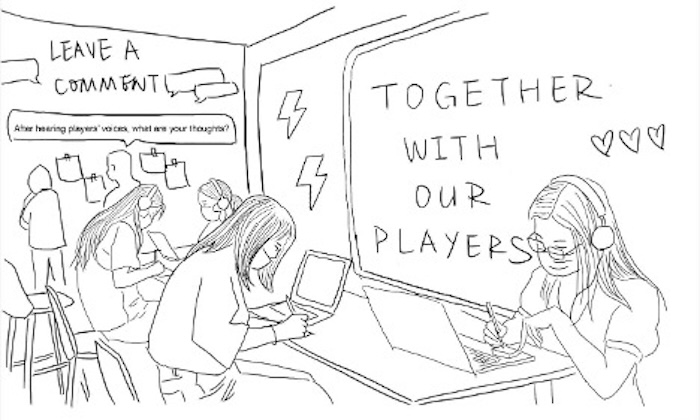
A studio promises it is always listening. Drawing by the author, based on the studio’s webpage.
When Listening Becomes a Right
The claims players make are rarely only about the game. For many of my interlocutors, in a broader social environment where explicitly feminist or oppositional speech can be policed, these games act as one of the relatively safe spaces where they can express feelings and test other possibilities for selfhood. Within it, players complain about dialogue they read as sexist, or object when a character update seems to drift away from a personality they have grown attached to. Their feedback is saturated with expectations about what a game made for young women should be, and the safety of the space feels at stake when it is challenged. Oftentimes, the trigger could be very subtle. In one case, an in-game illustration was “modest” on its own, but its pose echoed a well-known manga image in which a woman is portrayed in a degrading way. What upset players was both the image as well as the sense that the game had let the old scripts that ridicule and discipline women everywhere else back into their refuge.
In other words, a complaint about a single pose is never only about the pose. When players argue over whether a word in one line of script normalizes harassment, whether a character arc quietly devalues “leftover women,” or whether a reference invokes players’ memory of a humiliating meme, they are debating which gendered lives are imaginable and legitimate. Not only do they want to see the next update address their complaints, but they also want an answer to a broader question: whether the game’s portrayal of romantic relationships and womanhood lines up with their own sense of themselves and lived experiences. To these women, speaking up is how they insist that their own experiences and judgments count.
Heard, but Not Answered
The companies, for their part, mostly listen in a thinner sense. Feedback submitted through ordinary channels tends to return a reply so standardized that fan communities mock it almost as a genre of its own: “Thank you for your feedback. I have recorded this issue and will pass it on to my colleagues. We will resolve it as soon as possible.” Interestingly, players are often perfectly content to be soothed by a game character’s scripted lines, but the company’s scripted reply comes across as an insult. The difference probably lies in whether the script performs the attentiveness players have been trained to expect.
Anthropologists of institutional listening offer a useful vocabulary here. They distinguish procedural listening, which opens channels and invites speech, from substantive listening, in which what is said can actually move a decision (Babcock and Gershon 2025). They also notice how institutions can “re-hear” what they are told, translating it into categories the institution already recognizes so that speech is absorbed rather than acted upon (López-Espino 2024). Players are heard procedurally and only rarely substantively, and when a critique is sharp enough to be inconvenient, it is re-heard in a more comfortable frame. In the process of getting listened to, players keep adjusting themselves. They decide which channel to use, what words might travel through, when to stay quiet and when to get loud. Being heard turns out to be something they have to keep working for, orienting and reorienting towards it.
My case for the Chinese romance simulation game reveals a condition that is not unique to itself. More and more of digital life unfolds inside environments engineered to make us feel heard, from the feedback button to the “your call is important to us” hold message. China’s romance game players show how much work the promise of listening can do: it shapes what people expect, how they speak, and what they keep fighting for, even after any actual listening has stopped. Attending to listening as a practice gives anthropology a way to see how these environments hold users close while also keeping them at arm’s length. The promise of listening may matter as much as the content of what is said, which is exactly why it is worth listening to more closely.
Notes
[1] All names used in this piece are pseudonyms.
[2] A gacha mechanism (from the Japanese for capsule-toy machines) lets players spend in-game or real currency on randomized draws. In the games my research focuses on, players roll for a chance to win particular character illustrations, story content, or outfits.
References
Babcock, Joshua, and Ilana Gershon. 2025. “How Does the State Ignore? Ideologies and Practices of Substantive and Procedural Listening in U.S. School Board Meetings.” Language & Communication 100 (January): 186–95.
Carr, E. Summerson. 2023. Working the Difference: Science, Spirit, and the Spread of Motivational Interviewing. University of Chicago Press.
Ihde, Don. 2007. Listening and Voice: Phenomenologies of Sound, Second Edition. SUNY Press.
Inoue, Miyako. 2006. Vicarious Language: Gender and Linguistic Modernity in Japan. University of California Press.
Jia, Xintong. 2026. Gender and Postfeminism in Chinese Reality Dating Shows. Springer Nature Switzerland.
López-Espino, Jessica. 2024. “Re-Hearing Parents as Risks to Children: Institutional Listening Practices in a California Child Welfare Court.” Journal of Linguistic Anthropology 34 (3): 420–40.
Marsilli-Vargas, Xochitl. 2022. Genres of Listening: An Ethnography of Psychoanalysis in Buenos Aires. Duke University Press.
Nancy, Jean-Luc. 2009. Listening. Fordham University Press.
Slotta, James. 2017. “Can the Subaltern Listen? Self-Determination and the Provisioning of Expertise in Papua New Guinea.” American Ethnologist 44 (2): 328–40.
