In Mexico, quelites refers to uncultivated edible plants. The word has a Nahuatl origin derived from kilitl, a term referring to these edible weeds. The earliest dictionaries of colonial Mexico translated kilitl as “vegetable”, an equivalence that obscured the fact that they were collected (not cultivated), and interpreted them as any other green crop. There is an ongoing trend to revaluate quelites as a way to counter their gradual disappearance from national diets. These efforts involve universities, governmental and private institutions, civil associations, and organized communities.
Central to this trend is a perspective rooted in an urban-commercial outlook, in which the idea of quelites as vegetable goods resonates. The declining consumption of quelites is presented here as a problem rooted in misconceptions that they are “poor people’s food” or lack nutritional value, and as an issue affecting national food security, as it represents a loss of accessible foods with nutritional and medicinal properties. The proposed solution to the problem of quelites promotes their production and consumption, while disseminating information about their health properties, and highlighting their cultural and gastronomic value. Through this gaze, quelites have been popularized within the national culinary narrative, especially in urban settings. There, they are regarded as “native vegetables” and featured as exotic dishes in prestigious restaurants, encouraging their gourmetization. However, these efforts of revaluation seem to have few benefits in rural contexts, where quelites have been historically a crucial part of the diet.
This text presents some vignettes from my doctoral research. I seek to understand how peasants relate to these plants through ethnographic work with Nahua communities. This allows me to reflect on the differences between the disappearance of quelites from the Mexican diet in these contexts, and that which, in urban, scientific, and economic representations, tends to rescue them as “vegetables”. Throughout my work, I consider the way quelites are felt-thought [sentipensados] in peasant ways of life, how they are collected, cared for, named and narrated, and how they nourish other ways of co-inhabiting territory. In this essay, I propose that the relationship between these two ways of understanding quelites (peasant and urban) is an example of a conflict between political epistemologies (Blaser, 2019). In this conflict, the ontological otherness of quelites in peasant life is not recognized, and their declining use is reductively attributed to bias against these plants.
I am extremely grateful to the Nahua peasants with whom I shared these reflections on quelites. Ninenmechmotlasohkamachilia.
Hueitlatilolpa is one of the neighborhoods of San Miguel Tenango, Puebla. One of the neighborhood’s hillsides faces Tsatsitipetl, a rock that seems to echo the voice of anyone who shouts at it. The other hillside overlooks the wide valley through which the Atoyac River flows. When the fog lifts, the Sierra Norte of Puebla can be seen from there, a Nahua and rural region for which this community is one of the gateways. That is the view from Marcelina Hernández’s home. We are on her patio, doing an exercise in identifying quelites. Margarita and Julio, Marce’s parents, and their children are also there, participating. Doña Margarita told me that malakakilitl and masakilitl (two quelites, which I have heard of but have not seen) are hardly growing anymore. She attributes this to changes in the weather. Marce, who knows a lot about the land, listens with as much curiosity as I do, since she has not heard much about these “difficult” quelites.
I have participated a couple more times in this peculiar intergenerational disconcertment surrounding those “hard-to-find” quelites. On another occasion, I was chatting with teacher Elizabeth Márquez and her parents, Doña Ernestina and Don Ponchito, in a classroom that Elizabeth uses for alphabetizing in mehcanotlahtolli (the local dialect of Nahuatl). When I asked them about quelites that grow pohihtik (in the woods), Elizabeth and I learned about chikiusolkiliti, nihnimini, and masakilitl, three quelites she had not seen because they grow in the forest; and her parents, being elderly, can hardly go looking for them anymore.
Although I tried to find those “difficult” quelites, I could not find them during my visits to San Miguel. Later, Elizabeth, who had become intrigued by them, sent me photos she found with her father on a trip to the countryside.
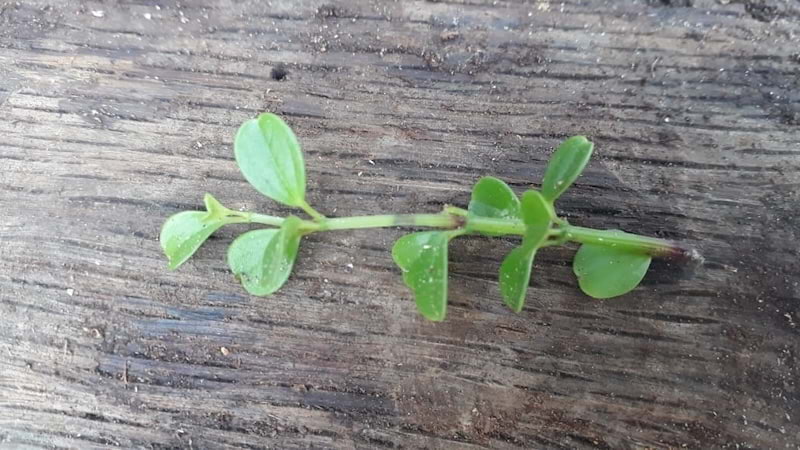
Nihnimini photographed by Elizabeth Márquez, San Miguel Tenango (Puebla, Mexico).
Image used with the permission of the photographer.
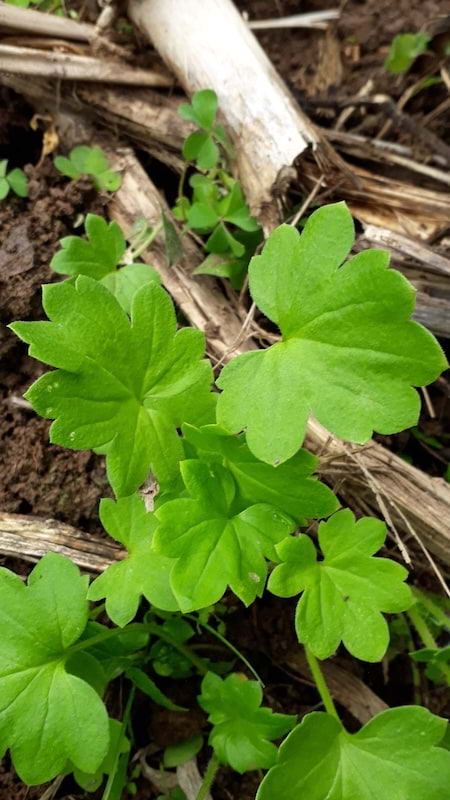
Chikiusolkilitl photographed by Elizabeth Márquez, San Miguel Tenango (Puebla, Mexico).
Image used with the permission of the photographer.
These names and images of quelites are the traces left to us by towewetsin (elders) that indicate the subtle process of these plants’ disappearance from the peasant way of life. Towewetsin’s teachings on how to name and recognize these plants are just some of the many threads woven together to maintain our relationship with them. Now let us see other dimensions that kilitl also encompasses regarding the world’s greenness.
The word that names the quelites is a special sign of the connection one has with them. This is because, as they are gathered plants, knowing their name is a crucial form of inheritance. Unlike crops, where seeds are passed through generations, with quelites there are no seeds, but words that are transmitted between generations: words about what they are called, where and when they appear, how they are gathered, how they are cooked, what other uses they have, and what stories are told about them. In peasant ways of life, this transmission is oral in local languages–mehcanotlahtol, masewalkopa–and is learned by working the land. Thus, the oblivion of these languages means the oblivion of quelites.
Territory is another important element in the inherited relationship people have with quelites: the way of inhabiting the environment, working it, caring for it, feeling and thinking about it. It is the seeds scattered on the ground that sprout with the rains; it is the climate that determines the agricultural cycle; it is the type of soil cultivated that dictates which quelites will appear. This is what the inherited words speak of: how to live with the territory and its green season, and with quelites. But land dispossession, pollution, climate change, agroindustrial pressure, and other changes in the territory–as well as the loss of vernacular languages–are contributing to the gradual disappearance of quelites.
While quelites appear during the rainy season, peasants know that most of them only grow in soil worked in specific ways. Certain ways of tilling, plowing, and fertilizing with manure favor the germination of quelites and other arvenses (plants related to the plow). Once quelites have sprouted, you need to know how to identify and care for them while weeding, as well as when to harvest them. For example, if they are recios (flowering), they can taste bitter. One must let some of them bloom and spread their seeds so they will continue to grow in the field. We can encourage their growth, or even–if we really like them–try to cultivate them. There are many ways to manage quelites, but there are also ways of working the land that hinder their growth, for example, through the use of herbicides and the uniform pattern of monoculture, where the only desirable thing growing on the plot is what humans have sown.
Peasants also know that quelites have other uses besides being food for humans. Some quelites are used as pahtli (medicine) or as feed for poultry, sheep, and pigs. Others can serve as farm boundary markers, like ikimixochitl or iksoxochitl, used to demarcate plots of land. These are quelite trees, a controversial concept that pushes back against narratives that insistently define quelites as a category of vegetables. For Nahua peasants, this is not problematic. Kilitl is an open, plural, and polyphonic category. It includes plants from other places, such as peas or vetches, whose sprouts are “eaten like quelites”.
San Miguel people acknowledge that the decline in the use of quelites is related to urban pressures that transform their rhythms of life, their ways of speaking, understanding, and coexisting with the territory: migration, land dispossession, and changes in eating habits. Formal education, they say, is a fundamental cause of this decline: it does not address the land, is taught in Spanish, and focuses on vegetables, crops, and nutrients rather than on Xopantlakwalli and plants gathered in the forest.
Even when a quelite is no longer used and imposed social structures force it out of peasants’ daily life, its disappearance does not entail its extinction. This is because these plants’ life cycles are not as closely tied to humans as those of domesticated species. Masakilitl continues to grow in the forest, even if its relationship with humans has been broken: now almost no one knows where to find it, how to cook it, or how to use it medicinally. Perhaps kilwiwilan still appears among the crops, but the agro-industrial system of vegetable monoculture labels it a weed or a pest and develops techniques to eradicate it.
According to the Royal Spanish Academy, a vegetable is an edible plant cultivated in gardens. Interpreting quelites as native vegetables limits how we can relate to and work with the greens that grow spontaneously in the plots after the rains. The disappearance of quelites is not just the loss of a food item, or a name; it is the loss of a way of working the land, caring for it, getting to know it, coexisting with it, and making room for what grows in the green season. This view frames the solutions for their disuse within an ontology distinct from that of these peasant alliances with quelites. The outlook is a world where food is cultivated solely for its economic value and can be classified only by clear, distinct taxonomies.
The case of quelites can be understood as a conflict of political ontology (Blaser, 2019; De la Cadena, 2010) in which tensions between forms of life are reduced to epistemological misunderstandings. In current nationalistic revindicatory efforts and narratives, the disuse of quelites is attributed to biases that must be overturned with scientific information (data on nutrients and health benefits) so that people start eating quelites again. These narratives rely on convincing producers that quelites are profitable, helping them to grow and market their products to support national food and economic security, and reminding chefs that quelites come from the Nahuatl language, are part of the nation’s intangible cultural heritage, and can be part of gourmet dishes. These narratives hide ontological alterity, the different ways of relating to uncultivated plants that feed us, to the territory, to words, and to memory. They divert our gaze from all the threats leading to the disappearance of quelites.
Kilitl, for the Nahua communities, is not merely a plant. It is an existential relation with what grows in the green season, with the other lives of the territory, and with the life of the past; it is nourishment for the life to come and for forms of coexistence that are, in fact, already being and resisting.
These are the names of some quelites in Nahuatl (Audio)
Description
This audio says in Nahuatl: “Yehun motoka sekintin kiltin: kilwiwilan, masakilitl, malakakilitl, nihnimini, chikiusolkilitl. Tikinmotlasohkamachilia masewaltin tlein Tenanko iwan Tlakutenko ipampa yewatsin techihtitiah kenin tiktenewah iwan tinemih itlauk kilitl”.
[In English: “These are the names of some quelites: kilwiwilan, masakilitl, malakakilitl, nihnimini, chikiusolkilitl. Thanks to the Nahua peasants of San Miguel and Santa Ana for teaching us how to name and live with quelites.”]
This post was curated by Multimodal Contributing Editor Karina Aranda and reviewed by Contributing Editor Jackie Ashkin.
References
Blaser, M. (2019). Reflexiones sobre la ontología política de los conflictos medioambientales. América Crítica 3(2): 63-79. DOI: http://dx.doi.org/10.13125/americacritica/3991
De la Cadena, M. (2010). Indigenous cosmopolitics in the Andes: conceptual reflections beyond politics. Cultural Anthropology, 25 (2): 334-370. DOI: https://doi.org/10.1111/j.1548-1360.2010.01061.x
