It is a winter day. Workers at the dump are busy emptying trucks, sweating profusely as the sun beats down on all of us. The smell of the freshly arrived waste grows worse in the heat. I have come to the dumping ground to meet Shivam, a municipal officer deputed there to supervise the workers.
Shivam is new to the dumping ground. He is responsible for keeping track of how many trucks arrive each day, how much waste is processed, resolving conflicts between workers, and maintaining the records of the dumping ground. He often sighs when I ask him about his work there, confirming what I have often assumed: it is not the best place to work.
“The dump is not your friend,” Shivam says. “It may feel like it is. When you come here, you may see this vast, open ground where so many people are working. But there is real danger here. The dump often appears harmless, but just when you let your guard down, it strikes. It is my job to protect people. I do that by trying to understand what the dump is trying to say.”
I imagine Shivam as a shaman, trying to understand the language of the dump. I imagine the dump as a living organism, a predator always becoming something else according to its waste composition, geological characteristics, and the humans who occupy it. I return to imagining the dump and its many monsters, trying to subdue the humanity spread across its unstable landscape.
The Ground That Moves
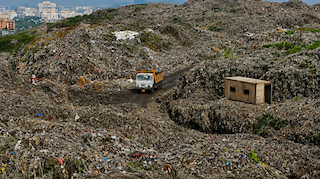
A waste truck moves across the slopes of Mumbai’s Deonar dumping ground, where decades of accumulated refuse tower above the surrounding landscape. Photo by author.
The Deonar Dumping Ground is tucked along the western edge of Thane Creek in eastern Mumbai. You might miss its relation to the mangroves unless you trudged through the mountains of waste and reached the water. Deonar is often treated as a bounded municipal infrastructure. But its edge opens onto mud and water, making it a liminal space both geographically and politically. The city’s discards and the state’s presence seemed to have taken refuge there, protected from the Arabian Sea.
Polythene bags and jagged construction debris. Brightly colored sacks and soda bottles. Buried beneath fresh layers of waste that arrive every day. One layer on top of another.
One day, I found a broken toy excavator. Its color had weathered from a lustrous yellow to something close to off-white. Most of its constituent parts were long gone. It had only one wheel left, connected to the rest of the toy like an appendage that wanted to be freed.
Slippers and shoes made of polyurethane formed part of the ground one walked on. Whenever a truck rolled past, the surface trembled as though it might give way, sinking beneath those who found themselves there. Sometimes there would be a black patch, an indication that organic waste was rotting nearby.
Shivam has characterized the dump well. The dumping ground is a space of embodied risk. After a brief conversation with him in his office, I walk the short route to the working area of the dump, making my way through the mountains of trash and following a path in the plastic ground, along a route etched by the excavators that plow through it every day. The feeling of standing on unstable ground composed almost entirely of polymers is always surprising. One’s body can never quite get used to it.
At one end of the dump, a group of workers is segregating waste. I can see Shabana and Prakash, two twenty-something segregators, hard at work. They are investigating a suspicious-looking cardboard box that has just been dropped off. Boxes like this can contain harmless objects such as books or toys, but they can also hold dangerous items such as used syringes. There is no way of knowing until one opens them.
What a monstrous being the dumping ground is, I think to myself, as I watch the workers laboring under the sun on unstable terrain.
After the Sun Sets
After spending the afternoon with the workers in the unyielding heat, we decide to take a break.
Shabana and Prakash are the only people I know in the crew, and they suggest that we get some tea nearby. They fetch their small plastic bags and tiffin boxes. Their day, it seems, has come to an end. As we make our way across the dumping ground and over a culvert choked with plastic, I am awestruck by the sun setting over the dump. Sparrows dart from one mound to another, crows caw, and sometimes, if one is lucky, a rat scurries across one’s feet. Clothes, plastic bags, and sachets are lodged deep within the ground, part of what is called legacy waste. The discards beneath my feet are not always recent. Sometimes, if one looks closely, they can be traced to consumer products from decades ago. The dump is one of the few places in the city where one can physically encounter the many layers of histories that constitute it.
“What is the dump like after the sun sets?” I asked Shabana and Prakash.
“The dump is a dangerous place. It becomes even scarier at night,” Prakash replied, smirking.
“How so? Are there any ghosts here that I should be afraid of?” I asked.
“Not ghosts. But there are other things. Has anyone told you about the swamp men?” Shabana said.
No one had.
“At night, there are people who swim through the marshes and enter the dumping ground. They are scary people. If you encounter them, chances are you won’t live to tell the tale. They come here looking for things to sell—pipes, electronics, plastic wares,” Prakash said.
“Isn’t there a boundary wall to prevent people from entering the dump?” I asked.
“There is a boundary wall, but not over the marshes. Sometimes they make their way through the water pipes!” Prakash added, his eyes widening.
A colonial landfill on the marshes, its many accretions being taken apart by different actors, its histories being pulled to the surface. As I searched for questions in my head—were the swamp men an urban legend designed by the state to keep people out of the dump? Were they human? —we made our way out of the dumping ground.
By then, a visible frown had formed on my face. Shabana and Prakash tried to ascertain what I was thinking.
“Are you scared of the monsters here?” they asked playfully.
What the Monsters Keep
In Deonar the story of legacy waste and ecological collapse, of civilization and its discard become signified by untimely monsters.
Monsters produce a body where fear and desires can be localized rather than being dispersed across a social field (Cohen 1996). They also produce cyclical histories because they emerge from enduring social conditions (Cohen 1996). Scholars of damaged ecologies have often used the figure of monsters to describe entanglements that lay hidden in stories of progress: forms of life that are to be found in ruins (Tsing et al. 2017; Stoler 2008; Haraway 2016). At Deonar the true monster is time and the discard the city has dumped and forgotten about. Colonial efforts to desiccate land, and postcolonial technorationalities to manage toxicity (Dossal 1991; Anand 2017). Both, state functions dependent on the environmental labor of recyclers and segregators in the present (Gidwani 2015). The monster of time gathers the varying temporalities in one encounter.
Stories of swamp men inhabiting the liminal spaces between land and sea thus make the monsters of time real. At Deonar, the swamp men become a metadiscursive register that points to the city’s ecological accretions (Anand, 2015). The monsters of Deonar are untimely because they force histories and futures excluded from the managed present back into view. The toy excavator, buried sachets, and polyurethane shoes make past consumption present. The unstable ground and injured bodies make future harm immediate. The monsters are testaments to the physical toll that the revaluation of matter takes on both ecologies and bodies.
“Are there other things that make you afraid here? Other than the swamp men?” I asked.
“The swamp men aren’t really harmful. You just shouldn’t get in their way. There are other scary things here.
As an anthropologist, I sometimes return to childhood stories to make sense of what I encounter. In Scooby-Doo, the monster was usually a person in a mask—a caretaker, property owner, or local official using fear to conceal a scheme. Ethnographers can be tempted by the same plot: unmask fear and reveal the political economy beneath it. At Deonar, that would mean showing how labor, municipal administration, property, and recycling markets produce danger. But perhaps a better way to think about ethnography is to ask what the monster’s mask does. Like Scooby and his gang, I kept searching for the figure concealed behind the monster. Yet each time, I found plastics: accreting around me in ecologies and legacies.
“Sometimes I think it’s good that people are scared of the dump,” Prakash said. “Otherwise, they would take it over as well.”
Prakash was right.
We tend to think of the dumping ground as a single entity, as something that endures. Yet, pay attention to the monsters and you begin to see how the dump is in a continuous state of change: through the labor of workers, changes in the economy, and what people consume. The monster is not only the swamp man. It is the unstable assemblage of plastics, marsh, animals, infrastructure, markets, and labor that makes the ground live and move.
This monstrosity can also create openings. The fear attached to the dump leaves spaces that regimes of private property and administration do not fully occupy. The municipality tries to tame the dumping ground through walls, records, and authorized routes. Yet people, animals, water, and valuable materials continue to move through its gaps. These fugitive ecologies and economies do not stand outside the dump. They are made in the incompleteness of its boundaries and classifications.
Later, as we waited for the bus to arrive, I asked Prakash how he would deal with the swamp men if he ever encountered them.
“I won’t fight them. They are not the problem. There are more things that can kill me here than the monsters,” he said.
“Like what?” I asked.
“Look around,” he replied with a smile.
I did! Rats, workers sorting unopened boxes, and the marsh beyond an incomplete wall. The monsters were not hidden in one body. They were spread across the ground: plastics persisting beyond use, ecologies escaping enclosure, and the labor required to live among them.
A soundscape is the sonic environment through which a place is experienced: the overlapping sounds of movement, work, machines, voices, and weather that give a place its particular rhythm. In this recording, listeners hear a constructed soundscape combining the noise of Mumbai traffic with a low musical track.
I use this soundscape not as a literal recording of Deonar, but as a way of placing the listener within the atmosphere of the essay. The traffic evokes a city in constant motion, where people, vehicles, and discarded materials continually circulate. The musical undertone draws attention to what this movement leaves behind: waste that accumulates, histories that remain unresolved, and materials that return to trouble the city’s imagined stories of progress.
This post was curated by Contributing Editor Melina Campos Ortiz and reviewed by Contributing Editor Eva Steinberg
The background music that appears in the soundscape is from Ghost Story by Kevin McLeod.
References
Anand, Nikhil. 2015. “Accretion.” Theorizing the Contemporary, Fieldsights, September 24. Society for Cultural Anthropology.
Anand, Nikhil. 2017. Hydraulic City: Water and the Infrastructures of Citizenship in Mumbai. Durham, NC: Duke University Press.
Cohen, Jeffrey Jerome, ed. 1996. Monster Theory: Reading Culture. Minneapolis: University of Minnesota Press.
Dossal, Mariam. 1991. Imperial Designs and Indian Realities: The Planning of Bombay City, 1845–1875. Bombay: Oxford University Press.
Gidwani, Vinay. 2015. “The Work of Waste: Inside India’s Infra-Economy.” Transactions of the Institute of British Geographers 40 (4): 575–595.
Haraway, Donna J. 2016. Staying with the Trouble: Making Kin in the Chthulucene. Durham, NC: Duke University Press.
Stoler, Ann Laura. 2008. “Imperial Debris: Reflections on Ruins and Ruination.” Cultural Anthropology 23 (2): 191–219.
Tsing, Anna Lowenhaupt, Heather Anne Swanson, Elaine Gan, and Nils Bubandt, eds. 2017. Arts of Living on a Damaged Planet: Ghosts and Monsters of the Anthropocene. Minneapolis: University of Minnesota Press.
