When I first arrived at the makerspace known as Fab Casa del Mig, in the Sants neighborhood of Barcelona, I crossed a large urban park called La España Industrial. I later learned that the park occupies the site of a former textile factory with the same name. Walking through the park, I passed people walking their dogs, groups playing basketball or pétanque, and others simply spending time with their family there. At the end of the park stands Fab Casa del Mig, the last remaining building of this former industrial complex. Inside, there is a large makerspace.
On my first visit, I attended the exhibition “Coronavirus Makers,” which documented how, during the COVID-19 pandemic, makers in Barcelona organized to produce equipment such as protective face shields and to distribute them to medical institutions (Lambert, 2023a). At the same time, in another room, a group of men were developing an automated irrigation system using Arduino, an open-source microprocessor and electronics platform. On a second visit, a group of elderly women sat in the main room, laughing and drinking sparkling wine while celebrating the exhibition of a woman, aged 90, after a Photoshop workshop. On my third visit, I attended an Arduino workshop in a room filled with laptops. Nearby, two women were making jewelry with a laser cutter with the help of a technician, while a young boy watched a 3D printer producing a smartphone case.
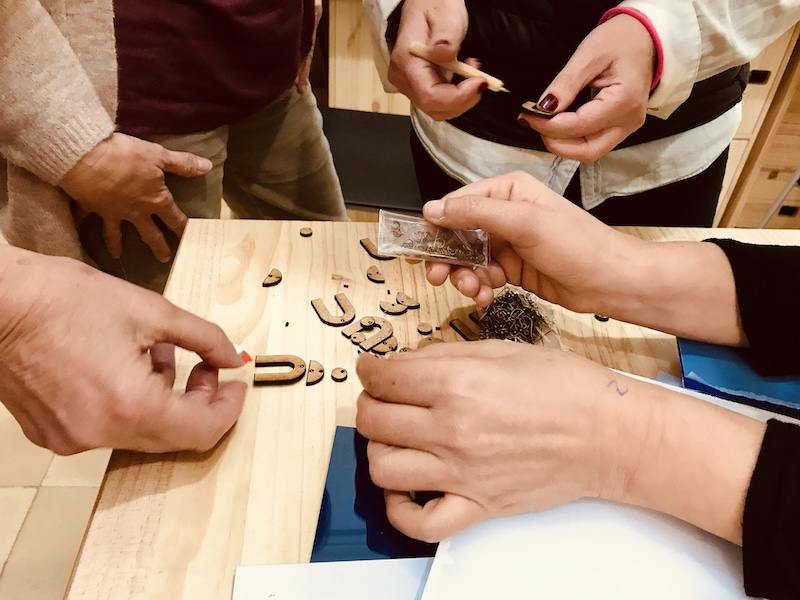
Women making earrings during a laser cutting workshop at Fab Casa del Mig. Image by author.
Over the 18 months of my fieldwork between 2020 and 2022, I returned frequently. I used a CNC machine to make printed circuit boards, attended workshops on Arduino, laser cutting, and 3D printing, and learned electronics and soldering. I also took part in “Makers Wednesdays,” which brought together a diverse group of people (Lambert, 2023b). During this time, we developed a memoria histórica project to create a small exhibition with artifacts and images about the former textile factory, using the makerspace’s tools (Lambert et al., 2024). We also engage in discussions on improving the surrounding park using the knowledge available there.
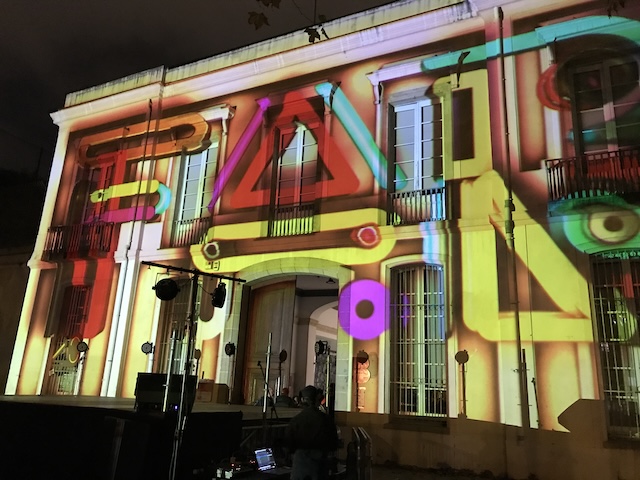
The façade of the Fab Casa del Mig building during the organization’s 20th-anniversary celebrations in España Industrial Park. Image by author.
This is what led me to develop the concept of citizen technology, a useful framework for discussing popular education in technology, as well as inclusive technologies, which bring people together rather than divide them. It is also a concept that helps contrast with artificial intelligence systems characterized by opacity and the lack of participatory governance.
Understanding Participation in Makerspaces
A makerspace or digital fabrication space is defined as a physical place equipped primarily with digital tools and machines. This is the lowest common denominator. The human, social, and empowering dimension is also an integral part of these spaces.
The sharing of tools and machines facilitates access to material resources needed to make or repair things and/or to acquire knowledge in electronics, robotics, and computing. As several participants and coordinators expressed, the idea behind these spaces is to bring people closer to technology. Others specified that the goal is to remove fear of technology, to eliminate apprehension. This represents an initial stage where access to resources is made easier, although the support of a technician or coordinator is often necessary to help carry out projects.
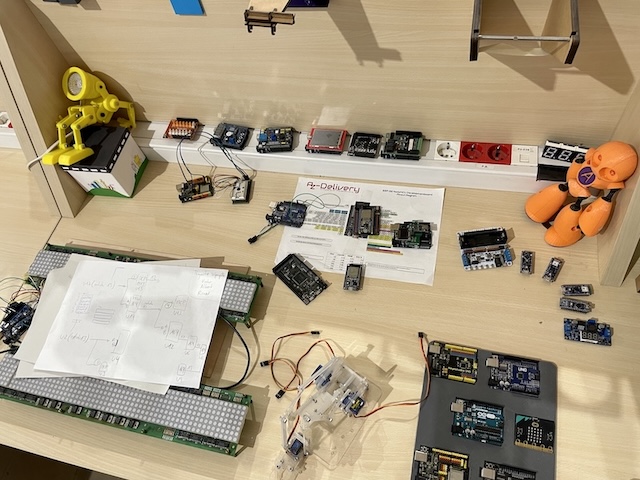
Electronics and robotics are taught at Fab Casa del Mig. Image by author.
In a space where machines and tools produce or connect artifacts, participation is inherently material. Materiality places objects and individuals’ relationships with objects at the center of participation in makerspaces. It is the visible part of digital fabrication technology, anchoring it in its environment and territory. Materiality is also relational, as it connects participants when they work on projects together.
Participation in makerspaces is not institutionally organized as it is in citizen assemblies, neighborhood councils, or other mechanisms associated with democracy as a form of government. Rather, it is spontaneous, informal participation (Neveu and Vanhoenacker, 2017; Zask, 2011), in the sense that it occurs outside any obligation and does not follow predefined rules beyond those of the space itself. Instead, it evolves according to projects and individual interests, taking the form of workshops, collective builds, events, or shared individual creations.
Makerspaces emerge as laboratories for participatory experimentation with digital fabrication technologies, made possible by existing material commons (spaces, machines, components) and the production of immaterial commons (knowledge, skills, critical perspectives, repurposing of uses and social or political goals). These participatory experiments, by fostering empowerment, mutual aid, material production, and the appropriation of how machines, software, electronic and robotic systems, and microprocessors function, whether for personal projects (manufacturing and repair enabling independence from commercial circuits and ready-made technologies) or collective projects (social, territorial, heritage-related), contribute to the democratization of technology. These technologies thus become more accessible, understandable, and easier to mobilize for personal or collective purposes.
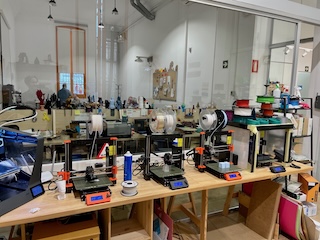
A series of 3D printers in action at the Fab Casa del Mig. Image by author.
Thus, participating in a digital fabrication space offers an opportunity to move beyond passivity toward technology, to develop and share knowledge and technical skills. Ultimately, the place itself, this physical space of practice and sociability, is fundamental both for building community among makers, for accessing shared equipment, and for acquiring and transmitting digital literacy.
This spontaneous participation, which fosters active learning of digital fabrication technologies and the creation of projects for those who wish to engage, invites the development of a new concept that may support future research in social sciences and Science and Technology Studies: what I have termed Citizen Technology.
What is Citizen Technology?
Citizen technology refers to technologies that are governable by and for citizens. Inspired by citizen science, this notion of citizen technology does not yet exist, to my knowledge, in either French or English.
Citizen science applies to a wide variety of topics, ranging from bird counting to measuring air quality, as well as biohacking for insulin production. This highly popular term in media and public policy is closely linked to amateur practices and voluntary participatory dynamics (Land-Zanastra and al., 2021; Dias Da Silva, 2017). Citizen science is defined by the possibility “to turn anyone into a scientist, promising to produce new knowledge, educating the public and above all reconfiguring science from a closed to an open activity, in short, ‘democratizing science’” (Strasser et al., 2018). This approach considers citizens as potential producers of knowledge alongside experts.
In the technological field, some have sought to return power to people through the implementation of “public interest technology” defined by “the application of design, data, and delivery to advance the public interest and promote the public good in the digital age” (McGuinness and Schank, 2021). However, these authors describe government actions serving people as the primary means of achieving this goal, in line with representative democracy. The concept that appears closest to Citizen Technology nonetheless reflects a very different reality. Indeed, so-called civic technologies or “civic tech” (de Feraudy, 2024 ; Mabi 2021; Peixoto and Sifry, 2017) are technologies that claim to serve democracy, often through platforms, for example, for online voting in participatory budgeting processes. Civic technologies are implemented by institutions for citizens.
Citizen technology, by contrast, involves citizens taking control of technologies themselves. This is the key difference. In this sense, citizen technology, based on direct participation in this domain, promotes a redistribution of power and would enable citizens to be fully included in shaping present and future sociotechnical systems, meeting the criteria of a politically just society where individuals effectively participate in decisions that affect their lives (Wright, 2010).
Participation in these digital fabrication spaces fosters the development of political subjectivities as a way to move beyond technological determinism. These physical spaces of sociability dedicated to popular education in technology and offering educational activities for all levels and ages, encourage engagement with machines, materials, systems, peers, mentors, and the needs of the local community.
Participation in makerspaces embodies citizen technology. Citizen technology is characterized by:
- contributing to the enrichment of knowledge;
- increasing participants’ power in terms of digital literacy and skills;
- fostering a critical and reflective perspective on practices;
- reappropriating (reinventing, repurposing) the uses of digital technologies;
- redirecting technological goals toward the needs of communities and territories.
Citizen technology brings together several concepts already developed by authors concerned with sharing power and decision-making over technology. It is necessarily popular (Eubanks 2011), in the sense that “popular technology assumes that all people have a rich array of experiences with technology” and that popular education approaches aim “nurturing critical technological citizenship” (Eubanks 2011, p. xx). Citizen technology is also social and convivial with the prerequisite “to serve politically interrelated individuals rather than managers” (Illich 1973, p. 12). In other words, technology is also democratic, as opposed to authoritarian technologies (Mumford 1964).
Like citizen science, citizen technology promotes the empowerment of participants, as they develop relatively autonomous learning mechanisms. In makerspaces, participants gain agency in repairing or creating objects and customized projects, build self-confidence, and develop critical capacities to debate or influence technological redirection. Based on ecological redirection, this could allow for choosing technological applications according to their social, environmental, and political impacts.
Participation, along with the sharing of machines, tools, and spaces, is what enables citizen technology to exist. The creation of knowledge commons is one outcome of this participation in makerspaces. Learning outcomes or prototype designs are shared informally or documented in shared resources, often supported by free and open-source software (Broca and Coriat, 2015). It reminds us that knowledge is power. Whether it is know-how or critical understanding and the ability to debate, it is undeniable that knowledge in the field of technology expands participants’ scope of action and agency.
Why Citizen Technology Matters?
Because in a world shaped by increasingly authoritarian technologies, where individuals are subjected to a constant injunction to adapt, there nonetheless exist spaces – makerspaces – where citizens can learn tools at their own pace, learn collectively, and learn from and with others. These are places where people can reflect on the uses and consequences of digital machines and tools and choose the domains in which the projects developed there will be applied.
Because citizen technology, as demonstrated by the openings created by certain neighborhood makerspaces, reminds us that alternative ways of producing, making, and using technology are possible. It shows that questioning the role of technology in society, rather than passively accepting narratives of inevitability, is both feasible and necessary.
Because we can further refine its definition and multiply empirical studies using this conceptual framework. citizen technology places all humans back at the center of a domain typically reserved for the private, profit-driven world of digital oligopolies. Within the spectrum of democratic experimentation, it involves reintegrating technology as a subject of debate, repurposing, and reappropriation. However, this possibility should not make us overlook the pitfalls experienced by citizen science, which sometimes appears to represent “another effort at governing the critique of science, rather than producing citizens with a critical understanding of science and its role in society” (Strasser and al., 2018, p. 67).
Because, more broadly, by analyzing digital fabrication spaces, this reflection on citizen technology establishes key foundations for understanding power dynamics and opportunities for participation and education as citizens who produce or actively use technologies for technological redirection. This perspective supports exploring popular education in technology as a promising avenue for research in the political anthropology of technoscience. It opens the possibility of shared governance of digital technologies, which could redefine power asymmetries in this domain.
This post was curated by Contributing Editor Melina Campos Ortiz and reviewed by Contributing Editor Aaron Neiman.
References
Broca, S. and Coriat, B. (2015) ‘Le logiciel libre et les communs : Deux formes de résistance et d’alternative à l’exclusivisme propriétaire’, Revue internationale de droit économique, 29(3), pp. 265–282.
De Feraudy, T. (2024) ‘What does civic tech mean in France? When digital democracy entrepreneurs produce a public problem that can lead to depoliticising citizen participation’, Mots. Les langages du politique, 134(1), pp. 39–56.
Dias da Silva, P., Heaton, L. and Millerand, F. (2017) ‘Une revue de littérature sur la « science citoyenne » : la production de connaissances naturalistes à l’ère numérique’, Natures Sciences Sociétés, 25(4), pp. 370–380.
Eubanks, V. (2011) Digital dead end: fighting for social justice in the information age. Cambridge, MA: MIT Press.
Illich, I. (1973) Tools for conviviality. New York: Harper & Row.
Lambert, S. (2023a) ‘Ethnographie en période de pandémie et mobilisation des Coronavirus Makers à Barcelone. Le fleurissement des solidarités impromptues’, Anthropologica, 65(1), pp. 1–22.
Lambert, S. (2023b) ‘Fabrication numérique à Barcelone : les effets sociopolitiques de la participation lors des Mercredis Makers’, Les Enjeux de l’Information et de la Communication, 23(4). Available at: https://lesenjeux.univ-grenoble-alpes.fr/2023/dossier/04-fabrication-numerique-a-barcelone-les-effets-sociopolitiques-de-la-participation-lors-des-mercredis-makers/.
Lambert, S., Perron, L. and Guinovart, O.B. (2024) ‘Les artefacts sonnent l’alarme dans un makerspace de Barcelone ! : Explorations autour d’une fiction ethnographique illustrée’, Anthropologica, 66(2).
Land-Zandstra, A., Agnello, G. and Gültekin, Y.S. (2021) ‘Participants in Citizen Science’, in Vohland, K. et al. (eds.) The Science of Citizen Science. Cham: Springer.
Mabi, C. (2021) ‘La “civic tech” et “la démocratie numérique” pour “ouvrir” la démocratie ?’, Réseaux, 225(1), pp. 215–248.
McGuinness, T.D. and Schank, H. (2021) Power to the public: the promise of public interest technology. Princeton, NJ: Princeton University Press.
Mumford, L. (1964) ‘Authoritarian and Democratic Technics’, Technology and Culture, 5(1), pp. 1–8.
Neveu, C. and Vanhoenacker, M. (2017) ‘La participation buissonnière, ou le secret dans l’ordinaire de la citoyenneté’, Participations, 19(3), pp. 7–22.
Peixoto, T. and Sifry, M.L. (2017) Civic Tech in the Global South: Assessing Technology for the Public Good. Washington, DC: World Bank and Personal Democracy Press.
Strasser, B.J., Baudry, J., Mahr, D., Sanchez, G. and Tancoigne, E. (2018) ‘“Citizen Science” ? Rethinking Science and Public Participation’, Science & Technology Studies, pp. 52–76.
Wright, E.O. (2010). Envisioning real utopias. London: Verso.
Zask, J. (2011) Participer : essai sur les formes démocratiques de la participation. Latresne: Le Bord de l’eau.
