Author Archives: Kim Fernandes

Kim Fernandes is a researcher, writer and educator interested in disability, data and technology in urban India. They are an Assistant Professor in Anthropology at Brown University. Fernandes holds a joint Ph.D. with Distinction in Anthropology & Interdisciplinary Studies in Human Development from the University of Pennsylvania. Their recent work has been funded by the Social Science Research Council and the Taraknath Das Foundation’s Marion Jemmott Fellowship.
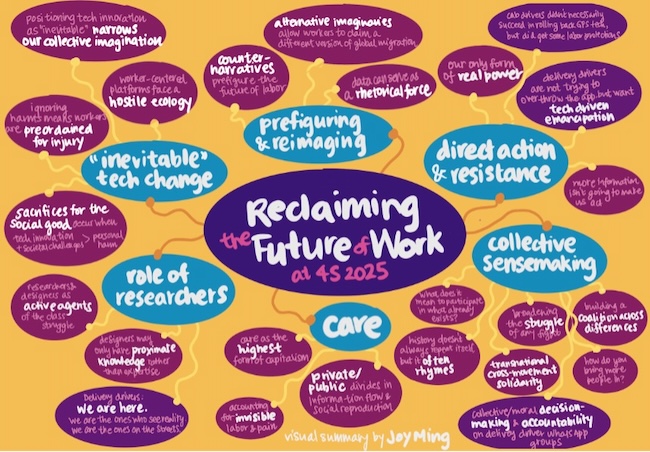
A colorful graphic with a yellow background and interconnected purple, teal, and pink bubbles and words in each of the bubbles. In the center, there is a dark purple bubble that says "Reclaiming the Future of Work at 4S 2025." One of the teal bubbles that emerges from the center says "'inevitable' tech change" and links to pink bubbles that say: • "positioning tech innovations as 'inevitable' narrows our collective imagination" • "worker-centered platforms face a hostile ecology" • "ignoring harms means workers are preordained for injury" • "sacrifices for the social good occur when tech innovation + societal challenges > personal harm" The next teal bubble that emerges from the center says "prefiguring & reimagining" with links to pink bubbles that say: • "alternative imaginaries allow workers to claim a different version of global migration" • "counternarratives prefigure the future of labor" • "data can serve as a rhetorical force" The third teal bubble says "direct action & resistance", with linked bubbles: • "cab drivers didn't necessarily succeed in rolling back GPS tech, but did get some labor protections" • "our only form of real power" • "delivery drivers are not trying to overthrow the app, but want tech driven emancipation" • "more information isn't going to make us act" The fourth bubble says "collective sensemaking" and links to: • "what does it mean to participate in what currently exists?" • "broadening the struggle of any fight" • "building a coalition across differences" • "history doesn't always repeat itself but it often rhymes" • "transnational cross-movement solidarity" • "how do you bring more people in?" • "collective/moral decision making & accountability on delivery driver WhatsApp groups" The fifth teal bubble says "care" and has links to the pink bubbles that say: • "care as the highest form of capitalism" • "private/public divides in information flow & social reproduction" • "accounting for invisible labor & pain" The final teal bubble emerging from the center says "role of researchers" and connects to: • "researchers & designers as active agents of the class struggle" • "designers may only have proximate knowledge rather than expertise" • "delivery drivers: we are here. We are the ones who see reality. We are the ones on the streets" At the bottom of the graphic, there is a note in white that says "Visual Summary created by Joy Ming"

Reclaiming the Future of Work: Series Introduction

Debates about the future of work often center around adapting the workforce to fit capitalist proposals of what work should look like. Pre-digital examples include scientific management, just-in-time production, and de-skilling of industrial labor in favor of more mechanized and automated processes. Recently, capitalist proposals of arrangements of work have centered on digital platforms, algorithmic management, pervasive surveillance, and the deskilling of white-collar work through aggressive adoption of large language models (generative AI). In the face of these changes, workers are expected to accept their new, typically more controlled, unstable, exploitative work arrangements, re-train and re-skill to find employment in different or new types of work or face un- and under-employment with whatever safety net might be available. Underlying these changes to work arrangements is a drive for efficiency and profit. (read more...)

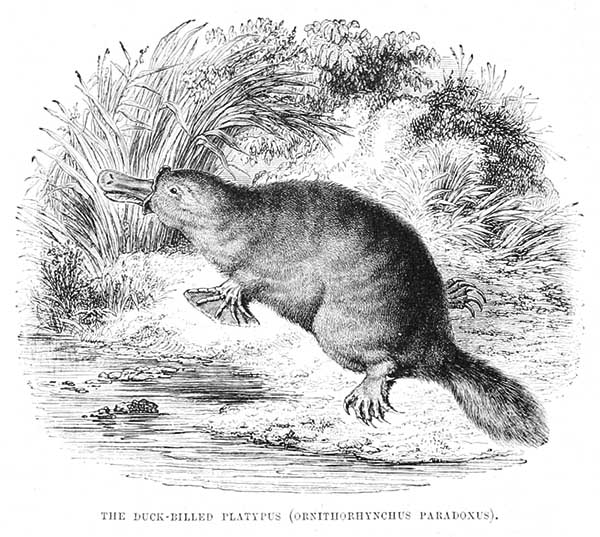
Duck-billed platypus engraving, 1853.

Platypus in 2026

Welcome to Platypus in 2026! Last year, we published over 65 posts, almost a quarter of which were also in a second language, and maintained a readership from 175 different countries. A full summary of CASTAC’s activities in 2025 can be found at our 2025 Year in Review. As we look ahead to another engaging year of publishing a wide range of work from the social sciences on science and technology, we are thankful for the labor that our editorial team and our authors continue to put in. We are also very grateful to you, our readers – thank you for being here every week! (read more...)

2025 in Review

Welcome to our annual wrap-up, where we share some highlights for CASTAC’s 2025 activities! We are grateful to for your generous engagement with our content this year, and we look forward to sharing more pieces on the anthropology of science and technology in 2026. (read more...)

Platypus in 2025

Welcome to Platypus in 2025! Last year, we published over 65 posts, almost half of which were also in a second language, and maintained a readership from 169 different countries. A full summary of CASTAC’s activities in 2024 can be found at our 2024 Year in Review. As we look ahead to another engaging year of publishing a wide range of work from the social sciences on science and technology, we are thankful for the labor that our editorial team and our authors continue to put in. We are also very grateful to you, our readers – thank you for being here every week! (read more...)