Platypod, The CASTAC Podcast

Listen for free on Spotify or Apple Podcasts. Do you listen on a different app? Request syndication by emailing the CASTAC Web Producer (webmaster@castac.org).

Listen on Apple Podcasts Listen on Spotify

Full Episodes

Platypod is the official podcast of the Committee for the Anthropology of Science, Technology, and Computing. We talk about anthropology, STS, and all things tech. Tune in for conversations with researchers and experts on how technology is shaping our world.

Worrying over Speaking and the Pretentiousness of Podcasts

Read the transcript here. This was meant to be a podcast about making podcasts. But in the end, this podcast is really just a conversation between two people who used to be close friends. It rambles and meanders. It doesn’t always stick to a coherent point. I wondered then whether it could also be academically useful. Relevant to conversations in anthropology? Or even interesting to anyone other than me? This podcast is a conversation with Thuy Nguyen, founder of the Berkeley Community Acupuncture clinic and licensed TCM practitioner who has her own podcast, You Are Medicine. We first started talking about what it’s like for her to make a podcast back in March, on a long drive together from Bakersfield, California to Window Rock, Arizona. Thuy runs acupuncture pop-up clinics and is training interns as part of her Navajo Healing Project there and she invited me to spend a weekend (read more...)

Cover for Ground Control: : An Argument for the End of Human Space Exploration by Savannah Mandel.

Space Anthropology with Savannah Mandel

View/Download the transcription for this episode. For this episode of Platypod, I interviewed space anthropologist Savannah Mandel about her new book Ground Control: An Argument for the End of Human Space Exploration (Chicago Review Press, 2024) where she writes about commercial space exploration in the US based on her ethnographic fieldwork with SpacePort America in New Mexico, and with space policymakers in Washington DC.  (read more...)

The Many Modes of Ethnography

Download the transcript for this episode. This podcast episode talks to three anthropologists, Rachel Douglas-Jones, Rine Vieth, and Kara White, scholars working in three different parts of the world who use multimodal methods in their teaching and research. It is not a history of multimodal methods, or even a really detailed review of them; instead, it is a consideration of some of the issues they raise or resolve for ethnography. Whatever Tim Ingold has or hasn’t said about ethnography, he inadvertently offered what I think is the most compelling definition when he wrote: It is where we, “join with things in their passage through time, going along together with them, working with them, and suffering with them” (24, 2020). I’m tweaking the first part of this sentence to make it work here, as he’s actually describing the Latin prefix co- and his idea of “the gathering,” but it works for (read more...)

Decorated image used as an invitation for CASPR 2023

Platypod, Episode Eight: CASPR 2023

Download the full transcript of this episode. The 2023 edition of CASPR: CASTAC in the Spring discussed digital ethnography and its multiple facets. The event was moderated by Dr. Baird Campbell, who, along with guest speakers Dr. Ilana Gershon, Dr. Nicole Taylor, and Dr. Patricia G. Lange, shared their experiences and valuable insights based on their many years of interactions with digital ethnography—much before the recent spike in interest in this method due to the COVID-19 pandemic. Some critical insights from the event: On the online-offline divide, guest-speakers pointed out that this division will not matter in the future as interlocutors are increasingly interconnected. Speakers were skeptical about how much this topic still matters now, coming to the conclusion that this separation is largely artificial. The speakers mentioned how digital technologies, social media platforms, and other technological products would indirectly be part of future ethnographies, even if the researcher had (read more...)

Platypod, Episode Seven: An Anthropology of Data, AI, and Much More

Download the transcript of this interview. For this episode of Platypod, I talked to Dr. Tanja Ahlin about her research, work, and academic trajectory. She’s currently a postdoctoral researcher at the University of Amsterdam in the Netherlands, and her work focuses on intersections of medical anthropology, social robots, and artificial intelligence. I told her of my perspective as a grad student, making plans and deciding what routes to take to be successful in my field. Dr. Ahlin was very generous in sharing her stories and experiences, which I’m sure are helpful to other grad students as well. Enjoy this episode, and contact us if you have questions, thoughts, or suggestions for other episodes.  (read more...)

Platypod, Episode Six: An Anthropology of Algorithmic Recommendation Systems

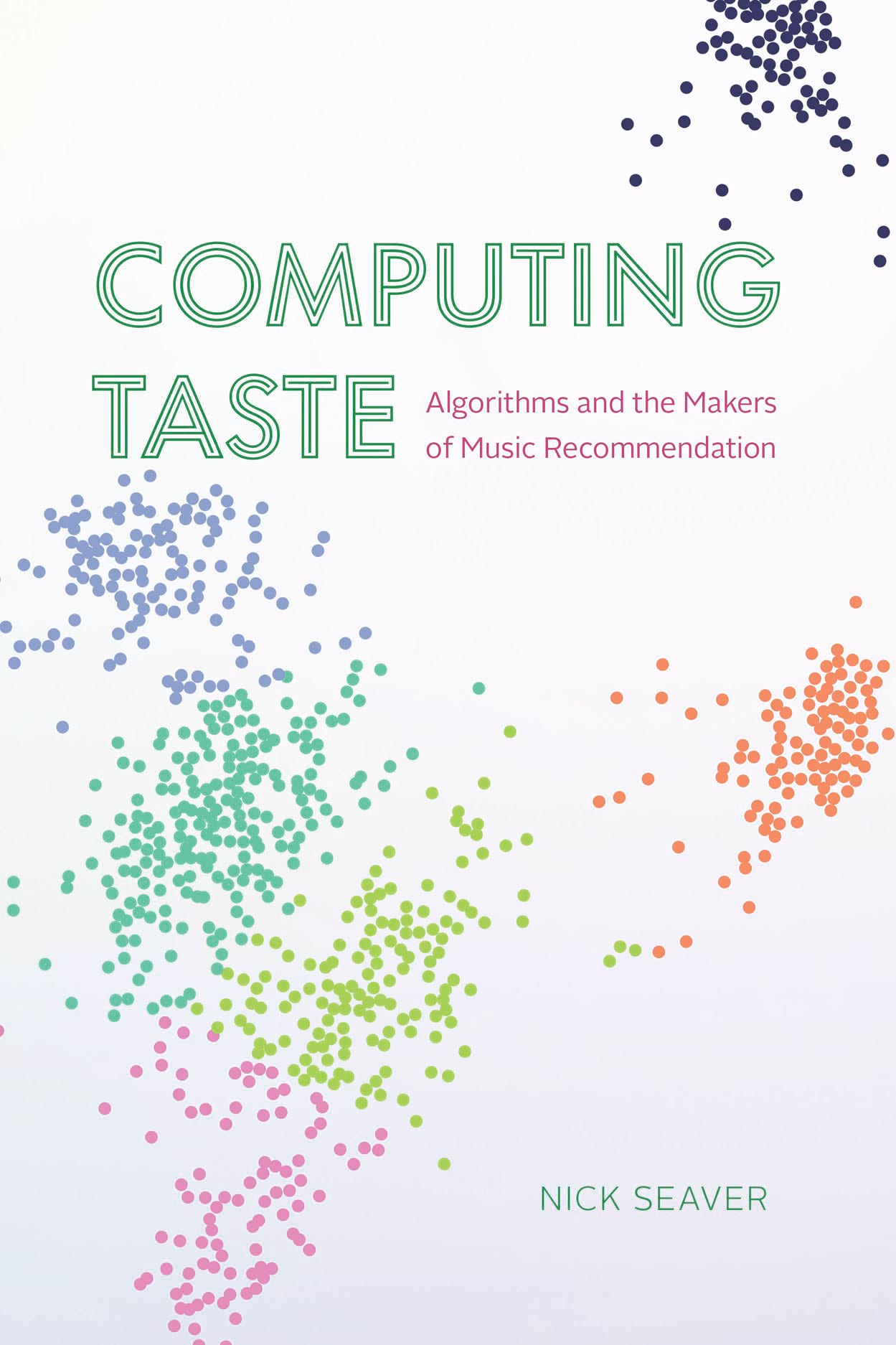
Download the transcript of this interview. On the morning of Friday, March 10, 2023 Nick Seaver and I met over Zoom to talk about his new book Computing Taste: Algorithms and Makers of Music Recommendation, which was published in 2022 by the University of Chicago Press. In that meeting, we recorded an episode for the Playpod podcast, which is available at the link above. (read more...)

Orange Platypus with black headphones

Platypod, Episode Five: CASPR – CASTAC in the Spring 2022

This episode presents a recording of CASPR 2022, or the CASTAC in the Spring 2022 event, which took place on May 10, 2022. CASPR 2022 was organized to encourage dialogue on breaking down binaries that have separated academe and industry. Angela VandenBroek (TXST), Melissa Cefkin (Waymo), and Dawn Nafus (Intel) discuss their work in leading socially-informed research in industry contexts. (read more...)

Orange Platypus with black headphones

Platypod, Episode Four: Connections and Disconnections on Social Media

In this episode, Platypod presents a conversation between Baird Campbell (Rice University) and Ilana Gershon (Indiana University Bloomington). They discuss the politics of connection and disconnection via social media in Chile and the US. (read more...)

Orange Platypus with black headphones

Platypod, Episode Three: Disability, Toxicity, and the Environment

In this episode, Platypod presents a conversation between Elizabeth Roberts (the University of Michigan) and Sophia Jaworski (the University of Toronto). They discuss the complexities of corporeal life in toxic environments. This episode was created with the participation of Elizabeth Roberts (the University of Michigan, speaker), Sophia Jaworski (the University of Toronto, speaker), Svetlana Borodina (Columbia University, host, producer), Gebby Keny (Rice University, host, sound editor), and Angela VandenBroek (Texas State University, CASTAC web producer). The transcript of their conversation is available below. We thank Sophia Jaworski for her work on editing the transcript for comprehension. (read more...)
Orange Platypus with black headphones

Platypod, Episode Two: Ableism in Anthropology and Higher Ed

In this episode, Platypod presents a conversation between Laura Heath-Stout (Brandeis University) and Rebecca-Eli Long (Purdue University). They discuss their research and experiences of ableism in academia, anthropology, and higher ed, in general. This episode was created with the participation of Laura Heath-Stout (Brandeis University, speaker), Rebecca-Eli Long (Purdue University, speaker), Kim Fernandes (University of Pennsylvania, host), Svetlana Borodina (Columbia University, host), Gebby Keny (Rice University, sound editor), and Angela VandenBroek (Texas State University, CASTAC web producer). The transcript of their conversation (edited for comprehension) is available below. (read more...)

Orange Platypus with black headphones

Platypod, Episode One: Technologies and Politics of Accessibility

In its opening episode, Platypod presents a conversation between Cassandra Hartblay (University of Toronto) and Zihao Lin (University of Chicago). They discuss their research on accessibility cultures, politics, and technologies. This episode was created with the participation of Cassandra Hartblay (the University of Toronto, speaker) and Zihao Lin (the University of Chicago, speaker), Kim Fernandes (University of Pennsylvania, host), Svetlana Borodina (Columbia University, host), Gebby Keny (Rice University, sound editor), and Angela VandenBroek (Texas State University, CASTAC web producer). The transcript of their conversation is accessible below. (read more...)

Platypus on Platypod

The bonus episodes below are the most recent readings from Platypus, The CASTAC Blog. Look for more readings in the Platypus archives or find them on your favorite podcast app.

Black and white dog standing behind a barbed wire fence, looking directly at the camera, with a blurred green rural background.

Animals in War: Multispecies Agency and the Memory of the Colombian Armed Conflict

In one testimony from Colombia’s armed conflict, a parrot named Lola repeated the phrases she heard around her: “Paraco asesino” (“paramilitary murderer”), “Viva la guerrilla” (“long live the guerrilla”), and “The vultures are coming” Her voice condensed the sounds, fears, and political tensions of war into a multispecies archive of memory. Far from being passive witnesses, animals moved within the infrastructures of conflict as companions, alarms, transportation, and sometimes even weapons. Yet these violent incorporations are only the most extreme expression of a broader multispecies world of conflict. (read more...)
An individual stands outside of an off-white building that reads ShanghART with Canontese characters below it. The individual is holding a piece of paper in their right hand and a mobile phone to their ear with their left. On both sides of the large entrance to the building, posters for art exhibits are prominently featured.

Making for the Feed: Creativity, Platforms, and Visibility in China

Creativity is often imagined as a deeply human capacity: a moment of inspiration, a flash of originality, or an individual act of expression. Yet in contemporary digital environments, creativity rarely unfolds in isolation from technological systems. Across creative industries, from fashion and design to visual media, branding, and online content production, creative work increasingly takes shape within infrastructures of platforms, software tools, and algorithmic systems. These technologies do not simply enable creativity; they actively shape how creative ideas are imagined, produced, circulated, and evaluated. (read more...)

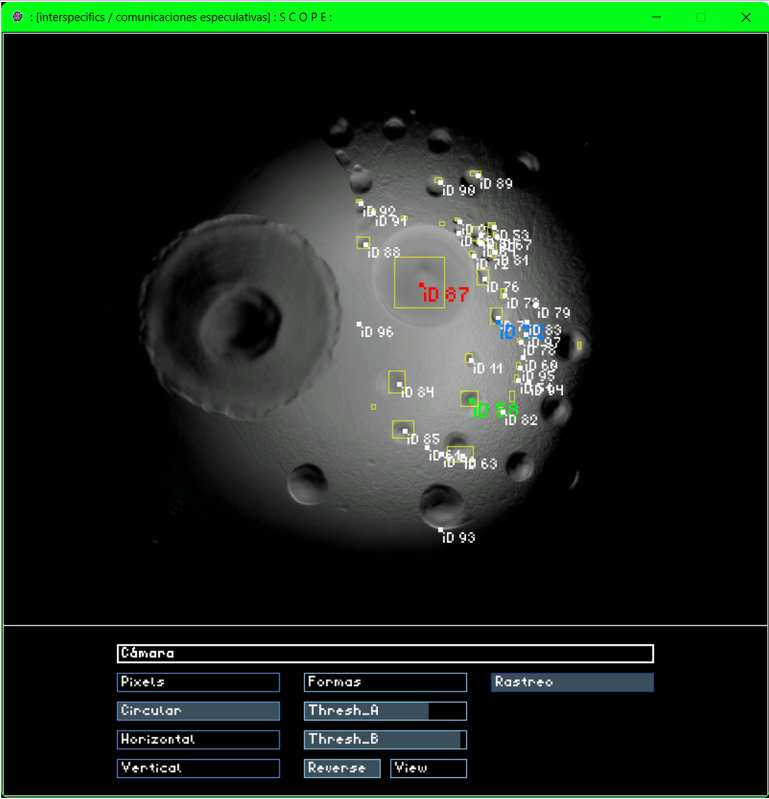
It is a three-dimensional network generated in TouchDesigner, where connecting the software to sound signals allows the image to react in real time, transforming its structure and movement according to variations in the audio.

What Would Happen if Ethnographers Learned to Process Signals?

During my doctoral research, focused on neuroscience laboratories and their forms of engagement with other spaces in the city of Bogotá, Colombia, I have been observing how artists and researchers use different processes to modulate, transform, and process biological signals in order to create artistic works. This experience led me to try to learn how to use the same software they employ. I created a small piece that I would like to show, along with a brief presentation of some of the reflections that emerged from it. (read more...)

Blood Circulation: Opening Up a Closed System

On any given day, at any given moment, blood flows through bodies, flesh and viscera, shaping our world from the inside out. The process is rather simple, I have been told: in the human body, blood is propelled by the heart, repetitively flowing from the right atrium and right ventricle, through the pulmonary system, into the left atrium, left ventricle, and aorta. It then unfurls into the rest of the body and back to our starting point, the right heart. (read more...)

What’s in a Name?

“My Dear Sir,” wrote Henry Fox Talbot one Wednesday in late 1870, “I am informed by Mr. Cooper that a new Society under your auspices is going to be…formed for the promotion of Egyptian and Assyrian Archæology and Biblical Chronology…It will perhaps be difficult to devise a suitable name for the Society, that of Syro-Egyptian being preoccupied. Perhaps Egypto-Chaldæan would do – I know nothing of the Syro-Egyptian beyond its name, but I suppose from the fact of your promoting a new society, that you think the Syro-Egyptian a failure.” Talbot was a British aristocrat and a scholar of Assyrian cuneiform, writing to Dr. Samuel Birch, keeper of Oriental Antiquities at the British Museum. The two men had corresponded about Assyrian antiquity for almost twenty years, working to decipher cuneiform texts stamped into ancient clay tablets. Birch’s response was swift. His new project would combine the Syro-Egyptian Society with another organization, the Chronological Institute, to create an expanded journal for “researches connected with Biblical lands.” (read more...)

Vue aérienne du port de pêche de Tanger-Ville. Les installations portuaires et les quais sont entourés d’une digue. Au loin, un porte-conteneurs navigue dans le détroit de Gibraltar. La côte espagnole se profile à l’horizon.

What the Map Conceals: Sovereignty and the Sea in the Strait of Gibraltar

An aerial view of the Strait of Gibraltar shows something that resembles order. Container ships move in two disciplined lanes, their wakes parallel lines across the surface. Between them, a single patrol vessel sits like a traffic cop at an intersection. Smaller ships move differently: ferries on fixed schedules, fishing boats angling across the grain, following lines invisible from above. The Strait, fourteen kilometers at its narrowest, appears split down the middle, dividing Morocco from Spain, Africa from Europe. Deleuze and Guattari (1987) described the sea as the exemplary smooth space—fluid, directionless, resistant to the grid—but also as the first place to be striated, ruled into navigable geometry by technologies of longitude and open-water navigation. From above, the striae of the strait are clear. The question is what that striation conceals. (read more...)

A screenshot of an official, public notification from the Gazette of India announcing the enforcement date of the Surrogacy (Regulation) Act, 2021. The text is in English and Hindi, and describes the source of the notification (Ministry of Health and Family Welfare, Department of Health Research, Government of India), and states that the provisions of the Act will come into force on January 25, 2022.

Criminality, Risk, and Labor: Altruistic Surrogacy in Contemporary India

Surrogacy is a form of assisted reproduction in which the gestational labor of birthing a child is carried out by someone other than the intending parent/s. Surrogacy in India has gained a great deal of popularity over the last three decades, emerging as a major transnational commercial hub. Generating close to $2.3 billion in annual revenue (Rudrappa 2015), the industry was largely unregulated, until recently. In December 2021, the Indian state passed the Surrogacy (Regulation) Act, criminalizing commercial surrogacy and permitting only altruistic surrogacy for select clients. The Act bans the “commercialization of surrogacy services,” outlawing any possible compensation for surrogate workers, whether it is “payment, reward, benefit, fees, remuneration, or monetary incentive in cash or kind” (Government of India 2021, 2). In effect, surrogacy is legally permitted only if it is “altruistic,” with heavy punitive measures in place for commercial surrogacy. By “altruistic” surrogacy, the state means an unpaid surrogacy arrangement that is borne out of the good will and selflessness of the surrogate worker, upon whose body the biomedically intensive, complicated, and risky process of surrogacy is carried out. It is important to note that surrogacy arrangements in India are largely shaped by stark power imbalances. Surrogate workers tend to come from marginalized socioeconomic backgrounds, and are often low-income, oppressed-caste women from rural areas. Intending parent/s, by contrast, are typically more privileged – urban, middle-to-upper-class, and from dominant-caste groups. These structural disparities have significant implications for surrogate workers in the current moment, with the regulatory turn to “altruism.” (read more...)

Data Borders: Three Years Later

What should we do today? How would you write Data Borders differently today? But what can I do? People often ask me these questions when I present my research on my book, Data Borders: How Silicon Valley is Building an Industry Around Immigrants (Villa-Nicholas 2023), which examines the growing industry of data collection for the surveillance and control of immigrants in the United States. These questions arise in undergraduate and graduate classrooms, at academic conferences, and among public workers in the United States. I respond by advocating for policy protections for immigrant information rights, providing examples of data rights activism, and demonstrating how we are applying techno-imagined futures within my Southern California community to advocate for humane shifts in technological design and data collection. (read more...)

Gender Dimensions of Platform Work: How Do They Shape Unionizing?

This article is the fourth article in a series about gig and platform worker unions in India written by members of the Labor Tech Research Network. Read the introduction to the series here, the second post in the series here, and the third post here. In January 2024, hundreds of women workers associated with the on-demand home services app Urban Company (henceforth UC) gathered in protest outside the platform’s regional office in Hyderabad, India. The workers, many of whom were working as beauticians on the app, were protesting a slew of platform policies that had steadily eroded their working conditions over time (Figure 1). Most notable of these was the introduction of a new feature called ‘auto-assign’, which requires workers to mark the time slots that they are available to work on the app, following which they are assigned gigs automatically by the platform. The new ‘auto-assign’ policy marked a significant shift away from a previously more flexible system, where women could choose their gigs and hours. The promise of flexibility has been a prime reason that attracted women workers to platforms like UC, as it enables them to access paid work while also attending to their housework and care work responsibilities. It is this very erosion of flexibility that women were holding UC to account for. (read more...)

Conceptual diagram with curved connecting lines linking key terms. On the left, “indexicality” and “inclusive AI systems” connect to “incompleteness” and “(queering) bridging.” These central ideas link to “building” and “text” at the bottom. On the right, “incompleteness” also connects to “large image models,” which relate to “fabulating” and “convivial GPT.” All elements are interconnected, suggesting a network of relationships between AI systems, language, and interpretive processes.

Techno-Ethics and Feminist AI: What Role for an African Studies Approach to Science and Technology?

This post is inspired by the collaborative conceptualization of a workshop on African feminist AI held at ETHOS Lab in May 2025. It is deeply indebted to the ideas shared by the workshop organizers and participants. (read more...)

A detailed black-and-white map of a 19th-century London neighborhood, showing square dots that indicate cholera cases, which concentrate around Broad Street.

From Hotspots to Outbreaks: Keywords for (Un)Grounding Space, Temporality, and the Boundaries of Infection

This special series examines the spatial, temporal, and conceptual boundaries of infection. As a primarily analytic approach, the authors in this series unpack epidemiologic keywords such as outbreak, hotspot and epidemic, to assess their uptake, uses and meanings amongst scientists, public health and healthcare practitioners, experts and broader publics. As disruptions to public health ripple through the healthcare landscape in the United States, and whilst the global COVID-19 pandemic continues to haunt our collective present, the fundamental terms or “keywords” through which we understand disease transmission demand ethnographically-grounded inquiry, critique, and theorization. The posts in this series look at how infectious diseases and their conceptualizations spread through space and time, as well as how ethnography can articulate the expansive, lived realities of infection. (read more...)

A view of Kudankulam's sea shore. In the foreground of the image, waves touch the shore where boats are moored on beach sand. In the background, is the tomb of KKNNP's nuclear containment.

On Resolving Controversies: Enduring Regulatory Neglect in Southern Tamil Nadu

At India’s southern tip, eight reactor buildings line the shore of the coastal communities of Tirunelveli district, Tamil Nadu—one of the four districts my family and I call home. These reactor buildings are of the Kudankulam Nuclear Power Plant (KKNPP), envisioned to be India’s largest nuclear park. People living in the nearby Idinthakkarai and Kootapalli villages mock the association of a risky technoscientific complex to anything close to a ‘park,’ or poonga—a forest or garden of flowers, in Tamil. The sea that rolls against the compound of KKNPP is where women protestors claimed that they derived their energy to lead the protest against the plant in March 2011. Following suit, fishermen rowed and drove their boats into the sea to protest the commissioning of the plant. (read more...)

An artistic illustration of computer servers with patterns of white and blue connected through lines that converge into a single line at the extreme left side

The Human Cost of Precision

In 2022, Microsoft CEO Satya Nadella’s son died at the age of twenty-six from a lifelong battle with cerebral palsy, a neurological disorder caused by birth-related brain damage. When in 2017, Nadella delivered a talk about the use of assistive artificial intelligence for people suffering from disabilities like CP, he was contacted by one his colleagues in Spain. Julián Isla, a software engineer at Microsoft, emailed Nadella out of a sense of resonance, because his own son suffered from a rare genetic epilepsy making him a parent of a child living with disability as well. Like Nadella, Isla was also motivated to think of the role of artificial intelligence in the assistance of other parents who, as he described, were on the “odyssey of diagnosis”. (read more...)

An animated peanut with a bowler hat and a white beard sits on one side of a campfire, opposite three smaller peanuts grinning back at him adoringly. Amid the chirping crickets and the crackling of the fire, the older peanut calls out: “Gather round my little legumes, it's story time!”

Love at First Sprout: Wild Peanuts and Mars’ Plan for Climate Security

An animated peanut with a bowler hat and a white beard sits on one side of a campfire, opposite three smaller peanuts grinning back at him adoringly. Amid the chirping crickets and the crackling of the fire, the older peanut calls out: “Gather round my little legumes, it’s story time!” A small redheaded pod responds, “Grandpa, tell us the M and M’s story again.” Grandpa responds in a chiding tone: “We’ll get there! But, let’s start at the beginning…” (read more...)

A collage of three photos. One is a zoomed out image of buildings in New York City, one is a shadow of a pillar of the Golden Gate Bridge, and the final one is an intricate iron window grille with palm trees visible through the window.

Engineering Through Stuckness

This article is the first in a series about stuckness in science and technology. Read the introduction to the series here. What might we learn from the experiences of tech professionals being stuck? How does stuckness come about and what do these moments represent? This post traces two stories from different worlds: an Indian NGO and an American Big Tech corporation. One follows Leena , an employee at InnovateTech, an Indian education technology (EdTech) NGO. The other follows Cody, a software engineer at Microsoft, working in the United States. On the surface, Leena and Cody have more differences than things in common. Their employers operate in very different cultural and technological contexts influenced by distinct economic and political machinations. Their everyday experiences as they move through the world, one as a brown woman, and the other as a white man, have significant contrasts. (read more...)